
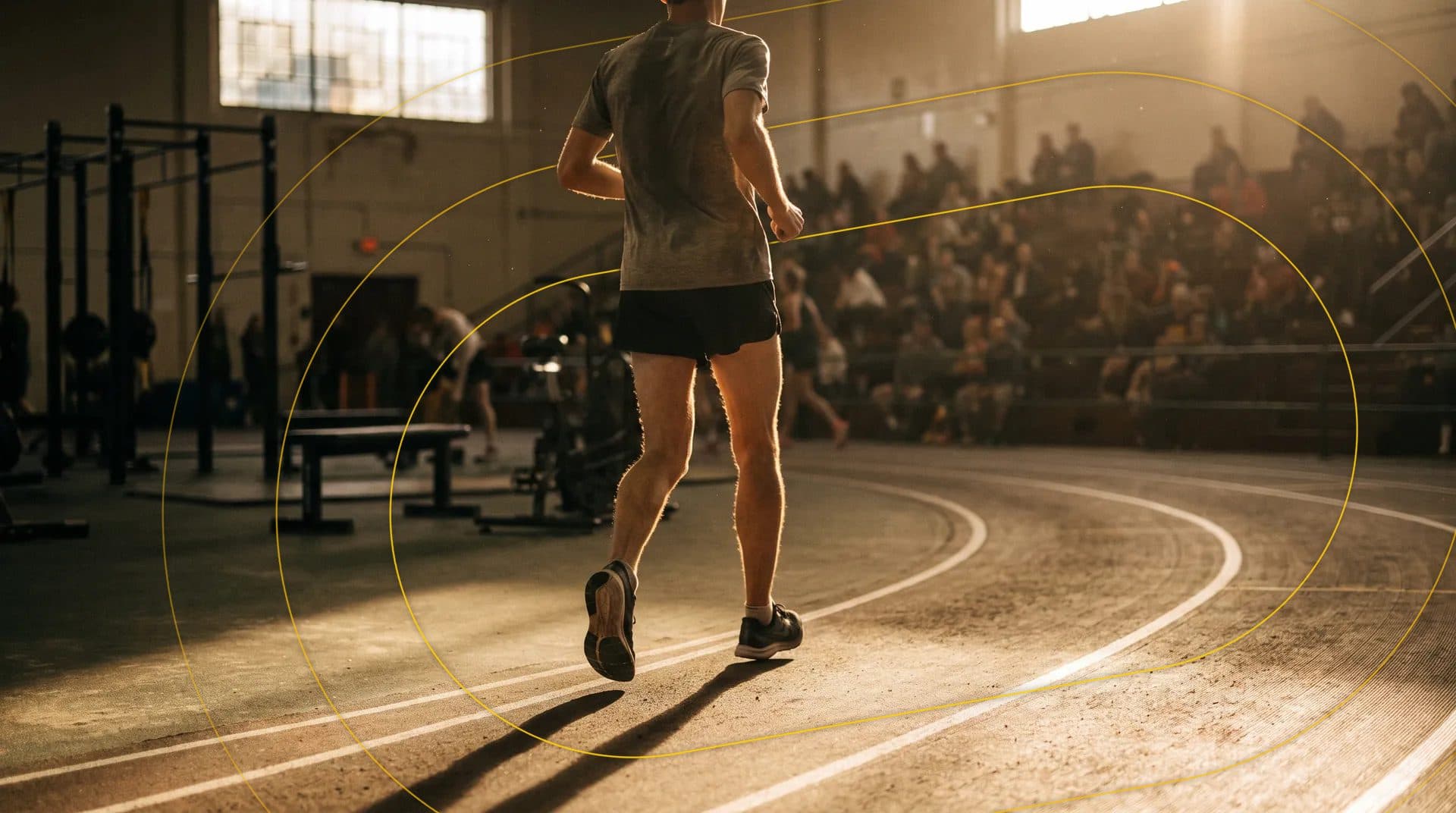
The Hybrid Games is an indoor arena fitness race built from 10 x 600m runs, 10 workout stations and a 200m sprint finish, raced solo or in a pair. You run 600m, you work one station, and you repeat that until all 10 stations are behind you, at which point a 200m sprint settles the places. The series calls itself the people’s race, and its own values page backs the slogan up: “No gatekeepers, no prerequisites, no excuses needed.”
What makes it read differently from everything else on a UK race calendar is the shape of the work. Ten stations instead of eight, runs short enough to tempt you into racing every single one, an air bike and a dumbbell snatch that the other major hybrid races do not use, and 6.2km of running in total once the sprint finish is counted.
This guide covers the Hybrid Games format run by run, all 10 Hybrid Games stations with their official loads, the penalties that quietly cost athletes minutes, how the race compares with HYROX, and what actually needs training. Every figure below comes from The Hybrid Games’ own race format page , its movement standards document and its published FAQs .
Key Takeaways
- The race is 10 x 600m runs, 10 stations and a 200m sprint finish, which is 6.2km of running in total.
- The stations run in a fixed order: air bike, wall balls, row, burpee broad jump, dumbbell snatch, sandbag lunges, farmers carry, sled pull, SkiErg, sled push.
- Five categories are on sale: Male Solo, Female Solo, Male Doubles, Female Doubles and Mixed Doubles.
- Mixed Doubles race at the male load everywhere except the dumbbell snatch, where each athlete may use their own.
- There is no official cut-off time, and waves are capped at 20 to 30 athletes.
- Age groups run from 16-22 up to 58+, and a doubles team is categorised on the average of both athletes.
- Missing a lap inside a run is a 4-minute penalty, and missing a station or a whole run is a disqualification.
- The 2026 season closes at the SEC in Glasgow on 10 and 11 October, with Newcastle, Birmingham and Glasgow on the 2027 calendar.
What Are The Hybrid Games?
The Hybrid Games is a UK hybrid fitness race series that runs its events inside arenas, with the full course laid out on the arena floor and spectators in the seats around it. The pitch is accessibility rather than qualification: there is no entry standard to hit, no proof of a previous race, and no official cut-off time waiting to end your day early.
The race itself is one continuous effort against one clock. Nothing is scored in rounds, nothing is scored by heat, and the only number that matters at the end is the time between the start line and the finish line. Every run and every station inside that window is timed individually, which is unusual at this level and worth understanding before you plan a pacing strategy.
Timing is handled by ankle-worn chips on the same Race Result system used at HYROX events, and the mats sit at four points: the start line, the entry to each exercise area, the exit from it, and the finish. Every crossing creates another split. In practice that means your race file afterwards shows each 600m run separately from each station, so you can see exactly where your race was won or lost rather than guessing from a single finish time.
Who Can Enter
Entry is open across seven age groups: 16-22, 23-29, 30-36, 37-43, 44-50, 51-57 and 58+. A doubles team is placed by the average of both athletes’ ages, so a 30 year old racing with a 44 year old is scored as a 37 year old team.
Beyond the individual race weekends, the series runs a season-long leaderboard. Points go to the top 25 finishers in each age group, 25 points for a win down to one point for 25th, with bonus points of 15, 10 and 5 for the best station results, the fastest lap and the fastest sprint finish. Those age group points roll into an overall leaderboard, and the season closes with a podium per category funded from a stated £50,000 prize pool, paying £5,000, £3,500 and £1,500 to the top three in each category.
The Hybrid Games Format, Run by Run
The Hybrid Games format never varies in its order: a 600m run, then station one, another 600m run, then station two, all the way to station 10, and then a 200m sprint to the line. Runs one to 10 are each 600 metres and the sprint finish is 200 metres, so the running adds up to 6.2km before you count a single rep.
How a Race Unfolds
- The first run. Your clock starts at the start line and the first run split closes the moment you enter the first exercise area.
- Into station one. Every station is judged. The judge sets the monitor where there is one, watches the movement standard, and releases you when the work is done.
- Back out and run again. Your next run split begins as soon as you leave the station, which is why a slow exit is expensive in a way most athletes never see until they read their splits.
- Repeat to station 10. The order is fixed and doing the stations out of sequence carries a penalty rather than a rerun.
- The sprint finish. After the last station you have 200 metres left, and on a season leaderboard that sprint is scored in its own right.
The series states plainly that it has no fast lane, so the standard asks you to overtake with care and stay aware of the athletes around you, and littering anywhere on the course is an instant disqualification rather than a warning.
Solo, Doubles and Mixed Doubles
Five categories are on sale at each event: Male Solo, Female Solo, Male Doubles, Female Doubles and Mixed Doubles. A solo athlete does all the work. A doubles pair splits each station between them however they like, subject to three rules that the penalties document enforces strictly.
Both athletes must run every run together, and a pair caught running apart takes a 2-minute penalty, with a 20-second time block allowed for each partner to move between the in and out gates and the station. Starting a station before your partner has joined you is another 2 minutes. And if only one athlete in a pair completes a run, that is a disqualification rather than a penalty.
The one place doubles gets harder rather than easier is the dumbbell snatch: a solo athlete does 50 reps, a pair does 100 between them.
Waves, Timings and What to Bring
Waves are kept to 20 to 30 athletes, which is a deliberately small number and keeps the course clear enough to run your own race rather than queue for a rig. Since January 2026 you choose your wave at the point of purchase and know your start time immediately, so entering with friends means picking the same wave before it sells out.
Check-in opens well before your wave and the series asks athletes to arrive at least 90 minutes ahead of their start time with photo ID and their ticket. Your timing chip is issued at registration, and racing without one means your result is recorded as a Did Not Start, whatever you actually ran.
The Hybrid Games Stations: All 10 in Order
There are 10 Hybrid Games stations and they never change order. Four are machine or bodyweight pieces and six carry an external load, and five of those six land from station five onwards, when your grip and your legs are already compromised.
| # | Station | The Work | Load (Male / Female) |
|---|---|---|---|
| 1 | Air Bike | 50 calories | None |
| 2 | Wall Balls | 100 reps | 6kg / 4kg |
| 3 | Row | 1,000m | None |
| 4 | Burpee Broad Jump | 80m | Bodyweight |
| 5 | Dumbbell Snatch | 50 reps solo, 100 reps doubles | 17.5kg / 12.5kg |
| 6 | Sandbag Lunges | 100m | 20kg / 10kg |
| 7 | Farmers Carry | 200m | 2 x 24kg / 2 x 16kg |
| 8 | Sled Pull | 60m | 105kg / 80kg including sled |
| 9 | SkiErg | 1,000m | None |
| 10 | Sled Push | 60m | 135kg / 100kg including sled |
Read that table as a sequencing problem rather than a list. The opening half is dominated by machines and volume, with the air bike, a 1,000m row and 100 wall balls arriving while you are still fresh. From the dumbbell snatch onwards it is a load problem: 100 metres of lunges, a 200m carry, a 60m pull, 1,000m on the SkiErg and a 60m push, in that order, with a 600m run between every one of them.
The Hybrid Games website lists the farmers carry at 24kg for men and 16kg for women, while the current movement standards document prints 20kg and 10kg in each hand. Train to the heavier pair, since it is the one published on the race format and event pages, and check the standards for your event during race week.
The Loads by Category
The rule for Mixed Doubles is that the female athlete races at the male load on every station except one: wall balls at 6kg, sandbag lunges at 20kg, the farmers carry at the male pair, and both sleds at the male weight including the sled. Only the dumbbell snatch is scaled, and there each athlete may lift their own weight and swap between them as they alternate reps.
If you are booking as a mixed pair, that single rule should shape your whole build. A 135kg sled push and a 20kg sandbag are not scaled to you, so they need training at the weight you will actually meet.
The Movement Standards That Catch Athletes Out
The movement standards document is worth reading in full, because several of its rules are not what an experienced gym athlete would assume.
- Wall balls start with a squat, and the hips have to break below the knee. The ball also has to strike the centre of the target, and while it may hit the floor between reps it has to come to a complete stop first. There is no bounce and catch.
- The dumbbell snatch alternates hands on every rep, with the hand change made below shoulder height and part of the dumbbell touching the floor on the way down. Judges count on a clicker and their tally is final.
- The burpee broad jump has a 30cm rule. On every burpee after the first, your hands may not be placed more than 30 centimetres forward of your toes, and once they are down they may not creep further forward. Feet must be parallel on take-off and on landing, and no shuffle steps are allowed in between.
- Sandbag lunges need the trailing knee on the ground and a fully upright finish, and the bag must not touch the floor for the whole 100 metres.
- The farmers carry may be put down, provided the kettlebells are placed rather than dropped and do not travel forward while they are down.
- The sled pull is a there and back, not a straight drag: you pull the sled past the 15m white line, switch to the other side of the lane, and pull it back.
- The SkiErg damper can be set before you start and changed once afterwards. A second adjustment costs 30 seconds.
The layout itself can also vary by venue. The standards note that at some venues the farmers carry runs multiple laps rather than one straight 200 metres, so the race map for your specific event is the document to read during race week, not a video of a different arena.
Penalties and Disqualifications
Penalties at The Hybrid Games are added to your finish time by the head judge through timing control, so they do not appear during the race and there is no chance to argue them back at the station. The published list is specific enough to plan around.
| Infraction | Cost |
|---|---|
| Missing a lap on a run | 4 minutes per lap |
| Completing a station out of order | 90 seconds per station |
| Swapping the transition entry and exit | 2 minutes |
| Doubles partners not running together | 2 minutes |
| Starting a station without your partner | 2 minutes |
| Leaving a station before the judge releases you | 2 minutes |
| Stepping outside the station area | Warning, then 30 seconds |
Missing a lap is the most expensive single mistake on the list at 4 minutes, and it is also the easiest one to make by accident on a multi-lap course when you are counting laps at threshold. Count your laps deliberately, every race.
Above the penalties sit the disqualifications, and they are absolute: missing an entire run or a station, one half of a doubles pair completing a run alone, swapping athletes mid-race, racing under someone else’s name, racing in a wave you were not assigned, or abusive behaviour towards anyone on site.
The station-level rules are smaller but they add up. Letting the air bike pedals move during a doubles transition is a warning and then a minute. Passing the wall ball or the rower handle to your partner is a warning and then 30 seconds. Failing to get both feet across the line on a burpee broad jump costs an extra burpee, and repeated form violations move a solo athlete back two barriers and a pair back four.
The Hybrid Games vs HYROX
The two races share eight movements and almost nothing else. If you already race HYROX, the honest summary is that your stations transfer directly and your pacing does not.
| The Hybrid Games | HYROX | |
|---|---|---|
| Running | 10 x 600m plus a 200m sprint (6.2km) | 8 x 1km (8km) |
| Stations | 10 | 8 |
| Machines | Air bike, rower, SkiErg | SkiErg, rower |
| Sleds | Push 60m, pull 60m | Push 50m, pull 50m |
| Unique work | Air bike, dumbbell snatch | None of the above |
| Categories | Solo and Doubles, male, female and mixed | Open, Pro, Doubles, Relay, Elite |
| Cut-off | None | Venue dependent |
The 400 metre difference per run sounds small and is not. A 1km HYROX run is long enough that most athletes settle into a rhythm and hold it; a 600m run is short enough that going out hard feels survivable, which is exactly the trap. You meet that decision 10 times rather than eight, and the cost of getting it wrong compounds into the loaded second half.
The other real difference is the air bike at station one. It is the only station in either race that can take an unlimited amount out of you in the first five minutes, because 50 calories can be produced fast and expensively or steadily and cheaply, and the difference between those two choices does not show up until station six. If HYROX is your background, our guide to what HYROX actually is and the full breakdown of the eight HYROX stations cover the format you are comparing this one against.
How Long Does a Hybrid Games Race Take?
The Hybrid Games publishes no average finish time and sets no cut-off, so the honest answer is that there is no benchmark to borrow. What you can do instead is build your own estimate from three numbers, which is more useful anyway because it tells you which part of your race to fix.
- Your running total. Ten 600m runs plus a 200m sprint is 6.2km. At a steady 5:30 per kilometre that is roughly 34 minutes of running, and at 4:30 per kilometre it is roughly 28. Use the pace you can hold when you are tired, not the one you hold fresh.
- Your station total. The two 1,000m machine pieces and the 100 wall balls are the long ones. Our own analysis of HYROX station times puts wall balls at 5 to 8 minutes for Open athletes, and the 100 reps at 6kg and 4kg are identical here, so that figure transfers directly.
- Your transitions. Every station has an entry mat and an exit mat, and the seconds between them are recorded in your splits. Ten stations means 20 crossings, and athletes who walk them lose more time than they expect.
Add the three together and you have a target that belongs to you. Then test it: a session of six 600m repeats with a station movement between each one will tell you more about your likely finish time than any published average would.
How to Train for The Hybrid Games
The 600m Repeat Is the Whole Engine
Train the distance you will actually race. Repeats of 600 metres at the pace you intend to hold, taken off short recoveries rather than full ones, teach the specific thing the race asks for: arriving at a station with your heart rate high enough to be uncomfortable and your hands steady enough to work anyway.
Build the volume of easy running underneath that. The 600s are the sharp end, but the reason athletes fall apart at stations eight, nine and 10 is almost never speed, it is aerobic depth. Run most of your weekly volume at a genuinely conversational effort and use the training zone calculator to find where that boundary sits for you, because running your easy days too hard is the single most common way a hybrid build quietly fails.
The Machine Stations Reward a Plan, Not Aggression
Three of the 10 stations are machines: 50 calories on the air bike, 1,000m on the rower, 1,000m on the SkiErg. All three will let you empty yourself in the first 30 seconds and none of them will give it back.
Practise them to a target split rather than to a feeling. Know what your 1,000m row costs you at four different paces, know the same for the SkiErg, and know how many calories a minute you produce on the bike at an effort you can walk away from. That is three numbers, they take one session each to establish, and they are worth more on race day than any amount of extra conditioning.
Grip, Shoulders and the Loaded Second Half
The back half of the race is a grip test disguised as five separate stations. The dumbbell snatch, the 200m farmers carry and the sled pull rope all pull on the same forearms, and the sandbag lunges and the SkiErg sit between them.
- Carries. Work up to the race pair, 2 x 24kg or 2 x 16kg, across 200 metres in a single set, and then do it again after a run.
- Snatches. Alternate every rep, exactly as the standard requires, and train the hand change until it is automatic at a load you can hold for 50 reps.
- Sleds. Push and pull heavy rather than fast. The race loads include the sled at 135kg and 100kg for the push, and arena flooring is slower than most gym turf.
- Lunges. The bag sits across both shoulders for 100 metres and may not touch the floor, so train the carry position as much as the lunge itself.
Then put it together. One session a fortnight that chains a run into a loaded station and straight back out into another run will expose the exact place your race falls apart, which is the whole point of a simulation. If you want the wider framework that sits behind this kind of build, our guide to hybrid training programmes covers how the running and the strength work fit into one week rather than fighting each other.
Where to Race in 2026 and 2027
The 2026 season finishes at the SEC in Glasgow on 10 and 11 October, with tickets from £95 and all five categories on sale. The 2027 calendar is already live and runs to three events.
| Event | Date | Venue |
|---|---|---|
| The Hybrid Games Glasgow | 10 and 11 October 2026 | SEC, Glasgow |
| The Hybrid Games Newcastle | 29 to 31 May 2027 | Newcastle |
| The Hybrid Games Birmingham | 3 and 4 July 2027 | Birmingham |
| The Hybrid Games Glasgow | 29 to 31 October 2027 | Glasgow |
Every event, with its dates, venue and the categories on sale, is listed on our Hybrid Games race hub , and entry is through the series’ own events page .
Conclusion
The Hybrid Games asks for a wider range than most hybrid races and forgives less of it than the marketing suggests. Ten stations, 10 runs, a sprint finish, no cut-off and no qualifying standard means anyone can start, and the fixed order means everyone meets the loaded second half in the same state of fatigue.
Three things decide how that goes. Whether your 600m pace is honest enough to survive being repeated 10 times. Whether you have numbers for the air bike, the rower and the SkiErg or only feelings. And whether your grip lasts from the dumbbell snatch through to the sled push without costing you a station.
Pick your event first, count backwards from it, and build the weeks in that order. What no guide can write for you is the week where the training collides with everything else you have on.
Kracey exists for that gap. Your coach sits in Telegram, so there is nothing to install and no dashboard to keep up with, and it takes your training from intervals.icu, which means it judges the session your watch recorded rather than the one the plan asked for. Tell it a Thursday has gone and it redraws the week instead of repeating the prescription. The trial runs 14 days with no card, and the clock starts when it can see your training.
Get coached in Telegram and race this one properly .
FAQ
The Hybrid Games is a UK indoor arena fitness race made up of 10 x 600m runs, 10 workout stations and a 200m sprint finish, raced against one continuous clock. It is sold in five categories, Male Solo, Female Solo, Male Doubles, Female Doubles and Mixed Doubles, and there is no qualifying standard and no official cut-off time.
You run 600 metres, complete one station, run another 600 metres, complete the next station, and repeat until all 10 stations are done, then finish with a 200m sprint. That totals 6.2km of running. The station order is fixed, and completing a station out of order carries a 90-second penalty.
There are 10, always in this order: 50 calories on the air bike, 100 wall balls, a 1,000m row, an 80m burpee broad jump, 50 dumbbell snatches for solo athletes or 100 for a pair, 100m of sandbag lunges, a 200m farmers carry, a 60m sled pull, 1,000m on the SkiErg and a 60m sled push.
Runs one to 10 are 600 metres each and the sprint finish is 200 metres, so the running comes to 6.2km in total. Every 600m run must be completed in full, missing a lap adds a 4-minute penalty, and missing a whole run is a disqualification.
Mixed Doubles race at the male load on every station except the dumbbell snatch, where each athlete may use their own weight. That means 6kg wall balls, 20kg sandbag lunges, the male farmers carry pair, a 105kg sled pull and a 135kg sled push, both including the sled.
No. The series states that there is no official cut-off time for completing the race. Waves are kept to 20 to 30 athletes, and the only hard requirements are completing every run and every station in the correct order.
There are seven: 16-22, 23-29, 30-36, 37-43, 44-50, 51-57 and 58+. A doubles team is categorised on the average of both athletes' ages. Age group placings also feed the season-long leaderboard, which awards points to the top 25 finishers in each age group.
The Hybrid Games runs 10 x 600m plus a 200m sprint against HYROX's 8 x 1km, and uses 10 stations against eight. All eight HYROX movements overlap, and The Hybrid Games adds an air bike and a dumbbell snatch, its sleds cover 60 metres rather than 50, and it sets no cut-off time.
Missing a station or an entire run is an immediate disqualification. Missing a lap within a run is a 4-minute penalty, leaving a station before the judge releases you is 2 minutes, and racing without your timing chip means your result is recorded as a Did Not Start.
The 2026 season finishes at the SEC in Glasgow on 10 and 11 October, with tickets from £95. The 2027 season runs Newcastle on 29 to 31 May, Birmingham on 3 and 4 July, and Glasgow on 29 to 31 October.
Got a Hybrid Games entry in the diary? Meet your Kracey coach in Telegram . It reads what your watch recorded, learns what your 600m pace actually costs you, and reshapes the block as race day gets closer. The first 14 days are free, no card.