
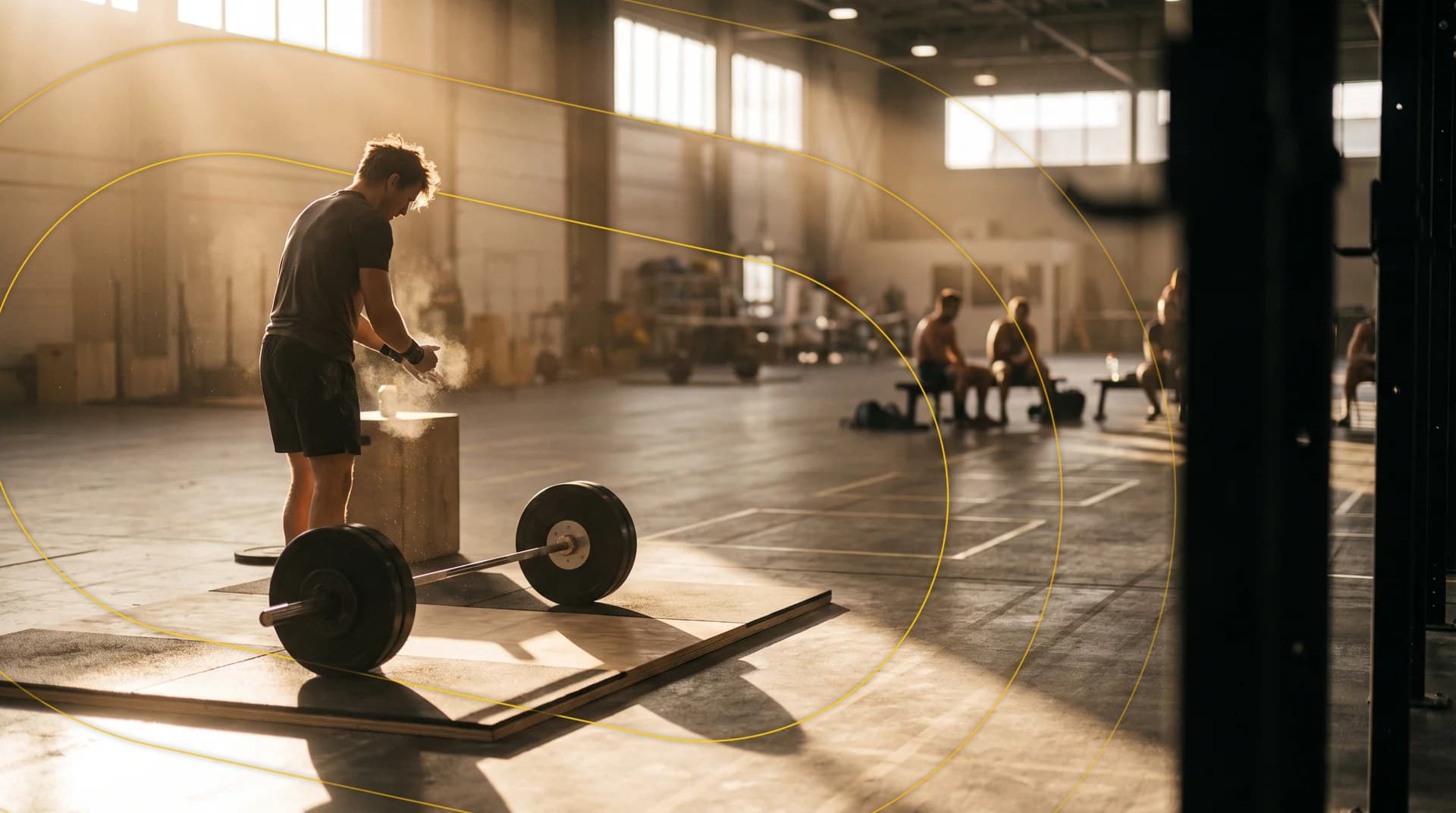
Nobody wins ATHX Games on a finish time. You move through six zones in one continuous session of about two and a half hours, and only three of those zones carry a score: the Strength Zone is measured on total weight lifted, the Endurance Zone on total distance covered, and MetCon X on time to complete. Those three results become a points total, and the points total is what puts you on the leaderboard.
That is the fact almost every write-up of the series gets wrong, and it is not a technicality. A timed race asks one question, which is how fast you can cover a fixed amount of work. ATHX asks three questions in three different units, then adds them up. Arriving with a HYROX pacing plan and no heavy lifting behind you is how athletes lose an entire scored test before the running starts.
This guide covers what ATHX is, the six zones in order, how each of the three tests is actually scored, the ability tiers and entry categories, how the format compares with a timed race like HYROX, and how to pace and train for a competition where the clock only matters once.
Key Takeaways
- ATHX Games is scored, not timed. The leaderboard ranks athletes on a points total built from three separate tests, each measured in its own unit.
- The session runs about two and a half hours through six zones: Warm-Up (30 minutes), Strength (20), Refuel (10), Endurance (30), Recovery (30) and MetCon X (30).
- The Strength Zone is a 1RM strict press, a 3RM back squat and a 5RM deadlift, scored on the total weight you put overhead and on the bar.
- The Endurance Zone is a run and row combination inside a 22-minute cap, scored on total distance, so every metre counts the same and there is nothing to sprint for.
- MetCon X is the only test measured on a clock, it carries a 25-minute cap, and it lands last, after roughly two hours on the competition floor.
- Three ability tiers (Lite, ATHX and Pro) change the loads and the running distances, and you can enter as an Individual or in Pairs, male, female or mixed.
- The workout stays fixed for a whole season and refreshes the following year, so you can rehearse the exact test you will be scored on.
What Is ATHX?
ATHX is a hybrid fitness competition that the organisers describe as a two and a half hour continuous event across six zones, built as one set challenge designed to test every aspect of fitness. It is held indoors in large exhibition venues, and the 2026 and 2027 calendars run across 11 countries, from Liverpool and Marseille to Miami and Los Angeles, with the ATHX Finals in Lisbon from 27 to 29 November 2026.
The structure is what separates it from everything else in hybrid racing. Most events in this space take the HYROX shape: a fixed amount of work, done against the clock, with the finish time as the result. ATHX breaks the session into scored blocks and unscored blocks, and it gives you real rest between them. Ten minutes in the Refuel Zone and 30 minutes in the Recovery Zone are not filler. They are part of the design, and they are long enough to change what you are capable of in the next scored test.
Because the tests are separated by recovery, ATHX can ask for genuinely maximal strength, which a continuous race cannot. A 1RM strict press does not belong in the middle of a race where you still have 6km of running left. It belongs at the front of a competition that gives you 40 minutes of warm-up and refuel around it.
Where ATHX Sits Between HYROX and CrossFit
ATHX occupies a gap that the hybrid calendar had left open. HYROX is an endurance event with functional stations attached, and the athletes who win it are runners first. A CrossFit competition tests a much wider range but changes its tests constantly, so preparing for one is preparing for the unknown.
ATHX takes the standardised, repeatable part from one and the strength ceiling from the other. The test is published, it is identical at every event in the season, and it refreshes once a year. You know exactly what you are being scored on, and you are being scored on more than your engine.
The Six ATHX Zones, in Order
The six zones fill the two and a half hours exactly, and only three of them count towards your score. This table is the whole session at a glance.
| Zone | Length | Scored? | What happens |
|---|---|---|---|
| Warm-Up Zone | 30 minutes | No | Mobilise, activate and get ready for the competition floor |
| Strength Zone | 20 minutes | Yes | Three maximal lifts in three timed windows |
| Refuel Zone | 10 minutes | No | Recover, rehydrate and reset before the running |
| Endurance Zone | 30 minutes | Yes | A run and row combination against a 22-minute cap |
| Recovery Zone | 30 minutes | No | A full reset block before the final test |
| MetCon X Zone | 30 minutes | Yes | The closing conditioning piece, capped at 25 minutes |
Seventy minutes of the session are unscored, and they sit between the scored blocks rather than at the ends. Nobody gets tired enough in the Strength Zone to ruin their Endurance score by accident, which means the format is genuinely asking whether you are strong, whether you have an engine, and whether you can still work after two hours. Those are three separate answers.
How ATHX Scoring Works, Test by Test
Your result is a points total, and the leaderboard carries a column for each of the three tests alongside it. Each test is measured in its own unit, which is why a single finish time cannot exist.
The Strength Zone: Total Weight Lifted
The Strength Zone gives you 20 minutes and three windows, and your score is the total weight you lift across them. In the 2026 season workout the sequence is a 1RM strict press from 0 to 6 minutes, a 3RM back squat from 6 to 12 minutes, and a 5RM deadlift from 12 to 20 minutes.
Read that as three deadlines rather than three lifts. Every warm-up single, every plate change and every failed attempt comes out of the same six or eight minutes, and a lift you do not complete inside its window contributes nothing at all. The athlete who opens conservatively and builds to a clean top set scores more than the athlete who chases a personal best and misses it twice.
The rep schemes are also a deliberate spread. A 1RM press is nearly pure maximal strength, a 3RM back squat sits just below it, and a 5RM deadlift starts to ask a question about work capacity. Training only one of those three leaves points on the platform.
The Endurance Zone: Total Distance Covered
The Endurance Zone is a run and row combination with a 22-minute cap, and your score is the total distance you cover. As an Individual you alternate between the two, switching every 500m on Lite, every 750m on ATHX and every 1km on Pro. In Pairs, one athlete runs while the other rows, and you swap every time the runner completes a leg.
Scoring on distance rather than on a finish time inverts how you pace it. There is no finish line to empty the tank into, because the clock stops where it stops and whatever you have covered is the number. Every metre is worth the same whether it arrives in minute two or minute 21, so the athlete who holds one honest pace for 22 minutes beats the athlete who covers 300m more in the first five and then fades.
The transitions are the hidden cost. On the ATHX tier you change between running and rowing roughly every three to four minutes, so you make a lot of swaps, and seconds lost getting on and off the rower are metres that never get counted. If you want to pace this off your heart rate rather than off feel, the training zone calculator gives you the ceiling to hold.
MetCon X: Time to Complete
MetCon X is the only test on this list measured by a clock, it carries a 25-minute cap, and it is the last thing you do. On the standard ATHX tier, an Individual works through a SkiErg opener (45cal for men, 30cal for women), 30 single-arm alternating ground to overhead at 20kg for men and 12.5kg for women, a 30m sandbag carry at 50kg and 30kg, 30 box jump overs at about 61cm and 51cm (ATHX publishes these as 24 and 20 inches), 30m of dual dumbbell walking lunges at 20kg and 12.5kg, 30m of burpee broad jumps, and then the same SkiErg again to close.
Pairs cover roughly double the volume and split the reps however they like, with mixed pairs working to the female equipment standards. Lite drops the loads, swaps box jump overs for step-overs and takes the lunges to bodyweight. Pro moves the single-arm work to dual dumbbells, raises the boxes and adds a heavier sandbag.
The piece opens and closes on the same machine, which turns it into a straight test of how much you held back on the first one. Go out hard on the opening SkiErg and the closing one is where your time disappears.
ATHX Divisions and Ability Tiers
ATHX runs three ability tiers and two entry formats, and the two choices are independent of each other.
The tiers are Lite, ATHX and Pro. They change the loads in MetCon X and the running distances in the Endurance Zone, not the structure, so a Lite athlete and a Pro athlete do recognisably the same competition at different weights. Lite is built for first-timers, with lighter implements and simplified movement standards. ATHX is the standard tier. Pro raises the loads, the box heights and the running distance per leg to 1km.
The entry formats are Individual and Pairs, and Pairs run as male, female or mixed teams. In the Strength Zone a pair’s score is the combined weight both athletes lift. In the Endurance Zone they alternate, one running while the other rows. In MetCon X they share a larger volume and split it however suits them. Age-group categories sit on top of both, and the public leaderboard filters by tier, age group, country and event.
Choose the tier you can complete rather than the one that sounds right. A missed lift scores zero and a movement standard you cannot hit under fatigue costs you time in the one test where time is the metric.
ATHX vs HYROX: What Actually Changes
Most people reading this already race HYROX, so the useful comparison is not which is harder but which demands you have not been training. This table sets the two formats side by side.
| Feature | ATHX Games | HYROX |
|---|---|---|
| Your result | A points total from three scored tests | A single finish time |
| Session shape | Six zones over 2.5 hours, with scheduled rest | One continuous race |
| Running | Run and row for distance inside a 22-minute cap | 8 x 1km, fixed and unchanging |
| Strength demand | Maximal: a 1RM, a 3RM and a 5RM | Sub-maximal loads repeated under fatigue |
| Recovery | Two unscored zones totalling 40 minutes | The Roxzone, and nothing else |
| Tiers | Lite, ATHX, Pro | Open, Pro |
| Entry formats | Individual, Pairs | Singles, Doubles, Relay |
| Test stability | One fixed test per season, refreshed yearly | The same 8 stations every season |
A HYROX block builds the ability to move moderate loads when your heart rate is already high, which is a different quality from putting a maximal single overhead. Plenty of strong HYROX finishers have not tested a 1RM press in two years, and on the ATHX floor that is one of the three results feeding the points total.
The running row matters almost as much, in the opposite direction. HYROX rewards holding a target pace over 8km of compromised running. ATHX asks for 22 minutes of continuous output split across two machines, with no station work interrupting it, which is closer to a hard hybrid training conditioning session than to a race.
How to Pace a Scored Race
Pacing a points total is a different skill from pacing a clock, and it comes down to four decisions.
- Open the Strength Zone below your ceiling. Three windows, three deadlines, and a missed lift is worth nothing. Work out your openers and your jumps before race day so you are not doing arithmetic with 90 seconds left on the squat clock.
- Run the Endurance Zone flat. Distance accrues at the same value throughout, so there is no reward for a fast start and no finish line to sprint at. Pick a pace you could hold for 25 minutes, not 22, and hold it.
- Treat the swaps as part of the test. On the ATHX tier you change machine every few minutes. Practise getting on and off the rower cleanly, because those seconds are metres.
- Use the Refuel and Recovery zones properly. Ten minutes and 30 minutes are long enough to rehydrate, get food in and bring your heart rate down. Athletes who spend them standing around talking arrive at MetCon X in worse shape than the format intends.
The whole session is built to reward energy management rather than a single sustained effort. You are being asked to be maximally strong, then aerobically strong, then still functional two hours in, and the recovery blocks exist so that each test can be honest. Use them.
How to Train for ATHX
Three tests in three units means three qualities, and the one you neglect gets its own column on the leaderboard.
- Build real maximal strength. You are scored on a 1RM, a 3RM and a 5RM, which means a genuine strength block with heavy singles and triples, not station work at race weight. If your lifting has been conditioning in disguise, a progressive overload programme is the piece that has been missing.
- Train the run and row as one session. Alternating every 500m to 1km for 22 minutes is its own skill, and doing the two separately does not prepare you for it. Rehearse the exact interval your tier uses, including the transitions, and learn what pace you can actually hold to the cap.
- Train MetCon X at the end of a long day. The piece arrives after roughly two hours on the floor, so testing it fresh on a Tuesday tells you very little. Do it after a heavy lift and a hard aerobic block to find out what your closing SkiErg really costs.
- Then rehearse the actual test. This is the advantage ATHX hands you that a CrossFit competition never will. The workout is published and fixed for the whole season, so you can run the real thing in training, score it, and find out which of the three tests is costing you before it costs you on the day. Very few sports let you do that, and almost nobody uses it.
FAQ
No. ATHX Games is scored, not timed. Over about two and a half hours you move through six zones, and the three scored ones are measured in different units: the Strength Zone on total weight lifted, the Endurance Zone on total distance covered, and MetCon X on time to complete. Those results combine into a points total, and that is what ranks you.
ATHX is a hybrid fitness competition run as a single continuous session of roughly two and a half hours across six zones, held indoors in large exhibition venues. Three of the six zones are scored tests of strength, endurance and conditioning, and the other three are a warm-up, a refuel block and a recovery block.
About two and a half hours from start to finish. The zones are Warm-Up at 30 minutes, Strength at 20, Refuel at 10, Endurance at 30, Recovery at 30 and MetCon X at 30. Only 80 of those minutes are scored, and the rest is deliberate preparation and recovery.
Each of the three tests produces its own score. The Strength Zone gives you the total weight lifted across a 1RM strict press, a 3RM back squat and a 5RM deadlift. The Endurance Zone gives you total distance covered inside a 22-minute cap. MetCon X gives you a time to complete. Those feed a points total on the leaderboard.
Warm-Up, Strength, Refuel, Endurance, Recovery and MetCon X, always in that order. Strength, Endurance and MetCon X are the scored tests. Warm-Up, Refuel and Recovery are unscored and exist so that each test can be done in a reasonably fresh state rather than as a fatigue contest.
The tiers change the loads and the running distances, not the structure. Lite is the entry level, with lighter implements, simplified movements such as box step-overs instead of jump overs, and 500m running legs. ATHX is the standard tier at 750m legs. Pro uses the heaviest loads, taller boxes and 1km legs.
Yes. You can enter as an Individual or in Pairs, and pairs run as male, female or mixed teams. A pair's Strength score is the combined weight both athletes lift, the Endurance Zone has one athlete running while the other rows, and MetCon X gives pairs a larger volume they can split however they like. Mixed pairs work to the female equipment standards.
It is not harder so much as broader. HYROX is an endurance race with functional stations attached, so it rewards running above everything else. ATHX scores maximal strength alongside the engine, so a strong HYROX finisher who has not tested a 1RM in two years will lose points in the first scored zone rather than on the running.
Conclusion
ATHX Games is the hybrid event that does not hand out a finish time, and once that lands, the whole thing makes sense. Six zones, two and a half hours, three scored tests in three different units, and a points total that asks whether you are strong, whether you have an engine, and whether you can still work when both have already been tested.
For a HYROX athlete that is good news and a warning in the same sentence. Your aerobic base transfers straight across and your movement quality under fatigue is already built. What probably is not built is a genuine 1RM press and the patience to run 22 minutes flat when instinct says race it.
Three things to do next. Pick your event from the ATHX race calendar , pick the tier you can complete rather than the one that sounds right, and find out honestly which of the three tests is your weakest, because that is where your points are.
Then there is the part a published workout cannot solve. Peaking strength, endurance and conditioning at once, on one date, without letting any of the three slip, is a programming problem that changes every week your life does.
That is what Kracey is for. It is an AI coach that lives in Telegram, with nothing to install, and it reads your training through intervals.icu so it sees what you actually did rather than what the session was called. Tell it the date of your ATHX event and it programmes the block around it, and when your Thursday disappears you say so in the chat and the week bends. The first 14 days are free, starting when it can see your training rather than the moment you sign up.
Get coached in Telegram and build the block around your ATHX date .