
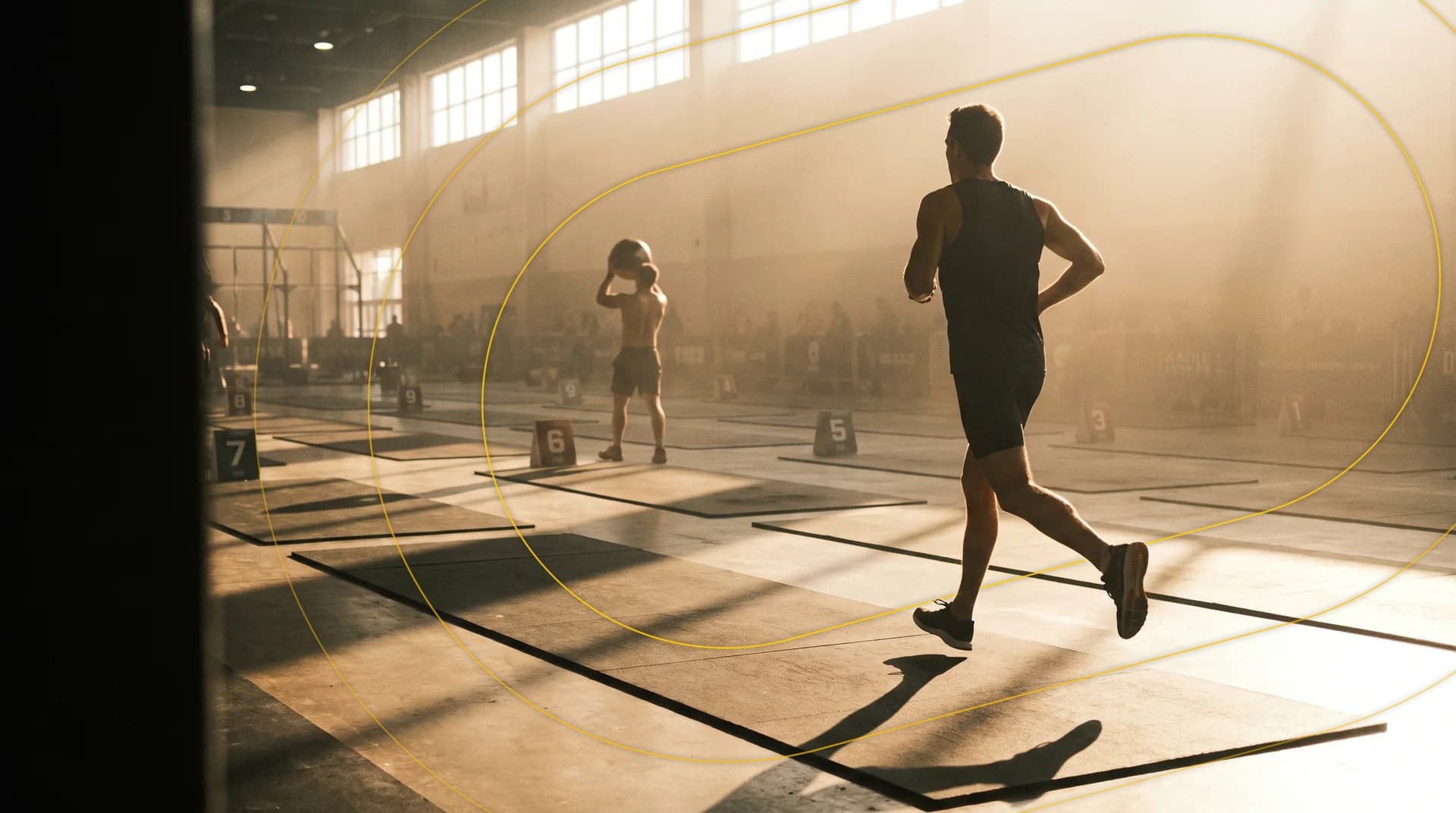
DEKA FIT is Spartan’s indoor fitness race: 10 standardised stations called DEKA Zones, completed in a fixed order, with a 500m run in front of every one of them for 5km of running in total. Nothing about the course changes between events, which is the whole point of it. The rower is 500m wherever you race, the dead ball weighs the same in every venue, and the finish time you walk away with, which DEKA calls your DEKA Mark, means one thing everywhere.
FIT is one of three formats built on those same 10 zones, and the other two are why this guide covers more than its title suggests. DEKA STRONG takes the zones back to back with no running at all. DEKA MILE puts a 160m run in front of each one, for 1.6km in total. Choosing between them is less a question of difficulty than of which quality you want measured, and plenty of athletes race all three inside one season.
What follows is the format in full: all 10 zones with the loads DEKA sets for each category, what changes in STRONG and MILE, the heat types and age groups, the penalties that quietly add minutes, what the 2026 global leaderboard says a realistic finish looks like, and how to train for it.
Key Takeaways
- DEKA FIT is 10 fixed zones with a 500m run before each one, so 5km of running and 10 stations against a single clock.
- All three formats share the same 10 zones: STRONG has no running, MILE has 160m before each zone (1.6km in total) and FIT has 500m before each zone (5km).
- Your finish time is called a DEKA Mark, and at DEKA FIT every zone and every transition is recorded separately on timing mats.
- Loads are set by category rather than chosen: men 14+ take 25kg (55lb) on the lunges and 27.5kg (60lb) on the carry and the dead ball, while women 14+ and men 65+ take 15kg (33lb) and 17.5kg (40lb).
- Complete less than 80% of a zone, or less than 80% of the running, and you finish unofficially: shirt and medal, but no time on the global leaderboard.
- Half the men on the 2026 global leaderboard finished a DEKA FIT in 48:20 or quicker, and half the women in 54:32 or quicker, out of 14,580 ranked results.
- Every DEKA FIT, MILE and STRONG event is a World Championship qualifier, and the top 15 in each event and division receive the first invites.
- STRONG and MILE are hosted by affiliate gyms, while DEKA FIT is run by Spartan DEKA in large indoor venues with Elite and Age Group heats.
What Is DEKA FIT?
DEKA FIT is the full version of a fitness test that Spartan built to be repeatable. You run 500m, you enter a zone and complete the work in it, you run another 500m, and you keep going until all 10 zones are behind you. That comes to 5km of running and 10 loaded or machine stations, and the clock does not stop for any of it.
The reps, the distances, the calories and the weights are published in the DEKA Rules of Competition, revised 1 May 2026 , and they are identical at every event in the world. That is what turns a finish time into a benchmark rather than a souvenir. Improve by two minutes six months later at a different venue in a different country, and the improvement is real rather than a difference in course.
At DEKA FIT the measurement goes further than the finish line. Timing mats sit at each zone, so your race file separates the time you spent inside every zone from the time you spent running and from the transitions in between. That zone-level detail is the most useful thing the format hands back, because a single finish time cannot tell you which of the 10 zones took your race apart.
Who It Is Built For
DEKA sets no entry standard. Its own line is that the event is designed for all levels of human fitness, and the rulebook backs that up with two mechanisms rather than encouragement alone.
The first is modification. If you cannot perform a movement to the published standard today, you may modify it, finish the race and collect the finisher shirt, medal and Trifecta wedge. The cost is stated plainly: a modified race does not put a DEKA Mark on the global leaderboard. The second is the team format, where two athletes split every rep, metre and calorie between them and only one works at a time.
Age is handled the same practical way. Adults race from 14, youth categories run from 10 to 13 at reduced loads and distances, and the brackets run all the way to 70+.
The DEKA FIT Stations: All 10 DEKA Zones in Order
DEKA calls them zones and most athletes searching for them call them stations. They are the same 10 pieces of work, they never change order, and they never change weight. This table is the whole course, with the loads DEKA publishes for the two largest categories.
| Zone | The work | Men 14+ | Women 14+ and men 65+ |
|---|---|---|---|
| 1 | 30 alternating reverse lunges, RAM or dumbbell | 25kg (55lb) | 15kg (33lb) |
| 2 | 500m row | Same for everyone | Same for everyone |
| 3 | 20 box step or jump overs | 60cm (24in) | 60cm (24in) |
| 4 | 25 med ball sit-up throws | 9kg (20lb) | 6kg (14lb) |
| 5 | 500m SkiErg | Same for everyone | Same for everyone |
| 6 | 100m farmers carry | 27.5kg (60lb) per hand | 17.5kg (40lb) per hand |
| 7 | 25 calories on the air bike | Same for everyone | Same for everyone |
| 8 | 20 dead ball overs | 27.5kg (60lb) | 17.5kg (40lb) |
| 9 | 100m sled push and pull | Resistance 8 or 3 | Resistance 7 or 2 |
| 10 | 20 weighted burpees, RAM or two dumbbells | 20kg (44lb) or 2 x 10kg | 10kg (22lb) or 2 x 5kg |
Three things in that table are worth a second look. The heavy work clusters late, with the carry at zone 6, the dead ball at zone 8 and the sled at zone 9 all landing after two thirds of the race is gone. The two erg pieces sit at zones 2 and 5, early enough that an aggressive 500m row is genuinely tempting and expensive. And the weighted burpee closes the race, which means the last thing you do is press a loaded implement overhead 20 times with nothing left.
Women 65+ and the youth 10 to 13 category race lighter throughout: 10kg (22lb) on the lunges, 5kg (10lb) on the med ball, 9kg (20lb) per hand on the carry and 9kg (20lb) on the dead ball. Youth athletes also halve the machine work to 250m on the rower and the SkiErg and 12 calories on the bike, unless they are racing alongside an adult, in which case the full numbers apply.
Zone 9 needs its own note, because it is the one place where the number in the table is a setting rather than a weight. Two magnetic resistance sleds are approved, a Xebex and a Torque Tank, and the required setting differs between them: men race at resistance 8 on the Xebex or resistance 3 on the Torque Tank. The rulebook adds 72.5kg (160lb) to the weight stack on top of the setting, for the Xebex XT4 and XT3 PLUS and for the Torque Tank M1S. The 100m is covered as a 10m course, pushed down and pulled back five times.
The Movement Standards That Cost Athletes Time
Every zone is judged, and several of the standards are not what a gym athlete would assume.
- The lunges are governed by a rep line. You step straight back until the trailing knee touches the ground behind the line, then bring the foot back in front of it, and the rep counts only once both feet are in front of the line with hips and knees at extension. Rotating or side-stepping lunges are not allowed, and neither are split squat jumps.
- The box requires both feet on top. Jumping the entire box without making contact is not a rep, your body has to travel over the box rather than around it, and both feet must land on the far side for the rep to count. One hand may assist if you need it, never two.
- The med ball has to hit the face of the target, which is set 1.37m (4.5ft) above the floor. Touching the underside of the bottom edge does not count, and touching the ball to the target without letting go is fine.
- The dead ball goes over a 1.22m (4ft) frame and then you follow it. Both feet stay inside the frame while you lift, the ball has to land on the far side, and you travel around to the other side for the next rep rather than working from one position.
- The carry is a maze, not a straight line. You take 100m with the weights at your sides, you may set them down whenever you like as long as you place them under control, and they must be returned to the spot they started in. Dropping them is a 30 second penalty.
- The weighted burpee finishes overhead. Chest or abdomen to the RAM at the bottom, then a full lockout with the weight pressed above the head and a straight line from ankle to hand. If you cannot reach full elbow extension, the rulebook lets you declare it and complete 28 reps instead of 20.
Two kit rules catch people out as well. Gloves and lifting belts are allowed; headphones, lifting straps and gymnastics grips are not. At DEKA FIT you cannot carry water on the course either, because the course provides one or two stations per run, which works out at 10 to 20 chances to drink across the 5K.
DEKA STRONG: The Same 10 Zones, No Running at All
DEKA STRONG is the 10 zones done back to back with zero running in between. That is the entire difference.
Strip the running out and there is nowhere to recover. In DEKA FIT the 500m between zones is a genuine, if unwelcome, reset for your grip and your shoulders. In STRONG, the farmers carry hands you straight to the air bike, and the dead balls hand you straight to the sled. What the format measures is how quickly you can repeat loaded work, which is a different quality from the one a 5km race measures.
STRONG is also the most accessible way in. It is hosted by DEKA affiliate gyms rather than at the big arena events, it is short, it asks for no running fitness at all, and it still puts a DEKA Mark on the global leaderboard. If a DEKA FIT is the eventual goal, entering a STRONG first is the cheapest way to meet all 10 movement standards under a judge before the 5km is added on top.
DEKA MILE: A 160m Run Before Every Zone
DEKA MILE sits between the other two. You run 160m before each of the 10 zones, which totals 1,600m, and the rulebook requires that distance to be measured with a rolling wheel rather than estimated. Like STRONG, it is an affiliate gym event and a World Championship qualifier.
At 160m there is no settling into a pace and no meaningful aerobic recovery, so each run functions as a sprint that arrives with your heart rate already high. If the running is the part of a DEKA FIT you dread, MILE keeps every zone and removes most of it. If you arrived here from running, FIT is the one that pays you back, because 5km is far enough for a real engine to show.
What Changes in the Zones for STRONG and MILE
The 10 zones are shared, but three of them are modified when the running comes out or shortens.
- Zone 4 becomes a plain med ball sit-up. Instead of throwing the ball at a target, you take it from behind your head to the ground between your feet, and the rep counts when the centre of the ball touches down.
- Zone 6 becomes a shuttle. The 100m carry is run as a 10m course, down and back five times, rather than through the maze DEKA FIT uses. Dropping the weights costs you a deadlift penalty rep rather than 30 seconds.
- Zone 8 becomes a dead ball shoulder over. The ball travels over one shoulder with hip and knee extension reached on at least one leg, rather than over the frame.
Those three modifications are the only structural differences. Everything else, including the loads, the reps and the judging, is identical to DEKA FIT.
DEKA FIT, STRONG or MILE: Which One to Enter
The three formats are best read as one test with three amounts of running attached. This table is the decision in full.
| DEKA STRONG | DEKA MILE | DEKA FIT | |
|---|---|---|---|
| Running | None | 160m before each zone (1.6km) | 500m before each zone (5km) |
| Zones | The same 10 | The same 10 | The same 10 |
| Modified zones | 4, 6 and 8 | 4, 6 and 8 | None, this is the reference version |
| Where it is held | Affiliate gyms | Affiliate gyms | Spartan DEKA venues, indoors |
| Timing | Hand timed at gym events | Hand timed at gym events | Chip timed, with mats at every zone |
| Heats at a normal event | Open, Teams, Ruck | Open, Teams, Ruck | Elite, Age Group, Open, Teams, Ruck |
| Counts for the leaderboard | Yes | Yes | Yes |
| World Championship qualifier | Yes | Yes | Yes |
Notice that the leaderboard column does not vary. A gym STRONG on a Tuesday evening and a DEKA FIT in an arena both produce a DEKA Mark and both qualify you for the World Championship in their own event and division, which is unusual for a race series and the main reason the affiliate events are worth taking seriously.
There is a fourth format worth knowing about, though it belongs to a different discipline. DEKA ATLAS is a strength test built on 10 heavier zones under a 30 minute time cap, raced in ATLAS Foundation and ATLAS Peak divisions, and DEKA says plainly that unlike the other three it is not designed for all fitness levels. There is also a DEKA FIT Ultra, which is the DEKA FIT course completed five times over for 25K and 50 zones, with an eight hour cut-off.
How Long Does a DEKA FIT Take?
DEKA publishes no average finish time, but it publishes something better: a global leaderboard carrying every ranked result of the season. Through 13 September 2026 that board held 14,580 individual DEKA FIT results, 8,621 from men and 5,959 from women, and the shape of that field is the honest answer to what a good time looks like.
| Men | Women | |
|---|---|---|
| Fastest 2026 time | 29:35 | 31:29 |
| Fastest quarter of the field, quicker than | 42:50 | 48:37 |
| Median | 48:20 | 54:32 |
| Slowest quarter of the field, slower than | 55:30 | 1:02:02 |
| Finished under an hour | 84% | 70% |
The first row is the one that puts the rest in proportion. Exactly one athlete in the entire 2026 field went under 30 minutes, so the very top of this sport is far thinner than the leaderboard length suggests, while the middle half of the men sat between 42:50 and 55:30 and the middle half of the women between 48:37 and 1:02:02. A first DEKA FIT somewhere either side of an hour is a completely ordinary result. The equivalent reference for a HYROX finish sits in our breakdown of a good HYROX time by division , built the same way, from real results rather than from a rule of thumb.
Build your own target from three components instead of borrowing anyone else’s. Take the 5km first: cover it at 5:30 for each kilometre and you have spent about 27 minutes before a single rep is counted, which on a median finish is more than half the race. Add the 10 zones next, and the three machine pieces are the ones you can time precisely in a single session rather than guess at. Then add the transitions, because 10 zones means 20 mat crossings, and your race file afterwards will price every one of them for you.
Heats, Teams and Age Groups
DEKA FIT sells several heat types on the same day. They are not difficulty tiers but different ways of taking on an identical course.
- Elite and Age Group are the competitive heats. Elite individuals race for podium prize money at the World Championship, Age Group athletes race for podium awards, and both feed the global leaderboard.
- Open heats exist for athletes who want the test and the finisher kit without the ranking pressure.
- Teams split the work between two adults, or four at DEKA FIT, dividing the reps, metres and calories by whatever strategy they like, with only one teammate working at a time.
- Ruck takes on the whole thing wearing a weighted pack, at 30lb (13.6kg) for men and 20lb (9.1kg) for women, in a bag of at least 14 litres, weighed before the start and again at the finish. Weight vests and plate carriers are not allowed in this category.
Team racing has its own rulebook section and the rules are stricter than most pairs expect. Only one teammate works at a time, physical contact between the pair is required inside the zone at each transition, both athletes have to run the first and last 500m, and both have to cross the finish line together. If one cannot finish, the team takes a DNF.
Age groups run 14-17, 18-24, 25-29 and then in five year bands to 70+, with two youth categories at 10-11 and 12-13. DEKA ranks you on your age on 30 September of the season, not on your age on race day. Team age groups work on the combined ages of the athletes, so a two person adult team falls into 59 and under, 60-79, 80-99, 100-119 or 120+.
Every DEKA FIT, MILE and STRONG event is a World Championship qualifier. The top 15 in each event and division on the global leaderboard at the end of the qualifying season receive the first invitations, with rolldown invites following until the heats fill. The 2026 DEKA World Championship runs from 10 to 13 December 2026 at the Fort Worth Convention Center in Texas, with the FIT championship on the Thursday, MILE on the Friday and STRONG on the Saturday.
Penalties, and the 80% Rule
Penalties at DEKA are added to your time rather than served at the station, and the published list is precise enough to train around.
| What happened | What it costs |
|---|---|
| A missed rep in zone 1, 3 or 4 | 10 seconds each |
| A missed rep in zone 8 or 10 | 20 seconds each |
| A missed down and back in zone 9 | 1:30 each |
| Leaving the rower or SkiErg 5m or less short | 20 seconds |
| Leaving the rower or SkiErg 6m or more short | 2 minutes |
| Leaving the air bike one calorie or less short | 20 seconds |
| Leaving the air bike more than one calorie short | 2 minutes |
| Dropping or failing to return the weights in zone 6 | 30 seconds |
| Completing the zones out of order | 1 minute per violation |
| Missing a lap of a run | 3 minutes on a two lap course, 2 minutes on a three lap course |
Read the bottom two rows together, because they are the expensive ones. The 500m at DEKA FIT is run as laps of a short course, and losing count of them is both the easiest mistake to make at threshold and among the dearest on the list.
Above the penalties sits the rule that ends a leaderboard day rather than lengthening it. Complete less than 80% of the work in any zone, or less than 80% of the total running, and you are recorded as an unofficial finisher: the shirt and the medal are still yours, the DEKA Mark is not. Skipping a zone outright does the same thing. It is a fairer system than a flat disqualification, and it means the leaderboard genuinely holds only completed races.
How to Train for DEKA FIT
The course is published and it never changes, which hands you an advantage almost no other race offers: the thing you are training for can be practised in full, in order, at the real weights. Four decisions shape how that practice goes.
Set the 500m Pace from a Tired Leg
The running adds up to a full 5K, but it never arrives as one. It comes in 10 pieces, each one starting the moment you step out of a loaded zone, and the pace that survives that treatment is slower than the one you hold in a standalone 5K. The HYROX pace calculator is built for the same problem on a different course, and it will turn a goal finish time into the per-kilometre splits you need to hold.
Give the Ergs Numbers Rather Than Feelings
A 500m row, a 500m SkiErg and 25 calories on the air bike are three known quantities, and you can establish what each one costs you at three different efforts in a single session. Our station guides to rowing and the SkiErg cover the technique, and the DEKA distances are shorter than the HYROX ones, which makes the temptation to empty yourself on them considerably stronger.
Train Grip as One System, Because the Race Does
The 100m carry at 27.5kg per hand, the dead balls and the sled all draw on the same forearms inside 15 minutes of each other, and the farmers carry is where most athletes first feel it going. Carry at race weight for the full distance in one piece, then do it again with a run either side.
Rehearse the Closing Sequence
Zones 8, 9 and 10 are a dead ball, a sled and 20 overhead reps, in that order, at the end of a race. Practising them fresh proves very little. Chain them after a hard aerobic block and you find out what your last four minutes actually look like, which is the part of a DEKA FIT that decides whether your finish time matches the plan.
When you have picked a date, the rest becomes a scheduling problem. Every event, with its venue and its dates, sits on our DEKA race hub , and counting backwards from a real date is what turns all of the above into a block rather than a list of good intentions.
FAQ
DEKA FIT is Spartan's indoor fitness race, made up of 10 standardised stations called DEKA Zones completed in a fixed order, with a 500m run before every zone for 5km of running in total. The reps, distances and weights are identical at every event worldwide, and your finish time, known as a DEKA Mark, goes onto the global leaderboard.
All three use the same 10 DEKA Zones and only the running changes. DEKA STRONG has no running at all, DEKA MILE has a 160m run before each zone for 1.6km in total, and DEKA FIT has a 500m run before each zone for 5km in total. STRONG and MILE also modify three zones: the med ball becomes a plain sit-up, the farmers carry becomes a 10m shuttle and the dead ball goes over the shoulder rather than over a frame.
There are 10, always in this order: 30 alternating reverse lunges, a 500m row, 20 box step or jump overs, 25 med ball sit-up throws, a 500m SkiErg, a 100m farmers carry, 25 calories on the air bike, 20 dead ball overs, a 100m sled push and pull, and 20 weighted burpees. DEKA calls them zones rather than stations.
On DEKA's own 2026 global leaderboard, covering 14,580 ranked results through 13 September 2026, the median man finished in 48:20 and the median woman in 54:32. The middle half of the men sat between 42:50 and 55:30, the middle half of the women between 48:37 and 1:02:02, and 84% of men and 70% of women came in under an hour. The fastest times of the season were 29:35 and 31:29.
Men aged 14 and over use 25kg (55lb) on the lunges, 9kg (20lb) on the med ball, 27.5kg (60lb) per hand on the farmers carry, a 27.5kg (60lb) dead ball and a 20kg (44lb) RAM on the burpees. Women aged 14 and over, and men 65 and over, use 15kg (33lb), 6kg (14lb), 17.5kg (40lb) per hand, a 17.5kg (40lb) dead ball and a 10kg (22lb) RAM. Women 65 and over and youth athletes race lighter again, and the box is 60cm (24in) for everybody.
Yes. There is no entry standard, and DEKA states that the event is built for all levels of fitness. If you cannot perform a movement to the published standard, you are allowed to modify it and still earn the finisher shirt, medal and Trifecta wedge, though a modified race does not put a time on the global leaderboard. DEKA STRONG, which has no running at all, is the simplest place to start.
Your DEKA Mark is your official finish time for the course. Because every DEKA event uses the same equipment, reps and standards worldwide, that time works as a global benchmark: you can compare it against your own previous races and against the global leaderboard for your event and age group.
Every DEKA FIT, DEKA MILE and DEKA STRONG event is a qualifier, including affiliate gym events. Athletes in the top 15 of the global leaderboard in their event and division at the end of the qualifying season receive the first invitations, and rolldown invites follow until the heats are full. The 2026 DEKA World Championship runs from 10 to 13 December 2026 at the Fort Worth Convention Center in Texas.
No, they are separate series with different formats. HYROX is 8 x 1km of running with one station after each run, always the same eight in the same order. DEKA FIT is 10 x 500m of running with 10 zones, and its equipment list includes an air bike, a med ball, a dead ball and a magnetic resistance sled rather than HYROX's weighted sleds and wall balls. Training transfers well in both directions, but the pacing does not.
Conclusion
DEKA FIT rewards athletes who treat it as a measurement rather than a race. The course is fixed, the loads are fixed, the standards are published, and the leaderboard exists so that your time next spring can be compared with your time this autumn and mean something. Pick the format that matches the running you actually want to do, learn the 10 movement standards before a judge has to teach them to you, and choose a date early enough to train backwards from it.
Then comes the part no published course can solve for you. Peaking the running, the loaded work and the grip endurance together, on one date, while the week keeps rearranging itself around work and everything else, is a programming problem rather than a knowledge problem.
That is where Kracey comes in. It is an AI coach for HYROX, running and hybrid athletes, and it works inside Telegram, so there is nothing to download and nothing you have to remember to open. It connects to intervals.icu, reads what your watch actually recorded, and reads it properly: an interval session gets judged on its lap splits and the time you spent in Z4 and Z5, not on an average that the recoveries have dragged down. Hand it your DEKA date and it writes the block back from there. Lose a Thursday and one message is enough to have the rest of the week rebuilt around what is left of it. Your first 14 days cost nothing and need no card, and the clock on them starts once your coach can see your training.