
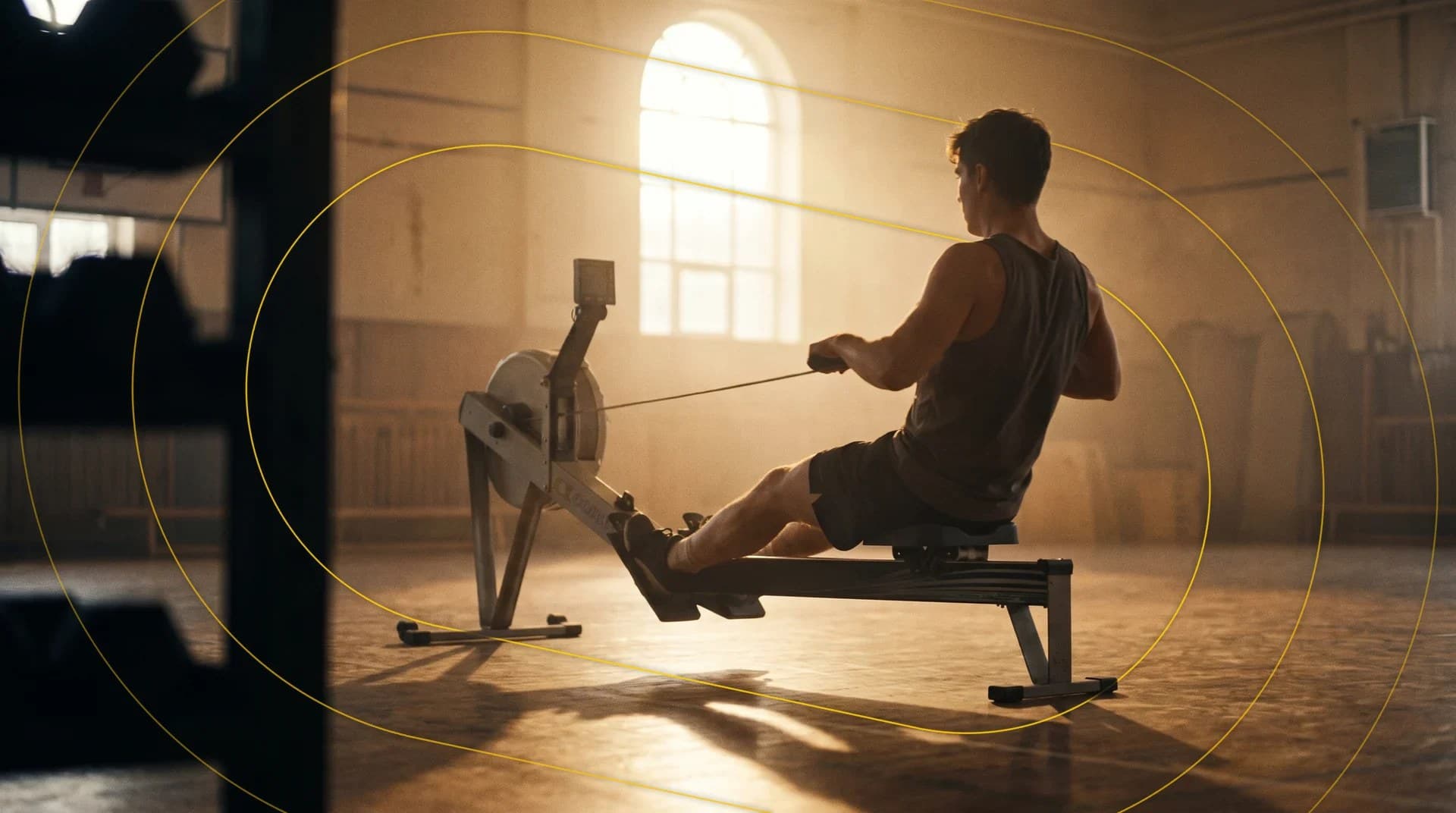
The HYROX row is Station 5 of 8: a 1,000 metre effort on a Concept2 rowing machine, sitting right in the middle of the race. Set the damper to 4 to 6, hold a stroke rate around 24 to 28, drive with your legs and split the 1,000m evenly. Do that and the row becomes the closest thing to a recovery you get all race. Do it wrong and you cook your legs for the three stations that decide your finish.
Here is what catches most athletes out. The rowing machine is not an arms exercise, and it is not the place to make up time. The seat gives your legs a brief rest from running, so the smart play is to row controlled and let your heart rate settle. The athletes who attack the row hard pay for it at the farmers carry, the sandbag lunges and the wall balls that follow.
This guide covers the damper and stroke-rate settings, the drive technique that saves your back and your legs, and how to pace the 1,000m so you leave the machine ready to race the back half. New to the format? Our HYROX workout stations guide runs through all eight in order.
Key Takeaways
- The row is Station 5: 1,000m on a Concept2 erg, bodyweight, straight after the burpee broad jumps.
- Set the damper to 4 to 6 (most athletes 4 to 5). Cranking it to 10 just torches your legs and grip.
- Hold a stroke rate of roughly 24 to 28 with a strong, complete drive. Flailing at 34-plus feels fast but wastes energy.
- Drive in sequence: legs, then hips, then arms. Pulling the arms early leaks power and loads your lower back.
- Split the 1,000m evenly and use the seat to lower your heart rate. Target around 3:45 to 4:30 (Open Men) and 4:15 to 5:00 (Open Women).
What Is the HYROX Rowing Station? Rules and Setup
The HYROX rowing station is a 1,000 metre row on a Concept2 rowing machine, performed at bodyweight with no added load. It is the fifth station, sitting between the burpee broad jumps (Station 4) and the farmers carry (Station 6), and it marks the midpoint of the race. You sit down, row 1,000m on the monitor, and stand up when it clicks over.
There is no weight and no rep count, just the distance on the screen. The one setting that matters is the damper lever on the side of the flywheel housing, which controls how much air the fan draws in per stroke. It is not a resistance or difficulty dial in the way most people assume. It changes the feel of each pull, and getting it right is worth real time and energy across 1,000m. For the full reference across every station, see our HYROX weights and standards guide .
Muscles Worked: Why the Row Is a Leg Station
The row is driven by your legs, glutes and back, with your arms doing the least work of all. Most of the power in a good stroke comes from your legs pressing the seat back against the footplate, exactly like a leg press. Your hips and back then swing open, and your arms simply finish the movement by drawing the handle in.
This matters because the athletes who treat the row as an upper-body pull burn out their arms and grip, which they need for the farmers carry that follows. By Station 5 you have already run five kilometres and pushed and pulled the sleds. A leg-driven, efficient row spreads that load onto your biggest muscles and keeps your arms fresh. Train the movement so your legs carry it, not your shoulders.
Technique: The Drive Sequence and Recovery
Good rowing technique follows one sequence on the drive and reverses it on the recovery: legs, then hips, then arms out, and back. Nail that order and every stroke transfers full power with no wasted effort or strain on your back.
The drive (legs, hips, arms): From the catch, press through your legs first with your arms straight and your back braced. As your legs near full extension, swing your hips and torso open to a slight lean back. Only then draw the handle to your lower ribs with your arms. Power flows from the biggest muscles to the smallest.
The recovery (arms, hips, legs): Reverse it. Extend your arms away first, then hinge your torso forward from the hips, and finally let your knees bend to slide the seat back to the catch. Keep the recovery slower than the drive, roughly a 2-to-1 ratio, so you get a brief rest and control your breathing.
The two faults that cost you: First, pulling your arms before your legs finish, which leaks power and loads your lower back. Second, rushing the recovery and slamming into the catch, which spikes your heart rate and wastes energy. Smooth and long beats short and frantic every time.
Take Dan, a strong gym athlete from Sheffield who rowed his first HYROX like he attacked a 500m sprint: arms yanking, damper on 9, stroke rate over 32. He finished the row in a decent 3:50, then arrived at the farmers carry with shredded grip and a maxed heart rate, and lost two minutes across the back half he could not explain. His row split looked good on paper. It quietly cost him far more time than it saved.
Damper and Stroke Rate: Getting the Settings Right
Set the damper to 4 to 6 and hold a stroke rate of 24 to 28. Those two numbers do more for your row split than any amount of extra effort, because they keep each stroke powerful without draining your legs.
Damper 4 to 6: The damper controls airflow, which changes how heavy each stroke feels. Most recreational HYROX athletes find 4 to 5 gives the best balance of power and leg conservation. Cranking it to 10 makes every pull a grind, torches your legs and grip, and does not make you faster. Set it once before you sit down and forget it.
Stroke rate 24 to 28: Stroke rate is how many pulls you take per minute, shown on the monitor. Aim for 24 to 28 strong, complete strokes rather than fast, shallow ones. Beginners often flail at 34 or more because it feels urgent, but there is little power behind each pull, so the split barely moves while the heart rate soars. Fewer, harder strokes win.
Watch the 500m split on the monitor, not the stroke rate, to judge your pace. Work out what split your goal finish time needs with the HYROX pace calculator , then hold it steady across the 1,000m.
Race Day Strategy: How to Pace the 1,000m Row
The best row strategy is to split the 1,000m evenly, use the seat to lower your heart rate, and lift the pace only in the final 250m. Because the row lands mid-race after five runs and four stations, control beats aggression here.
Sit down and settle into your target 500m split within the first few strokes. Do not go out hard in the first 200m, however fresh the seated position feels. The legs are already loaded from the run and the burpees, and early lactate here is paid back with interest at the farmers carry, sandbag lunges and wall balls. Hold an even, controlled pace through the first 750m and consciously relax your breathing on each recovery.
In the final 250m, you can start to build. Lift your stroke rate by 2 to 3 and pull a touch harder, then empty what is left in the last 100m knowing a short row into Run 6 is all that follows. Treat the middle 500m as active recovery for your legs and your heart rate, and you will stand up ready to race the back half. Our HYROX pace calculator shows how a controlled row protects the run and stations that follow it.
How to Train for the HYROX Row
Train the row by building aerobic rowing capacity and rehearsing it under fatigue two to three times a week. You do not need to be a technical rower, you need an efficient, repeatable stroke you can hold when your legs are tired.
If you have a rowing machine:
- Distance intervals: 3 to 4 x 1,000m at goal race split, damper 4 to 6, with 2 minutes rest. Progress by trimming the rest.
- Split holds: row 4 x 500m holding a fixed 500m split, focused on the legs-hips-arms sequence at 24 to 28 spm.
- Post-fatigue rows: do burpee broad jumps or a hard run, then row 1,000m immediately. This rehearses the exact mid-race state you meet at Station 5, which is the piece most athletes skip.
If you have no rower:
- Aerobic base work: any steady cardio (running, cycling, SkiErg) builds the engine the row draws on. The Kracey training zone calculator sets the right heart-rate zones for that base work.
- Leg and hinge strength: squats, deadlifts and hip hinges build the leg drive that powers the stroke. Our strength exercises for runners guide covers the posterior-chain work that carries over.
- Technique reps when you can: even a few minutes on a gym rower drilling the sequence pays off, since form under fatigue is the whole game.
To train the row in the fatigued context you will actually race in, Kracey coaches it in Telegram , folding erg work into your running build rather than leaving it as an afterthought.
FAQ
What is a good HYROX row time? A good HYROX row is around 3:45 to 4:30 for Open Men and 4:15 to 5:00 for Open Women. Faster is possible, but the row is not where races are won. A controlled split that leaves your legs and grip intact for the farmers carry and wall balls beats a fast row that empties the tank.
What damper setting should I use for the HYROX row? Use a damper of 4 to 6, and most recreational athletes are best at 4 to 5. It gives the best balance of power and leg conservation. A damper of 10 makes every stroke a grind, torches your legs and grip, and does not make you faster over 1,000m.
What stroke rate should I row at in HYROX? Aim for 24 to 28 strokes per minute with a strong, complete drive on each pull. Rowing at 34-plus feels fast but wastes energy on shallow strokes. Fewer, more powerful strokes produce a better split with a lower heart-rate cost.
Is the HYROX row an arms exercise? No. The row is powered mainly by your legs, then your hips and back, with your arms finishing the stroke. Pulling with your arms first leaks power and loads your lower back, and it drains the grip you need for the farmers carry that follows.
How do I get faster at the HYROX row? Build aerobic capacity with 1,000m intervals at race split, drill the legs-hips-arms sequence at 24 to 28 spm, and practise rowing immediately after burpees or a hard run to rehearse the mid-race fatigue. Efficient technique under fatigue improves your split more than raw effort.
Conclusion: Row Smart, Save Your Race
The HYROX row is the one station that can give something back if you treat it right. Set the damper to 4 to 6, hold 24 to 28 strong strokes a minute, drive with your legs in the right sequence, and split the 1,000m evenly. Done well, the row lowers your heart rate and leaves your arms and grip fresh for the stations that actually decide your finish.
Row it like a sprint and you flip that on its head: a good-looking split followed by a back half that falls apart. Train the row under fatigue, rehearse the settings until they are automatic, and on race day use the seat as the recovery it is.
Want the row trained as part of the race rather than as a separate erg session? Meet your Kracey coach , or map your target splits with the HYROX time predictor so every station, the row included, has a number before you reach the start line.