
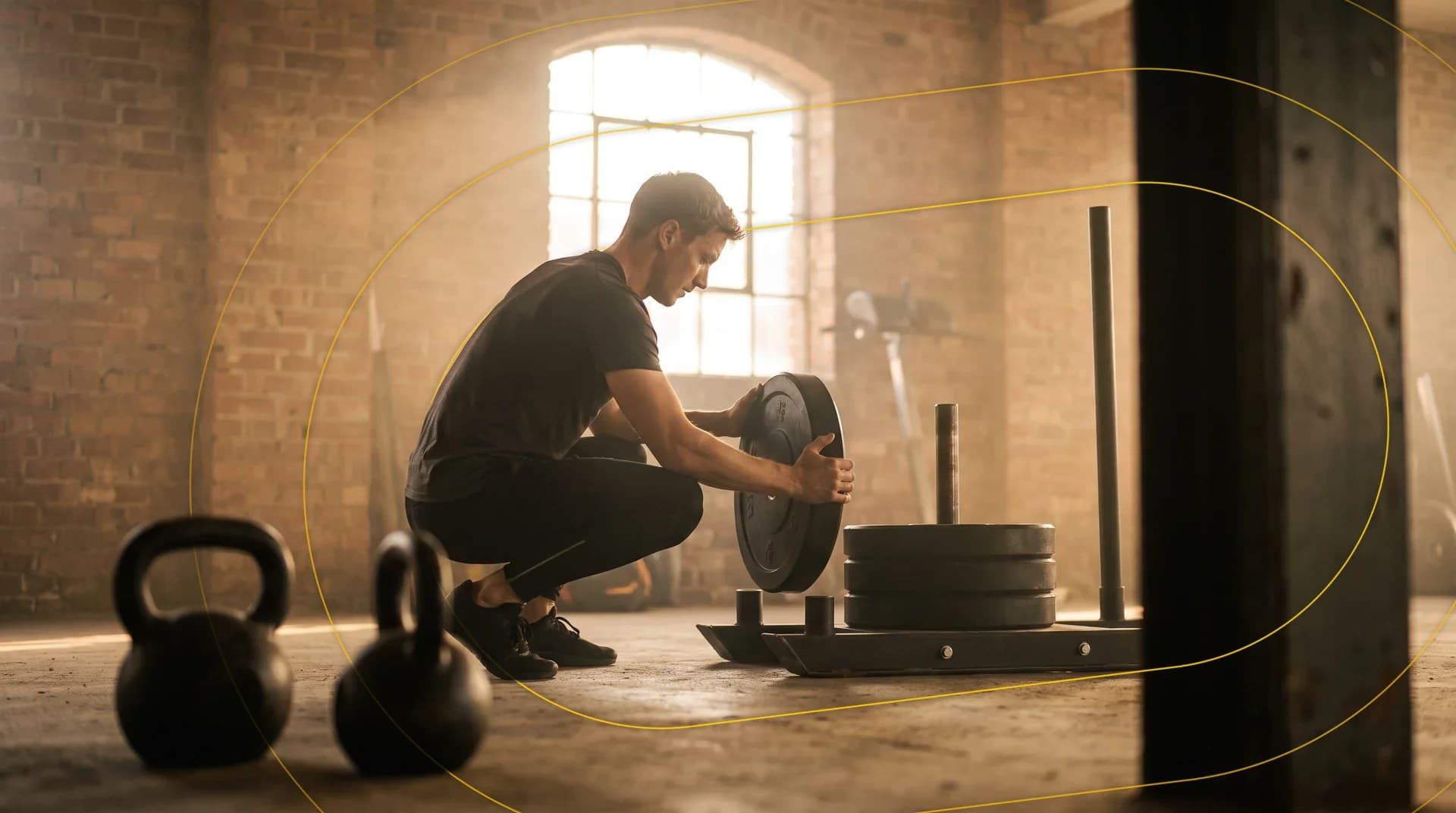
Every HYROX weight sits in one table on this page. Open Women push a 102 kg sled, Open Men and Pro Women push 152 kg, and Pro Men push 202 kg, and that same three-tier pattern runs through the sled pull, the farmers carry, the sandbag lunges and the wall balls. Five of the eight stations carry external load. The other three carry none at all.
This is the whole-race reference rather than a single-station guide. Every figure below is checked against the official HYROX Season 26/27 rulebooks for Singles, Doubles and Relay. Where you want technique, pacing and training drills for one station, that station has its own guide and this page points you to it.
Key Takeaways
- Only 5 of the 8 HYROX stations carry external load: sled push, sled pull, farmers carry, sandbag lunges and wall balls. SkiErg, rowing and burpee broad jumps have none.
- Every division completes 100 wall ball reps. The 75-rep figure for Women’s Open that still circulates in older guides is not the current standard.
- Open Men and Pro Women lift identical loads at every single station. The only thing separating them is the wall ball target height.
- HYROX colour-codes the kettlebells, sandbags and wall balls white, grey and black by load tier, so you can find your equipment on race day without reading a number.
- Mixed Doubles uses Men’s Open loads throughout. Mixed Relay assigns the load by the gender of whoever completes each station.
- The loads are manageable in isolation. What makes them hard is arriving at each station already carrying kilometres of running and several previous efforts.
Every HYROX Weight by Division: The Master Table
All four core individual divisions, all eight stations, in race order. Sled figures are the total including the sled itself, which is how the rulebook publishes them.
| Station | Open Men | Open Women | Pro Men | Pro Women |
|---|---|---|---|---|
| 1. SkiErg | 1,000 m | 1,000 m | 1,000 m | 1,000 m |
| 2. Sled Push (50 m) | 152 kg | 102 kg | 202 kg | 152 kg |
| 3. Sled Pull (50 m) | 103 kg | 78 kg | 153 kg | 103 kg |
| 4. Burpee Broad Jumps | 80 m | 80 m | 80 m | 80 m |
| 5. Rowing | 1,000 m | 1,000 m | 1,000 m | 1,000 m |
| 6. Farmers Carry (200 m) | 2 x 24 kg | 2 x 16 kg | 2 x 32 kg | 2 x 24 kg |
| 7. Sandbag Lunges (100 m) | 20 kg | 10 kg | 30 kg | 20 kg |
| 8. Wall Balls (100 reps) | 6 kg to 3.00 m | 4 kg to 2.70 m | 9 kg to 3.00 m | 6 kg to 2.70 m |
The running distance never changes. Every division runs 1 km between each station for 8 km in total, and the station order is fixed at every event worldwide.
Open Men and Pro Women are the same athlete on paper. At every station, the two divisions lift exactly the same load, which is why the rulebook prints them in a single column. The one difference is the wall ball target: Pro Women throw to 2.70 m, Open Men throw to 3.00 m. For a woman in Open weighing up a step to Pro, matching Open Men benchmarks in training is a concrete, checkable target before you register.
Find Your Colour: The Load Tiers
Three of the loaded stations use colour-coded equipment rather than printed numbers, and the colour is consistent across all three. Learn your colour once and you can walk into any HYROX venue in the world and pick up the right kit without doing arithmetic under a raised heart rate.
| Colour | Kettlebells | Sandbag | Wall ball | Who uses it |
|---|---|---|---|---|
| White | 2 x 16 kg | 10 kg | 4 kg | Open Women |
| Grey | 2 x 24 kg | 20 kg | 6 kg | Open Men and Pro Women |
| Black | 2 x 32 kg | 30 kg | 9 kg | Pro Men |
The two sleds are not colour-coded, because they are loaded to your division’s total at the venue. The other three are on you. The rulebook makes selecting the correct kettlebells, sandbag and wall ball the racer’s own responsibility, and completing all or part of the farmers carry or the sandbag lunges on the wrong weight means repeating the entire station at the correct one, with disqualification if you do not.
What the Published Numbers Actually Include
Three details change how you read the table, and all three trip athletes up on their first race.
Sled figures are totals, including the sled. The rulebook publishes 152 kg “incl. sled”, not 152 kg of plates on top of a frame. HYROX does not publish the bare frame weight separately, and the plate configuration varies by venue, so the total is the only number that is standardised and the only one worth training to.
The sled distance is 50 m, run as four lengths of 12.5 m. Both sleds. You are turning around three times, not pushing in one straight line, and the restarts are a meaningful part of the cost.
Wall ball target height is set by gender, not by division. Women throw to 2.70 m in both Open and Pro. Men throw to 3.00 m in both. Stepping up to Pro raises the ball weight and nothing else about the target.
How Much Heavier Is Pro? The Exact Jump
Pro is not a uniform percentage increase across the board, which is why athletes who prepare for it as “everything gets heavier” tend to be caught out by one station in particular.
| Station | Open to Pro, men | Open to Pro, women |
|---|---|---|
| Sled Push | +50 kg (152 to 202) | +50 kg (102 to 152) |
| Sled Pull | +50 kg (103 to 153) | +25 kg (78 to 103) |
| Farmers Carry | +8 kg per hand (24 to 32) | +8 kg per hand (16 to 24) |
| Sandbag Lunges | +10 kg (20 to 30) | +10 kg (10 to 20) |
| Wall Balls | +3 kg (6 to 9) | +2 kg (4 to 6) |
In absolute terms the sleds dominate. In relative terms the two genders get their hardest jump at different stations: for men it is the sled pull, which rises by roughly 49%, while the push rises by roughly 33%. For women it is the reverse, with the push rising by roughly 49% and the pull by roughly 32%. If you are moving up, that is where your training block should be pointed.
A fuller comparison of the two divisions, including finish-time benchmarks and a readiness checklist, is in the HYROX Pro vs Open guide .
The 5 Stations That Carry Load, and the 3 That Do Not
Eight stations. Five ask you to move weight. The SkiErg, the rowing machine and the burpee broad jumps involve no external load at all, which does not make them easy, only unweighted.
The five loaded stations, in race order:
- Station 2: Sled Push (50 m)
- Station 3: Sled Pull (50 m)
- Station 6: Farmers Carry (200 m)
- Station 7: Sandbag Lunges (100 m)
- Station 8: Wall Balls (100 reps)
The order never changes, and it matters more than the numbers do. The sled push hits you relatively fresh, in the first quarter of the race. The sandbag lunges arrive after 7 km of running and six previous efforts. The same load is a different exercise at those two points. The HYROX training plan guide breaks down the full race format and how to build a programme around that sequence.
Station-by-Station Reference
Sled Push (Station 2)
| Division | Total, including sled |
|---|---|
| Open Men | 152 kg |
| Open Women | 102 kg |
| Pro Men | 202 kg |
| Pro Women | 152 kg |
Fifty metres across a carpeted track, split into four lengths of 12.5 m. It arrives second, straight after the SkiErg and your second 1 km run.
Technique, pacing across the four lengths and the training drills that actually move this station are covered in the HYROX sled push guide .
Sled Pull (Station 3)
| Division | Total, including sled |
|---|---|
| Open Men | 103 kg |
| Open Women | 78 kg |
| Pro Men | 153 kg |
| Pro Women | 103 kg |
The same sled, 50 m again, hauled by rope from a braced position. Loads sit below the push in every division, which reflects that this is an arm, back and grip effort rather than full-body leg drive.
Note the one asymmetry in the whole weight table: for Open Women the pull is only 24 kg lighter than the push, whereas for Pro Men the gap is 49 kg. Rope technique and grip strategy are in the HYROX sled pull guide .
Farmers Carry (Station 6)
| Division | Per hand | Total carried |
|---|---|---|
| Open Men | 24 kg | 48 kg |
| Open Women | 16 kg | 32 kg |
| Pro Men | 32 kg | 64 kg |
| Pro Women | 24 kg | 48 kg |
Kettlebells, colour-coded white, grey and black. The distance is 200 m for every division without exception, and switching hands mid-carry is permitted. By this point you have covered roughly 6 km of running and five workout efforts, so grip is usually the limiter rather than back or shoulder strength.
Training your aerobic base is what keeps your heart rate low enough to hold a grip this late in a race. The training zone calculator will tell you which zones your easy sessions should actually be sitting in.
Sandbag Lunges (Station 7)
| Division | Sandbag |
|---|---|
| Open Men | 20 kg |
| Open Women | 10 kg |
| Pro Men | 30 kg |
| Pro Women | 20 kg |
One hundred metres of walking lunges with the bag on your shoulders or upper back, arriving after 7 km of running and six prior efforts. The bag weight looks modest on paper, which is exactly why it is the most under-trained load on the list.
Movement standards, the back-knee-touch rule that gets athletes no-repped, and how to train the station without owning a sandbag are in the HYROX sandbag lunges guide .
Wall Balls (Station 8)
| Division | Ball | Reps | Target height |
|---|---|---|---|
| Open Men | 6 kg | 100 | 3.00 m |
| Open Women | 4 kg | 100 | 2.70 m |
| Pro Men | 9 kg | 100 | 3.00 m |
| Pro Women | 6 kg | 100 | 2.70 m |
On the 75-rep question: Every division completes 100 valid reps. A 75-rep figure for Women’s Open is still repeated in plenty of guides and forum posts, and it is not the current standard: the Season 26/27 rulebook specifies 100 reps for Women, Women Pro, Men and Men Pro alike, and leaving the station before 100 valid reps is a disqualification. If you trained to 75, add the missing quarter.
This is also, measurably, the hardest station on the course. In a 2025 study in Frontiers in Physiology, eleven recreational HYROX athletes hit their highest heart rate, highest blood lactate and highest perceived exertion of the entire race at the wall balls. The same study found athletes rated the workout stations as significantly harder than the runs, despite the runs taking considerably longer.
Rep schemes, target-height mechanics and the most common faults are in the HYROX wall balls guide .
Doubles, Relay and Elite 15 Weights
Doubles
Doubles teams race the same course and the same loads as individuals, sharing the work at each station. There are no reduced weights.
- Doubles Women: Open Women loads
- Doubles Men: Open Men loads
- Doubles Women Pro: Pro Women loads
- Doubles Men Pro: Pro Men loads
- Doubles Mixed: Open Men loads for both partners
Mixed Doubles is the one people get wrong. Both partners work to Men’s Open loads across every station, including a 6 kg wall ball each. The single exception is the target: the man throws to 3.00 m and the woman to 2.70 m. There is no Pro category for Mixed Doubles, so the five Doubles divisions are Women, Women Pro, Men, Men Pro and Mixed.
Relay
Relay teams of four split the race, with each member running 2 x 1 km and completing the two matching stations alone before handing over. Relay runs three divisions: Women, Men and Mixed.
- Women’s Relay: Open Women loads
- Men’s Relay: Open Men loads
- Mixed Relay: the load at each station follows the gender of whoever completes it
This is the difference that catches teams out. In Mixed Doubles both partners work to Men’s Open loads throughout. In Mixed Relay the load is set per station by the athlete doing it, so a woman on the sled push moves 102 kg and a man on the same station moves 152 kg. Teams that confuse the two formats arrive undertrained for the loads they will actually face.
Elite 15
Elite 15 is a separate start wave made up of the fastest fifteen racers in the Pro division over a rolling season, not a separate set of standards. The loads are Pro loads exactly. What changes is that the wave races without other divisions on the course, which alters traffic and transitions rather than anything you have to lift.
Which Weights Apply to You
Work down this list and stop at the first line that fits:
- Racing your first HYROX, or racing solo without a qualifier in mind: Open, and Open loads.
- Racing solo and chasing a World Championship place: Pro, and Pro loads.
- Racing with one partner: Doubles, at your division’s loads, and Mixed pairs use Men’s Open.
- Racing in a team of four: Relay, and in a mixed team you lift your own gender’s loads at your two stations.
If you are genuinely unsure whether Open or Pro is the right entry, the HYROX finish time predictor will benchmark where you sit against typical finishing times in each division before you pay for a slot.
What Weight Should You Actually Train With?
Knowing your race loads is the starting point. Training at exactly those loads from day one is not the fastest route to them.
- Early phase: 60 to 70% of race load. Build the movement pattern, the range of motion and the habit.
- Build phase: 80 to 90% of race load. Add density, meaning more sets and shorter rest, rather than more weight.
- Race-specific phase, 4 to 6 weeks out: at or just above race load, and always at the end of a session rather than the start.
That last point is the one that decides races. For most athletes the load is not the problem. Arriving at the station with 7 km of running already in the legs is the problem, and it is entirely trainable. Athletes who only ever meet a 20 kg sandbag fresh are meeting a different exercise from the one that appears at Station 7.
Build a periodised programme around your race date with the Kracey HYROX training plan , or set realistic splits that account for the weighted stations with the HYROX pace calculator .
FAQ
What are the HYROX weights?
Five of the eight stations carry load. For Open Men that is a 152 kg sled push, 103 kg sled pull, 2 x 24 kg farmers carry, a 20 kg sandbag and a 6 kg wall ball. Open Women use 102 kg, 78 kg, 2 x 16 kg, 10 kg and 4 kg. Pro Men use 202 kg, 153 kg, 2 x 32 kg, 30 kg and 9 kg. Pro Women use the same loads as Open Men. The SkiErg, rowing and burpee broad jumps carry no external load.
What are the HYROX weights for Women’s Open?
A 102 kg sled push, a 78 kg sled pull, 2 x 16 kg kettlebells for the 200 m farmers carry, a 10 kg sandbag for the lunges, and a 4 kg wall ball for 100 reps to a 2.70 m target. All the Women’s Open equipment is colour-coded white.
Is it 75 or 100 wall balls for women in HYROX?
One hundred, in every division. The Season 26/27 rulebook sets 100 reps for Women, Women Pro, Men and Men Pro, and leaving the station before completing 100 valid reps is a disqualification. The 75-rep figure appears in older guides and is not the current standard.
What weight is the sled push in HYROX?
152 kg for Open Men, 102 kg for Open Women, 202 kg for Pro Men and 152 kg for Pro Women. Those are totals including the sled, and the distance is 50 m in every division, run as four lengths of 12.5 m. Technique and training are covered in the HYROX sled push guide .
Do HYROX Doubles use the same weights as individual divisions?
Yes. Each Doubles division matches its individual equivalent, with the partners sharing the work rather than the load. Mixed Doubles uses Men’s Open loads for both partners, with the man throwing to a 3.00 m wall ball target and the woman to 2.70 m.
What is the difference between Mixed Doubles and Mixed Relay weights?
In Mixed Doubles both partners work to Men’s Open loads at every station. In Mixed Relay each station is assigned to one athlete and the load follows that athlete’s gender, so men use Men’s Open and women use Women’s Open.
Are Elite 15 weights different from Pro?
No. Elite 15 is a separate start wave for the fastest fifteen Pro racers of the season, and the loads are identical to Pro. Only the racing conditions change.
Have the HYROX weights changed for the 2026/27 season?
The loads on this page are taken from the official Season 26/27 Singles, Doubles and Relay rulebooks. HYROX can revise standards between seasons, so confirm against the current rulebook before you register.
What weight should I train with for HYROX?
Start at 60 to 70% of race load to build the movement, progress to 80 to 90% in the build phase, then train at or slightly above race load in the final four to six weeks. The detail that matters more than any of those percentages: put the weighted work at the end of a session, after running, so you meet the load in the state you will actually meet it on race day.
Conclusion
HYROX loads are fixed and knowable. There is no ambiguity waiting for you on race day: you will push, pull, carry and throw exactly the numbers in the table above. That certainty is an advantage, but only if you use it.
Athletes who come apart on the weighted stations are rarely outmatched on strength. They are outmatched by accumulated fatigue they never rehearsed. Train the loads in context, after runs, at the end of sessions, in the order the race presents them.
Know your numbers, then build the plan around them. The Kracey HYROX training plan builds a periodised programme around your division, race date and current fitness, and the training zone calculator makes sure the aerobic work underneath it is hitting the right intensity.
The weight is fixed. Your readiness for it is not.