
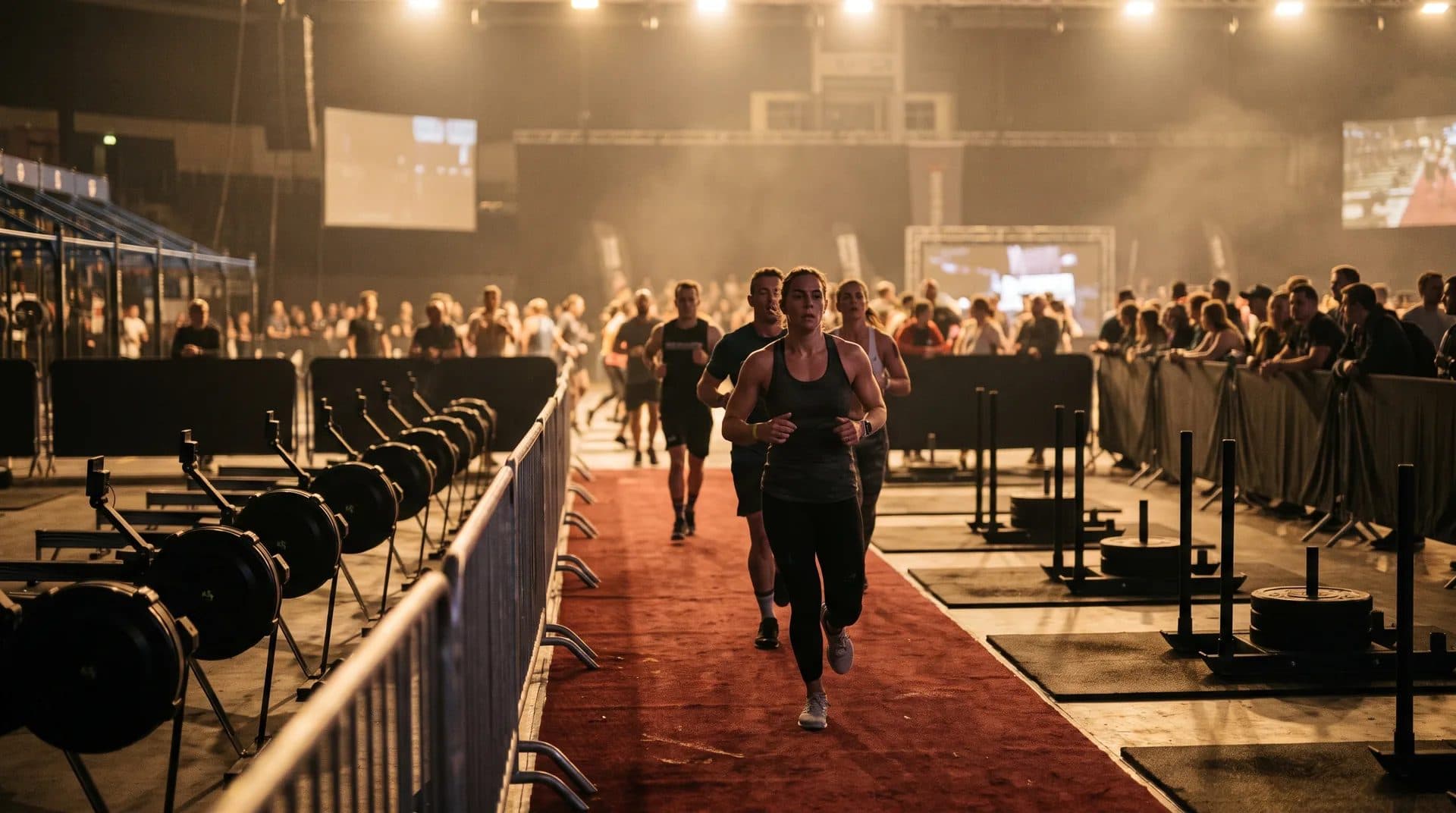
The Roxzone is the transition area between the HYROX running course and the eight workout stations, and every second you spend in it counts towards your finish time. There is no separate timer, no marshal telling you to hurry, and no split on the leaderboard that shames you afterwards. That is exactly why it costs most athletes so much: recreational racers spend almost 7 minutes in the Roxzone, while elite athletes get through it in under 4.
That gap, roughly 3 minutes, is the cheapest time saving available anywhere in HYROX. You do not need a bigger engine, a faster 10K, or heavier sled training to claim it. You need to know the zone exists, know what a good time through it looks like, and move with purpose every time you cross it.
This guide covers what the Roxzone is, why athletes call it the 9th station, average Roxzone times by finish-time bracket, and the specific habits that separate a 4-minute Roxzone from a 7-minute one.
Key Takeaways
- The Roxzone is the transition zone between runs and stations; the clock never stops while you are in it.
- It adds roughly 700 to 800 metres of extra floor to cover across a race, depending on the venue.
- Recreational athletes (1:30+ finishers) average 6:58 total Roxzone time; elites get through in 3:41, per HyroxDataLab’s analysis of 825 race results.
- The fix costs nothing: jog every transition, know the floor plan, and plan your fuelling so you never stand still.
- The Kracey HYROX Pace Calculator builds a realistic Roxzone budget into your goal-time plan, alongside your run and station splits.
What Is the Roxzone in HYROX?
Every HYROX race alternates eight 1km runs with eight workout stations . The Roxzone is the marked area that connects the two: when you finish a run, you pass through the Roxzone to reach your station, and when you finish the station, you pass through it again to rejoin the running course. Sixteen crossings in total, two per station.
Each individual crossing is short, typically 10 to 30 metres with a turn or two. Added up across the whole race, the Roxzone puts roughly 700 to 800 metres of extra floor under your feet on top of the 8km of running, with the exact layout varying by venue. Rox Lyfe estimates the average at around 800 metres across events.
The defining feature of the Roxzone is psychological, not physical. Because it sits between the timed-feeling efforts, it reads as neutral ground. It feels like the corridor between rooms, a place to catch your breath, adjust your grips, find your bearings. It is none of those things. It is race course. The athletes who treat it as race course finish minutes ahead of the athletes who treat it as a break.
Why the Roxzone Is Called the 9th Station
HYROX athletes call the Roxzone the 9th station because the time it swallows is comparable to a full station split. Look at the numbers: a mid-pack athlete spends 5 to 7 minutes in the Roxzone across a race. That is more than most athletes spend on the sled push, the sled pull, or the farmer’s carry. If the Roxzone had its own line on the results page, it would rank among your longest stations.
The difference is that every real station has a floor on how fast it can go. A 1,000m row takes what it takes. The Roxzone has almost no floor. The gap between a sloppy Roxzone and a sharp one is pure habit, which makes it the highest-leverage few minutes in the sport.
The maths is simple. HyroxDataLab’s venue analysis found recreational athletes average 52 seconds per transition against 28 seconds for elites. That 24-second gap, multiplied across 8 transitions, is 3 minutes and 12 seconds. No fitness required. For context on what 3 minutes does to your placing, see the average HYROX times by division : in the crowded middle of the Open field, 3 minutes can move you past hundreds of athletes.
Average Roxzone Times: What Good Looks Like
The most useful public dataset comes from HyroxDataLab , which analysed 825 complete race results from the Utrecht venue. Total Roxzone time scales cleanly with finish time:
| Finish-time bracket | Total Roxzone time | Per transition | Share of race time |
|---|---|---|---|
| Elite (sub-1:10) | 3:41 | 28 seconds | 5.5% |
| Advanced (1:10 to 1:20) | 4:33 | 34 seconds | 6.0% |
| Intermediate (1:20 to 1:30) | 5:19 | 40 seconds | 6.3% |
| Recreational (1:30+) | 6:58 | 52 seconds | 6.8% |
The combined average across the field was 6:08 total (5:57 for men, 6:34 for women). Two things stand out in that table. First, nobody skips the Roxzone: even elites give it three and a half minutes. Second, the share of race time rises as finish times get slower, which means slower athletes are losing time twice, once through pace and again through transitions.
Rox Lyfe’s leaderboard analysis of the best performances ever recorded points in the same direction: elite men totalled around 2:54 in the Roxzone and elite women around 3:47, while comparable average athletes (around the 90-minute mark) took 6:58 and 6:12. Their rule of thumb is worth remembering: your total Roxzone time should sit at roughly 75 to 90% of your average 1km run split. Average male athletes in their sample sat at 131%, which is a polite way of saying they walked it.
Set your target from the table above using the bracket you are racing for, not the one you are currently in. Chasing sub-1:30? Budget around 5 minutes of total Roxzone time, roughly 40 seconds per transition, and treat anything over that as time you donated.
Where the Time Actually Goes
Nobody plans to spend 7 minutes in the Roxzone. It accumulates in ways that feel individually harmless:
Walking instead of jogging. The single biggest leak. A slow walk over 800 metres of accumulated Roxzone distance takes roughly twice as long as an easy jog, and the recovery benefit of standing-height walking over slow jogging is smaller than it feels. Our HYROX race strategy guide makes the same point about the race overall: walking transitions can cost 4 to 6 minutes of total race time.
Hesitation and navigation. Arriving at the zone without knowing where your station entrance is, scanning for signage, doubling back after a wrong turn. Seconds per crossing, minutes per race.
Kit faff. Stopping to put on gloves for the sled pull, adjusting grips, re-tying laces. None of it is banned; all of it is expensive when done standing still in the zone.
Standing recovery. Hands on knees after the burpee broad jumps, a pause to “reset” after the wall balls start looming. The clock does not pause with you.
Queueing and congestion. In busy heats the zone gets crowded. Athletes who drift with the crowd inherit the crowd’s pace; athletes who pick a clean line through keep their own.
How to Cut Your Roxzone Time: Six Habits
1. Jog every metre, without exception
The rule is binary and it is the same one that governs the rest of your race: move at a jog, never a walk, never a standstill. An easy jog keeps your heart rate in a working zone, which actually makes the next station start feel smoother, and it is dramatically faster over 16 crossings. If you genuinely cannot jog, walk with urgency. The Roxzone is a moving rest, not a standing one.
2. Learn the floor plan before the gun
Most organisers publish the venue layout in advance, and you can usually walk the floor before your start time. Know where each station entrance sits relative to the running course exit, and which direction you turn after each station. Fold it into your race week routine alongside your kit and fuelling prep. Athletes who know the floor never donate seconds to signage.
3. Decide your kit before race day
If you use gloves or grips for the sled pull and farmer’s carry, decide that in training and rehearse where they live and when they go on, ideally while jogging. Race day is not the moment to discover you cannot get a glove on with a sweaty hand while standing in the middle of the zone.
4. Fuel on the move, at planned crossings
If your race runs long enough to need gels, assign each one to a specific transition in advance (before Run 4 and before Run 7 are common choices) and take it while moving through the zone. A gel taken on the jog costs nothing; a gel taken standing next to the kit table costs 20 seconds, three times a race.
5. Exit stations rolling
The transition starts before the station ends. Plan your last reps so you finish moving: come off the final wall ball already turning towards the exit, stand tall out of the sled push instead of hanging on the sled, and settle your breathing with a rhythm you can jog to after the burpee broad jumps. The habit of easing out slowly is where “just a few seconds” quietly becomes a minute.
6. Train transitions the way you train stations
The reason athletes stand still in the Roxzone is that their training never taught their body to start a station straight off a run. Transition training fixes both the fitness and the habit: run 1km at your target pace from our HYROX pacing guide , then move directly into station work without a rest, jogging the gap in between. Do that weekly and race-day transitions stop feeling like emergencies.
Take Chris, a 1:41 finisher at his first race in Birmingham. His watch told the story afterwards: over 8 minutes accumulated between the run course and the stations, most of it walking and one full minute lost looking for the sled lanes. Before his second race he walked the venue in the morning, committed to jogging every crossing, and moved his gel to the Run 4 transition. His Roxzone total came down by around 3 minutes, and his finish time dropped to 1:38 on essentially the same fitness.
Budget the Roxzone Like a Station
The final step is planning. Most athletes build a race plan with eight run splits and eight station splits, then wonder why race day comes out 5 minutes slower than the plan. The plan was missing its 9th station.
The Kracey HYROX Pace Calculator fixes this: give it your goal finish time and division, and it produces segment-by-segment targets that include a realistic Roxzone budget alongside your run paces and station splits. That does two things. It makes your run and station targets honest, because they no longer have to absorb hidden transition time. And it gives you a number to race against in the zone itself, which is exactly what turns “move with purpose” from advice into a target.
If you are still deciding what finish time to plan for, run your numbers through the HYROX Finish Time Predictor first, then let the pace calculator break it into segments.
FAQ
What is the Roxzone in HYROX?
The Roxzone is the transition area between the HYROX running course and the workout stations. You pass through it 16 times in a race, twice per station, and all of that time counts towards your finish time. Across a full race it adds roughly 700 to 800 metres of extra floor to cover, depending on the venue layout.
How long should the Roxzone take?
Set your target by your goal bracket. In HyroxDataLab’s analysis of 825 results, elite athletes (sub-1:10) totalled 3:41 in the Roxzone, advanced athletes (1:10 to 1:20) 4:33, intermediate athletes (1:20 to 1:30) 5:19, and recreational athletes (1:30+) 6:58. A useful rule of thumb from Rox Lyfe: your total Roxzone time should be roughly 75 to 90% of your average 1km run split.
Does Roxzone time count towards my HYROX finish time?
Yes, fully. There is no separate transition timer and no neutralised time anywhere in a HYROX race. The clock runs from the start gun to the final wall ball, including every second you spend walking, fuelling, or catching your breath in the Roxzone.
Why is the Roxzone called the 9th station?
Because the time it takes is comparable to a full workout station. A mid-pack athlete spends 5 to 7 minutes in the Roxzone across a race, longer than most athletes spend on the sled push or farmer’s carry. Treating it as a station, with its own target time in your race plan, is the mindset shift that shrinks it.
Can I walk in the Roxzone?
You can, and there is no rule against it, which is exactly why it is tempting. But walking is the main reason average athletes give up 3 minutes or more to efficient ones. Jog every crossing at an easy pace; if you need to recover, recover at a jog rather than a standstill.
How do I train to be faster through the Roxzone?
Train transitions, not just stations. Run 1km at race pace, jog straight to your equipment, and start the station without a rest, replicating the race sequence. Add a venue walk on race morning, pre-assign your gels to specific transitions, and rehearse any glove or grip changes on the move. None of it requires extra fitness, which is why the Roxzone is the fastest free time saving in HYROX.
The Cheapest Minutes You Will Ever Save
Every other improvement in HYROX costs training time: faster runs, stronger sleds, bigger engine. The Roxzone is the exception. The 3-minute gap between a recreational transition and an elite one is a set of habits, available to anyone, starting at your next race.
Know the zone. Jog every metre of it. Give it a budget like any other station, and hold yourself to the number.
Build that budget now with the HYROX Pace Calculator , which turns your goal time into run, station, and Roxzone targets you can actually race against. And if you want the preparation handled, Kracey coaches it in Telegram and counts the roxzone as race time from week one, so the 9th station is one you have already practised.