
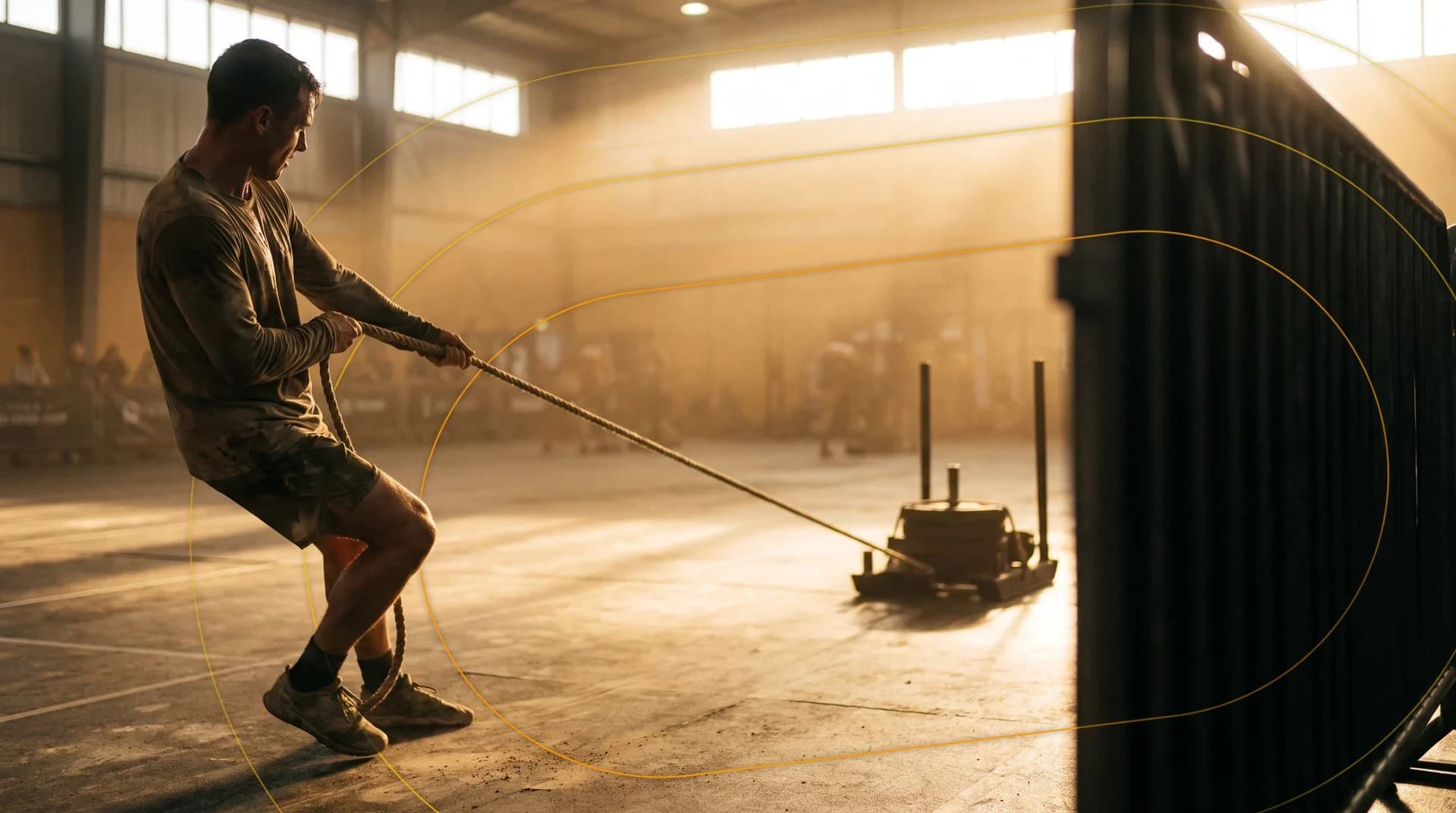
The HYROX sled pull is Station 3 of the eight HYROX workout stations , where you drag a loaded sled 50 metres across HYROX carpet using a rope, covering 4 x 12.5m lengths. Men Open pull 103kg (sled included), Women Open pull 78kg, and the station tests your lats, grip, and posterior chain harder than any other in the race.
It is the station most athletes underestimate. Not because it is the heaviest, but because the grip and posterior chain fatigue it creates follows you into Rowing (Station 5) and the Farmer’s Carry (Station 6). What you spend at Station 3 you will pay back with interest later. Train it deliberately, pace it conservatively, and you will bank time across the entire back half of your race.
Key Takeaways
- Men Open pull 103kg, Women Open 78kg, Men Pro 153kg across 4 x 12.5m for 50m total
- The walk-back drag technique is the most race-efficient method for most athletes at most divisions
- Grip fatigue from the HYROX sled pull directly impacts your Rowing and Farmer’s Carry performance, budget it accordingly
- HYROX carpet creates noticeably more friction than standard gym turf; train 10-15% heavier than race weight to compensate
- Athletes without sled access can replicate the stimulus using band pull-throughs, lat pulldowns, seated cable rows, and loaded carries
What Is the HYROX Sled Pull? Station Rules and Weights
The sled pull is the third workout station in a HYROX race. You arrive after completing 3km of running, the SkiErg (Station 1), and the Sled Push (Station 2). Your aerobic system is already working hard. Your legs have absorbed the push. Now you are picking up a rope and dragging weight toward you.
The station format is simple: you stand in a 2-metre work box, grab the rope attached to the loaded sled, and pull the sled from 12.5 metres away until it fully crosses your line. You then walk the rope back out, reposition, and repeat. Four lengths, 50 metres total.
Official HYROX Sled Pull Weights by Division
| Division | Total Weight (sled included) |
|---|---|
| Women Open | 78kg |
| Men Open | 103kg |
| Women Pro | 103kg |
| Men Pro | 153kg |
| Mixed Doubles (each athlete) | 103kg |
The Centr Competition Power Sled weighs approximately 50kg as a base unit. All additional weight plates are added on top to reach the division total. These weights are consistent across HYROX races globally.
The Rules You Cannot Afford to Break
Stay in your 2-metre box. You must remain within the athlete work area for the duration of the station. Stepping outside results in a time penalty.
Keep the rope inside your box. The rope must not trail outside your designated area. Manage pile-up as you pull or you risk a penalty.
The sled must fully cross the 12.5m line. If it is not fully over the line, the length does not count. Do not cut corners on the last pull of each length when your grip and back are screaming.
You must remain standing. Current HYROX rules specify athletes must pull from a standing position. Seated or kneeling pulling is not permitted and results in a penalty.
Rule accuracy note: Station regulations are updated between seasons. Always verify the current official rules at hyrox.com before your race.
Muscles Worked: What the HYROX Sled Pull Actually Trains
The sled pull is a posterior-chain dominant station, which makes it the natural complement to the sled push . Where the push hammers your quads, glutes, and anterior drive muscles, the pull loads the pulling chain: lats, biceps, forearms, and grip.
That complementarity is why the two are worth training as one unit rather than as two separate stations. With the 1km run between them they form a block of roughly 10 to 11 minutes, and the seam between them is where most front halves quietly fall apart: the push leaves your legs unable to brace for the pull, and the pull leaves your grip compromised for the farmers carry at station 6. The sled push guide sets out the block session that trains the pair together.
Primary muscles:
- Latissimus dorsi, the primary engine of every pull. Wide lats absorb load through horizontal rowing patterns and are the difference between controlled pulls and grinding, hunched desperation
- Biceps, under load on every hand-over-hand rep
- Forearm flexors and grip, the limiting factor for most athletes, especially as the race progresses
Secondary muscles:
- Hamstrings and glutes, activated heavily in hip drive and walk-back technique
- Spinal erectors, working isometrically to keep your torso braced throughout
- Core, stabilises the transfer of force from legs to rope on every pull
This is why grip training is not optional for HYROX. Your forearms are not just supporting the sled pull, they are supporting every grip-intensive station in the race. Fatigue that accumulates here is cumulative, not isolated. That connection matters when you are planning your HYROX training plan : the sled pull cannot be programmed in isolation. It belongs inside a session that reflects what comes before and after it on race day.
The 3 HYROX Sled Pull Techniques (and Which to Choose)
Most athletes arrive at Station 3 with a vague plan: grab rope, pull hard, finish. The athletes who lose time there are not always the weakest, they are often the ones who chose the wrong technique for their strength profile, or who went so hard in the first two lengths that their grip gave out by the third.
Here are the three main techniques and one hybrid approach that most competitive athletes settle on after a season or two.
Standing Hand-Over-Hand Pull
You stand in your box and pull the rope hand-over-hand, arms doing the majority of the work. Feet are relatively fixed, body acts as a stable anchor, and the lats and biceps drive every rep.
Best for: Athletes with strong lats and high grip endurance, typically those with a rowing, gymnastics, or rock climbing background.
Grip cost: High. This method creates the most forearm fatigue of any technique.
Leg cost: Low. Good if your legs are already damaged from the push.
Watch out for: Hunching forward as fatigue builds. Rounding the thoracic spine under sustained lat load is common and costs you both power and injury resilience.
Hip Drive Pull
You set up in a hip-hinge position, soft bend in the knees, hips back, load the posterior chain, then extend the hips explosively to initiate each pull, following through with the arms.
Best for: Athletes with strong glutes and hamstrings, particularly those from a CrossFit, weightlifting, or kettlebell background.
Grip cost: Medium. The hip drive offloads some demand from the forearms by generating power from a larger muscle group.
Leg cost: Medium. This asks more from the posterior chain, so if your glutes and hamstrings are cooked from the push, use this method carefully.
Watch out for: Losing the hip-hinge as fatigue sets in and defaulting to a pulling-only pattern that defeats the purpose.
Walk-Back Drag
You grip the rope with both hands, brace your core, and step backward, using your body weight and leg drive to move the sled. Rather than standing still and pulling, you are constantly creating displacement.
Best for: The majority of HYROX athletes, especially in heavier divisions or for athletes who prioritise energy conservation. This method distributes load more evenly across the whole body.
Grip cost: Medium to low. Your hands are maintaining tension rather than generating force through dynamic pulls, which spares the forearms.
Leg cost: Medium. You are walking backward, so there is leg involvement, but it is steady-state rather than explosive.
Watch out for: Poor rope management. If the rope pile-up behind you gets tangled, you will trip. Look back periodically and manage slack as you go.
The Hybrid Technique, What Most HYROX Athletes Should Use
Experienced HYROX athletes often default to a hybrid: initiate each pull with a hip drive to get the sled moving (static friction is highest at the start), then transition into a walk-back rhythm to sustain momentum across the 12.5m length. At the halfway point of each length, short hand-over-hand bursts can re-accelerate the sled if it slows.
This approach spreads the load, protects grip, and uses your biggest muscles for the hardest part of each length, getting the sled moving from dead stop.
Which Sled Pull Technique Should You Use?
| Your Strength Profile | Recommended Technique |
|---|---|
| Strong upper body, high pull endurance | Standing hand-over-hand |
| Strong posterior chain (glutes, hamstrings) | Hip drive pull |
| Prioritising energy and grip conservation | Walk-back drag |
| Mixed background, most HYROX athletes | Hybrid (hip drive start + walk-back) |
| Heavier division, later in training cycle | Walk-back drag or hybrid |
The right answer changes as you fatigue across the race. Many athletes use a more aggressive technique in lengths 1 and 2, then conserve with walk-back in lengths 3 and 4. Practise all of them so you can shift on the fly.
Race Day Strategy: How to Pace the HYROX Sled Pull
You are at Station 3. You have already run 3km, hit the SkiErg, and completed the sled push. Your heart rate is likely sitting between 165 and 180 beats per minute. The temptation is to attack the sled and prove a point.
Do not.
The Grip Budget Concept
Think of your grip as a finite currency for race day. You start with a full account. Every pulling station makes a withdrawal. The sled pull is a large transaction, but it is only the third of many.
After Station 3, your grip will be called upon again at:
- Station 5: Rowing, 1,000m of sustained handle grip under load
- Station 6: Farmer’s Carry, 200m with heavy dumbbells, the stage where most athletes’ grip finally fails
Athletes who attack the sled pull with maximum grip intensity consistently report their rowing splits deteriorating and their farmer’s carry technique breaking down. The connection is not coincidental.
A controlled, technique-led approach at the sled pull that saves 15% of grip capacity is worth far more than the 10 seconds you might gain by going harder there. Use the HYROX pace calculator to set an honest Station 3 target time, one that leaves you with enough grip and aerobic capacity to hold your splits through to Station 8.
The Carpet Friction Reality
HYROX carpet creates significantly more friction than the artificial turf or smooth gym floor most athletes train on. Multiple sources estimate the effective load increase is 20-30% greater than training conditions, depending on the venue surface and the sled’s base condition.
This is not an excuse, it is a training and pacing target. If you are preparing for a race, you should be training at 10-15% above race weight to calibrate your effort. If you arrive at race day having only ever pulled exactly race weight on gym turf, the first length on carpet will feel like a different exercise.
Rope Management
Two practical habits that cost athletes time at this station:
Eliminate slack before you pull. Walk the rope taut before your first pull on each length. A slack rope on the first pull wastes energy and creates a snapping load that spikes grip demand.
Manage the pile-up. As you walk back, rope collects behind you. Keep it roughly in front of your feet and to one side. A tangled rope pile does not just risk a trip, it can cause you to pull rope rather than sled for a half-second per rep, which adds up.
HYROX Sled Pull Time Targets
Based on aggregate race data, here are approximate target times for the sled pull station:
| Division | Target Time |
|---|---|
| Women Open (78kg) | 3:00-4:30 |
| Men Open (103kg) | 3:30-5:00 |
| Women Pro (103kg) | 2:30-3:30 |
| Men Pro (153kg) | 4:00-6:00+ |
If you are finishing well outside the upper range of these targets, the issue is usually one of three things: grip failure, technique breakdown, or starting too fast and blowing up on length 3. Not sure what time to target overall? Use the HYROX finish time predictor to work backwards from your goal finish and set realistic splits for every station, including the sled pull.
How to Train for the HYROX Sled Pull
With a Sled: Progressive Training Block
If you have access to a sled (many commercial gyms, CrossFit affiliates and independent gyms now carry one), structure your sled pull training in three phases aligned to a 12-week race prep block.
Phase 1, Technique (Weeks 1-4) Focus: Build movement pattern at moderate load. Do not chase weight.
- 4 x 12.5m at 60-70% race weight
- Full rest between lengths (90 seconds)
- Practise all three technique variations
- Always run 1-2km immediately before and after sled work to simulate race context
- 1 dedicated sled session per week
Phase 2, Load (Weeks 5-8) Focus: Progressive overload above race weight to account for carpet friction.
- 4-6 x 12.5m at 110-115% race weight
- Rest: 60 seconds between lengths
- Commit to your chosen technique and make it automatic
- Add one grip-specific finisher: 2 x 45-second dead hangs or 2 x 40m farmer’s carry
- 1-2 sled sessions per week
Phase 3, Race Simulation (Weeks 9-12) Focus: Replicate race fatigue. The sled pull should never be done fresh in this phase.
- Run 3km at race pace, complete 3-4 minutes of SkiErg work, then go directly into 4 x 12.5m at race weight
- No rest beyond the transition itself
- Track your time, you want consistent splits, not a fast first length and a crawl to the finish
- 1 race-simulation session per week; preserve recovery for your full race simulations
Without a Sled: Full Gym Alternative Programme
Most UK commercial gym athletes do not have regular sled access. The good news is that the movement pattern, horizontal pulling under load, with grip endurance as the limiter, is highly replicable with standard kit.
Primary substitutes:
| Exercise | What It Replicates | Sets / Reps |
|---|---|---|
| Seated cable row (heavy, low reps) | Lat-dominant horizontal pull | 4 x 8-10 at heavy load |
| Band pull-throughs | Hip drive pattern + posterior chain engagement | 3 x 15 |
| Lat pulldown | Lat endurance under sustained load | 3 x 12-15 moderate weight |
| Rope climb / rope pull (if available) | Closest full-body replication of rope-based pulling | 4-6 ascents or 3 x 30-second pulls |
| Farmer’s carry | Grip endurance pre-fatigue | 4 x 40m, heavy |
| Dead hang | Grip capacity development | 3 x max hold (target 45-60 seconds) |
| Bent-over barbell row | Lat and posterior chain strength | 4 x 6-8 heavy |
No-sled weekly session structure (45 minutes):
- 2km run at race pace
- 4 x 8 seated cable rows (heavy), 60-second rest
- 3 x 15 band pull-throughs, 45-second rest
- 4 x 40m farmer’s carry (heavy dumbbells), 90-second rest
- 3 x max dead hang, full recovery between sets
- 1km run at race pace
Run immediately after this session if time permits. The goal is to replicate the compromised grip and elevated heart rate context of race day, not to train the sled pull in isolation as a pure strength exercise.
Grip-specific add-ons (add to any training session):
- Wrist roller: 3 x full up-and-down cycles
- Rice bucket squeezes: 3 x 60 seconds (DIY: bucket of uncooked rice, open-and-close grip)
- Plate pinches: 2 x 30 seconds per hand
The exercises above build the raw capacity. But the sled pull does not exist in a vacuum, it sits inside a race that demands running fitness, hybrid strength, and smart periodisation across all eight stations. If you want this work built into a full structured block, the Kracey HYROX coach will programme every session around your race date, available kit, and current fitness level, including the sled-specific work above, sequenced correctly.
FAQ: HYROX Sled Pull
How much does the HYROX sled pull weigh?
The total weight, including the sled base, is: Women Open 78kg, Men Open 103kg, Women Pro 103kg, Men Pro 153kg, and Mixed Doubles 103kg per athlete. The Centr Competition Power Sled base weighs approximately 50kg, with plates added to reach division weight.
What muscles does the HYROX sled pull work?
The sled pull primarily targets the latissimus dorsi, biceps, and forearm flexors (grip). Secondary muscles include the hamstrings, glutes, core, and spinal erectors. It is a posterior-chain dominant exercise and the direct complement to the quad-dominant sled push.
Can you stand up during the HYROX sled pull?
Yes, you must remain standing. According to current HYROX rules, athletes are required to pull from a standing position. Seated or kneeling pulling is not permitted and results in a time penalty. Some older articles state the opposite; always check the current rules at hyrox.com before race day.
How do I train for the sled pull without a sled?
Use seated cable rows, lat pulldowns, band pull-throughs, bent-over rows, and farmer’s carries to replicate the movement demands. Add dead hangs and grip-specific work to build the forearm endurance that is usually the limiting factor. Always train with elevated heart rate by running before and after these sessions.
Why does the sled pull feel harder at a race than in training?
Two reasons: HYROX carpet creates more friction than standard gym turf (effectively increasing the load by an estimated 20-30%), and you arrive at Station 3 already fatigued from 3km of running, SkiErg, and the sled push. Training the sled pull fresh on gym turf at exactly race weight does not replicate these conditions. Train heavier than race weight, and always train it under pre-fatigue.
How does the sled pull affect the rest of my HYROX race?
The grip and lat fatigue generated at Station 3 directly impacts your rowing (Station 5) and farmer’s carry (Station 6) performance. Athletes who go too hard at the sled pull consistently see splits deteriorate at both of those stations. Pace Station 3 conservatively, protect your grip, and you will have more capacity in the back half of the race where time gaps are largest.
Conclusion: Master Station 3, Protect the Rest of Your Race
The HYROX sled pull rewards athletes who plan for it rather than just survive it. Get the technique right, use the hybrid walk-back approach for most lengths, save the aggressive hand-over-hand for moments when the sled is already moving. Treat your grip as a race-long resource, not a station-by-station expense. And account for carpet friction: train heavier than race weight so race day feels like training, not a surprise.
For athletes without sled access, the no-sled protocol above will build the lat strength, grip endurance, and posterior chain capacity you need. Add it to your training two to three times per week alongside your running and you will arrive at Station 3 ready to move efficiently and conserve what you need for the back half.
The stations after the sled pull are where HYROX races are won and lost. The way you manage Station 3 determines how much you have left for them.
Use the HYROX pace calculator to build your race splits around your sled pull target time, or predict your HYROX finish time based on your current running fitness. When you are ready for a full structured block, start your 14 free days with Kracey and it will programme the sled work around your race date, your kit and the days you train.