
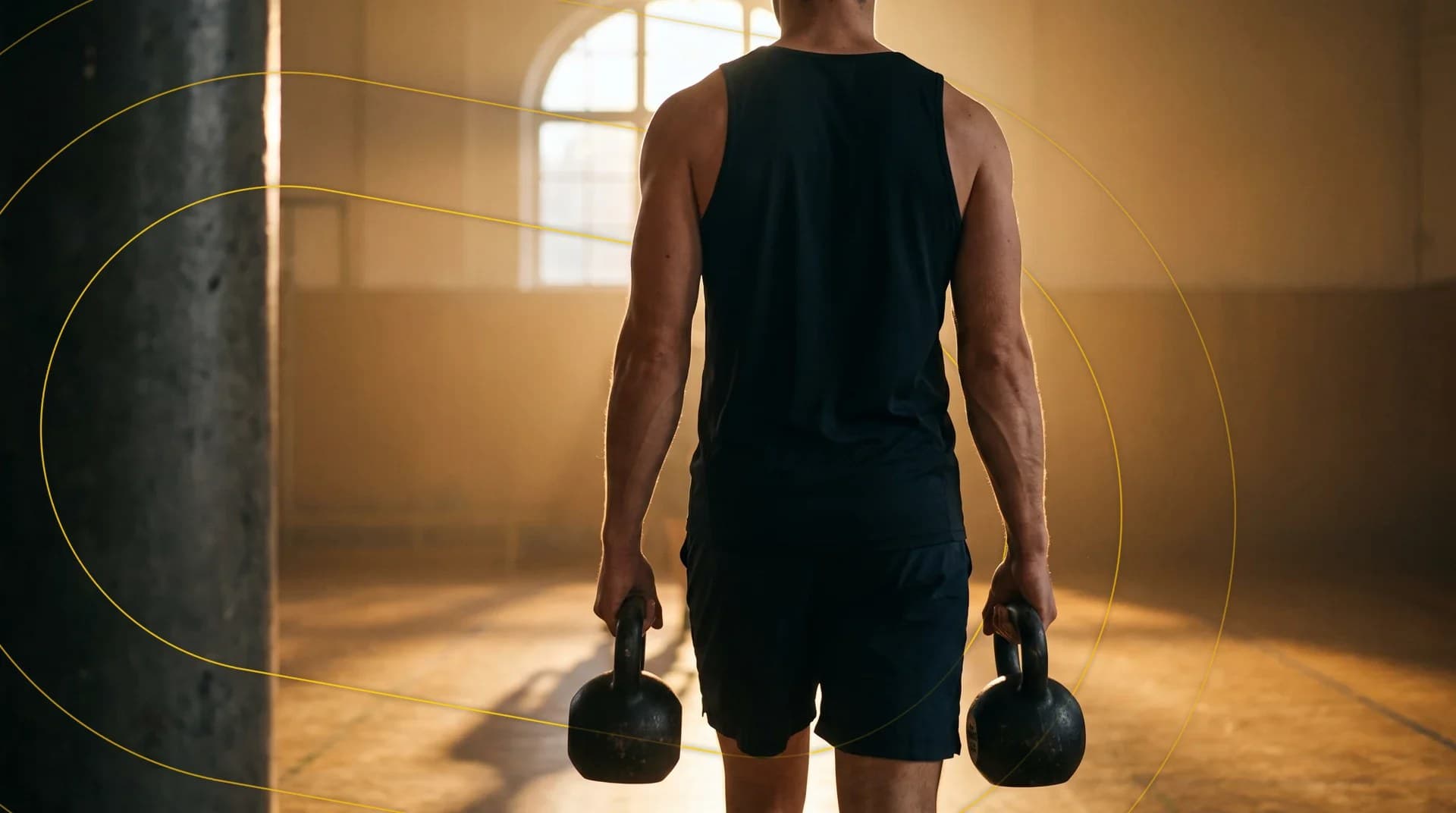
The HYROX farmers carry is Station 6 of 8, where you carry a kettlebell in each hand for 200 metres across the HYROX carpet. Open Men carry 2 x 24kg, Open Women 2 x 16kg, Pro Men 2 x 32kg and Pro Women 2 x 24kg. It looks like the simplest station on paper, and it is the one that quietly wrecks your grip for everything that follows.
Here is what most first-timers get wrong. They treat the carry as a leg station and march off fast, only to drop the bells at 120 metres with forearms on fire. The farmers carry is a grip and trap endurance test, not a leg test. Your legs can walk 200 metres all day. Your hands cannot hold that load without a plan.
This guide covers the exact weights by division, the technique that keeps your grip alive, how to pace the carry on race day, and how to train it whether or not you own a set of heavy kettlebells. Want to know how the whole race stacks up first? Our HYROX workout stations guide walks through all eight in order.
Key Takeaways
- The farmers carry is Station 6: a 200m carry with a kettlebell in each hand, straight after the 1000m row.
- Weights: Open Men 2 x 24kg, Open Women 2 x 16kg, Pro Men 2 x 32kg, Pro Women 2 x 24kg.
- The limiter is grip and trap endurance, not your legs. Plan your carry around your hands.
- There is no penalty for setting the bells down, so a planned break beats an unplanned grip failure.
- Median times sit around 2:02 for Open Men and 2:10 for Open Women, so a sub-2:00 carry is a genuinely strong split.
What Is the HYROX Farmers Carry? Station Rules and Weights
The HYROX farmers carry is a 200m loaded carry performed with one kettlebell in each hand. It is the sixth station in the race, sitting between the 1000m row (Station 5) and the sandbag lunges (Station 7). You pick the bells up, walk 200 metres across the carpet in a lane, and set them down at the finish line. That is the whole station, and its simplicity is exactly why athletes underestimate it.
The weights are fixed by division:
| Division | Weight per hand | Total load |
|---|---|---|
| Open Men | 24kg | 48kg |
| Open Women | 16kg | 32kg |
| Pro Men | 32kg | 64kg |
| Pro Women | 24kg | 48kg |
There is no rep count and no movement standard to hit beyond covering the distance with the bells in your hands. Crucially, there is no penalty for resting. You can set the kettlebells down as many times as you like, pick them back up, and carry on. That single rule shapes the entire strategy for this station. For the full weight list across all eight stations, see our HYROX weights guide .
Muscles Worked: What the Farmers Carry Actually Trains
The farmers carry hammers your grip, forearms and traps, with your core and upper back working hard to keep you upright and stable. Your legs contribute, but they are rarely the reason you have to stop. The load hangs from your fingers, travels up through your forearms into your traps, and asks your core to resist the pull of two heavy weights trying to drag you sideways with every step.
This is why grip is the story of the station. By Station 6 your forearms have already survived the sled pull rope (Station 3) and 1000m of rowing (Station 5), both grip-intensive. You arrive at the kettlebells with a partly-drained tank, which is why a carry that feels easy in training can fail on race day. Training the specific endurance of your grip, not just its max strength, is what holds up under that accumulated fatigue.
Technique: How to Carry Without Losing Your Grip
Good farmers carry technique keeps the load in your fingers and your posture tall, so your grip lasts the full 200 metres. Get the setup and the walk right and you can turn a station most people fear into one of your steadier splits.
Grip the bells high in the fingers, then hook. Let the handle sit across the top of your palm where the fingers meet it, and grip firmly without white-knuckling. A death grip from the first step burns your forearms early. Squeeze only as hard as you need to hold on.
Stand tall and brace. Pull your shoulders back and down, lift your chest, and brace your core as if bracing for a light punch. Rounding forward under the load shifts the work onto your lower back and shortens your grip endurance. Tall posture keeps the traps engaged and the spine safe.
Take short, quick steps. A fast, choppy cadence keeps the bells stable and stops them swinging into your legs. Long strides let the weights sway, which forces your grip to fight the momentum and wastes energy.
Breathe deliberately. Keep breathing steady and rhythmic. Holding your breath under load spikes your heart rate, and you have a 1km run waiting on the far side of this station.
Consider Marcus, a strong gym-goer from Manchester who deadlifts 200kg. He assumes the 24kg bells will be trivial and sprints the first 100m of his farmers carry. His grip gives out at 130m, he drops the bells, and the panic of re-gripping under a racing heart rate costs him a full 30 seconds and a messy transition into Run 7. Strength is not his problem. Grip endurance under fatigue is.
Race Day Strategy: How to Pace the HYROX Farmers Carry
The best farmers carry strategy is to walk at a controlled, unbroken pace if your grip can hold it, and to plan one break rather than risk an unplanned collapse. Because there is no penalty for setting the bells down, a deliberate mid-carry rest is a smart tool, not a failure.
Come out of the row and pick the bells up with intent, but do not charge. Settle into your short-step cadence in the first 20 metres and lock in your posture. If you have trained the carry unbroken, aim to cover all 200 metres in one go at a brisk walk. That is almost always the fastest option, because every set-down and re-grip costs three to five seconds and a heart-rate spike.
If your grip is a known weakness, plan a single break at around the 100m or 120m mark before your forearms fail. Set the bells down, shake your hands out for two seconds, re-grip, and finish. A planned break at 120m is faster than an emergency drop at 150m, because you stay calm and re-grip cleanly. The mistake is holding on past the point of control until the bells slip and you lose 30 seconds gathering yourself.
Remember what comes next. After the carry you run 1km, then face the sandbag lunges, so do not empty your legs sprinting the walk. Then you can use our HYROX pace calculator to see how a steady carry protects the run split that follows it.
How to Train for the HYROX Farmers Carry
Train the farmers carry by building grip endurance and loaded-carry capacity two to three times a week, using kettlebells, dumbbells, or even a trap bar if that is what you have. You do not need the exact race bells to build the right qualities, you need progressive time under load.
If you have kettlebells or dumbbells:
- Distance carries: Load close to your race weight and carry for 200m, replicating the station. Progress by adding a set or shaving rest.
- Heavy short carries: Go heavier than race weight for 40 to 60m to build raw grip strength. Two hands per side if needed.
- Post-fatigue carries: Row 500m or 1000m first, then carry immediately. This trains the exact fatigued-grip state you meet on race day, which is the gap most athletes miss.
If you train at home or with minimal kit:
- Dead hangs: Hang from a pull-up bar for time. Accumulate two to three minutes total across sets. This is the single best low-kit grip builder.
- Loaded carries with anything heavy: Water containers, a loaded rucksack in each hand, or a single heavy bag carried suitcase-style for distance.
- Farmer holds: Simply hold your heaviest available weights and stand for 45 to 60 seconds to build static grip endurance.
Because the carry sits deep in the race behind the sled pull and the row, general posterior-chain and grip strength pays off across multiple stations at once. Our strength exercises for runners guide covers the grip and back work that supports the whole back half of a HYROX. A HYROX coach in Telegram folds station-specific carry work into your running build so the two develop together rather than in isolation.
FAQ
What is a good HYROX farmers carry time? A good farmers carry time is around 2:00 or faster. Based on race data from tens of thousands of athletes, the median is roughly 2:02 for Open Men and 2:10 for Open Women, so anything under two minutes is a strong split. Elite athletes complete the 200m unbroken in well under 1:40.
How heavy is the HYROX farmers carry? Open Men carry 2 x 24kg, Open Women 2 x 16kg, Pro Men 2 x 32kg and Pro Women 2 x 24kg, one kettlebell in each hand for 200 metres. The load is fixed by division and does not change between events.
Can I put the kettlebells down during the farmers carry? Yes. There is no penalty for setting the bells down and picking them back up. A single planned break is often smarter than risking an unplanned grip failure, though an unbroken carry at a controlled pace is usually the fastest option if your grip can hold it.
Why do my forearms fail on the farmers carry? Because the station is a grip endurance test, and you reach it with forearms already fatigued from the sled pull rope and the 1000m row. If your grip fails, the fix is specific grip endurance training (dead hangs and post-row carries), not more leg work.
How do I improve my grip for HYROX? Train grip endurance two to three times a week with distance carries at race weight, heavy short carries, and dead hangs. The most race-specific drill is carrying immediately after a hard row, which rehearses the exact fatigued state you meet at Station 6.
Conclusion: Respect Station 6, Protect Your Grip
The HYROX farmers carry rewards athletes who understand what it actually tests. You cannot simply power through it on leg strength. It is a grip and posture test that arrives when your forearms are already tired, and the athletes who handle it best carry tall, step short, and have a clear plan for their hands.
Get the weight right for your division, train your grip endurance in the fatigued state you will actually race in, and decide before the gun whether you are going unbroken or taking one planned break. Do that and the farmers carry becomes a steady, predictable split instead of the moment your race unravels.
Want the carry trained in the fatigued context you will actually race it in? Start your 14 free days with Kracey , or map your target splits with the HYROX time predictor so you know exactly where the farmers carry fits into your finish time.