
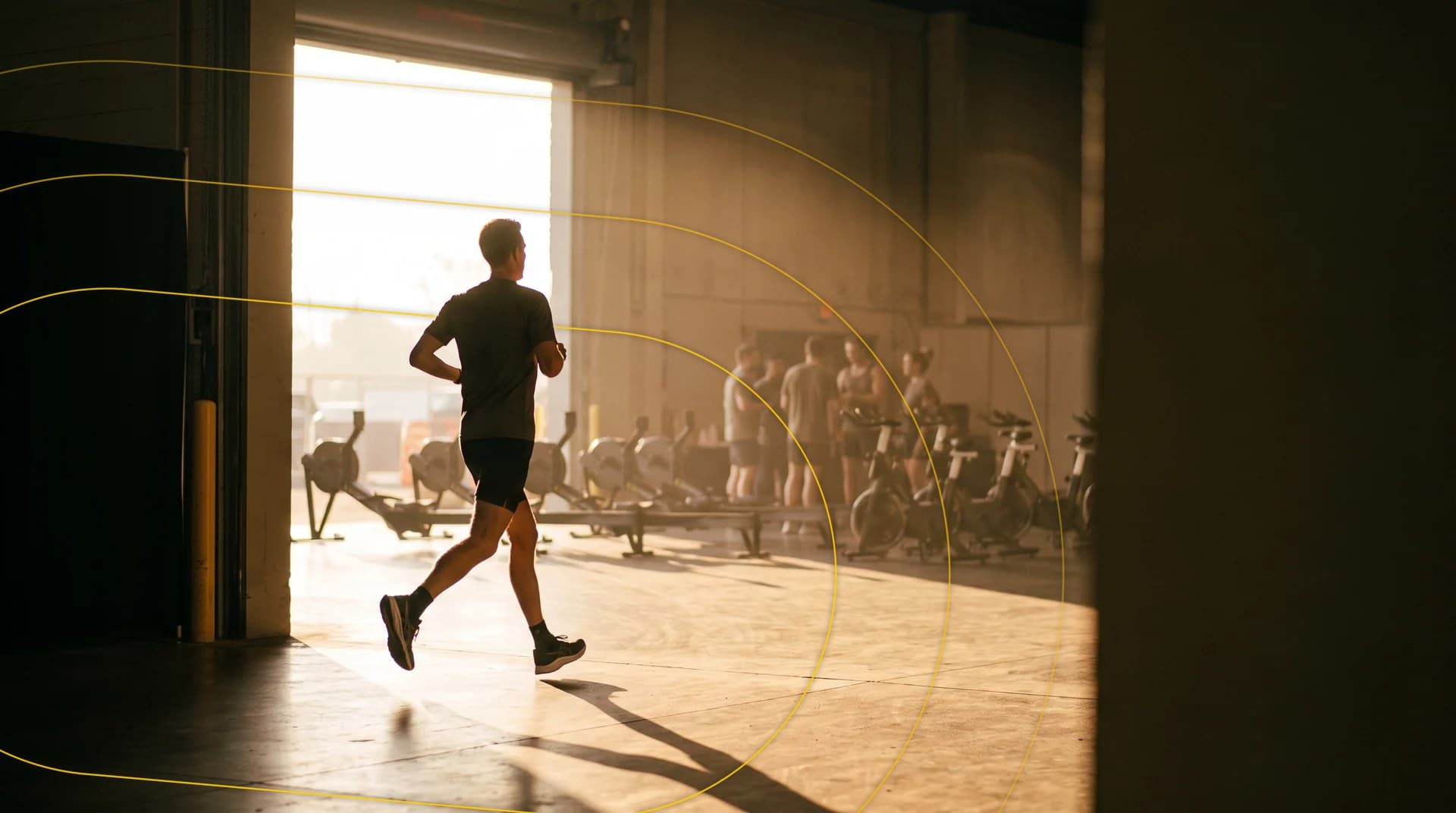
GYMRACE has no cut-off time. The series says so twice in its own FAQ , in the same two sentences each time: the average finish time is 1 hour 20 minutes, there is no cut-off time, and you may always finish your race. No marshal is going to stop your clock at a checkpoint and no station closes behind you.
That rule answers the question a first-timer is really asking. It is not whether the race is hard, because every hybrid race is hard. It is whether being slow at it is allowed, and here the organisers have written the answer down rather than leaving you to guess from a results page.
The 1:20 average is the second number worth planning against, and it is the one that tells you what shape the day has. Below is the whole race: the course in order, all nine stations with their published loads and movement standards, the 13 categories and what the weights do across them, what the no cut-off rule actually covers, and how GYMRACE lines up against HYROX. Every GYMRACE figure below comes from the series’ own race page , rulebook and FAQ.
Key Takeaways
- There is no cut-off time at GYMRACE, and the published average finish time is 1 hour 20 minutes.
- The course is five 1km runs and nine stations, closed out by a 50m sprint, so 5km of running in total.
- Runs one to four each lead into two stations. Run five leads into the burpee broad jumps and then the sprint finish.
- Thirteen categories are on sale across three entry formats, Solo, Buddies and Relay, with a stricter HEAVY tier alongside them.
- In the standard categories judges coach you through the movement standards. The HEAVY categories are judged strictly and are the only ones with prizes.
- Mixed Buddies and mixed Relay teams race at the men’s weights, and the women’s HEAVY loads are the same as the men’s standard loads.
- Missing a station, or not completing one to the movement standards, carries a 20-minute penalty rather than a disqualification.
- The minimum age is 16, and results are filtered into six age bands from 16-29 up to 70+.
What Is GYMRACE?
GYMRACE is a hybrid fitness race that alternates 1km runs with functional and machine stations inside large exhibition venues. It is run by the Mud Masters team, who have been putting on sports events in the Netherlands and Germany since 2012, and who ran the first indoor GYMRACE in 2019. The calendar has since grown past those two countries into London and Paris.
The race is one continuous effort against one clock, and it ends with a sprint rather than a station. You are timed from the start line to the finish line, your time goes up on the results page afterwards, and a chip worn around the ankle records it.
Two things separate it from the rest of the hybrid calendar, and neither is the station list. The first is the judging, which is split in two: in the standard categories the judges are there to coach you through a movement you have not perfected yet, while the HEAVY categories are run as strict competition. The second is that the series is openly uninterested in gatekeeping. Asked whether GYMRACE works for people who are not extremely fit, its own answer points them at the Buddies category and calls it the entry-level model.
The series states that it is not involved with organisations such as HYROX or CrossFit, while cheerfully recommending both as ways to get fit for it.
The GYMRACE Format: Five Runs, Nine Stations, One Sprint
The course never changes order. You run 1km, work through the stations in that round, then run again, and after the fifth run you finish with a 50m sprint. This table is the whole race from the start line.
| Round | Run | Then |
|---|---|---|
| 1 | 1km | Sled push, then 100 wall balls |
| 2 | 1km | 100m slam ball carry, then 1,000m row |
| 3 | 1km | 100 kettlebell swings to overhead, then 1,000m SkiErg |
| 4 | 1km | 100m dumbbell farmers lunges, then 2,000m BikeErg |
| 5 | 1km | 50m burpee broad jumps, then the 50m sprint finish |
Rounds one to four give you two stations each, and round five gives you one station and a sprint, so the race gets structurally lighter exactly where your legs are worst. The running comes to 5km, which GYMRACE describes on its own race page as 5,000 metres at tempo pace, and the organisers are blunt that it will feel longer than that after the stations.
Where the Running Actually Happens
The runs are not always indoors, and the event pages say which is which. Utrecht and Airport Weeze both list the running as outdoor, while Amsterdam RAI lists it as indoor. The number of laps per kilometre is published too, and it varies: two laps per kilometre at Utrecht in October 2026, one at Airport Weeze a week later.
A 1km leg run as two laps has twice as many turns as the same kilometre run in a single loop, and turns cost a runner more than distance does. Check the laps figure on your event page during race week rather than assuming the course you saw in a video is the one you will get.
The Nine GYMRACE Stations and Their Loads
There are nine stations and they are published with their weights per category. The table below carries the standard women’s and men’s loads exactly as GYMRACE prints them in its weights overview, with the work taken from the rulebook.
| # | Station | The work | Women / Men |
|---|---|---|---|
| 1 | Sled Push | 4 x 12.5m, 50m in total | 100kg / 150kg |
| 2 | Wall Balls | 100 reps to a 2.7m target for women, 3m for men | 4kg / 6kg |
| 3 | Slam Ball Carry | 100m, held in front of the body | 20kg / 35kg |
| 4 | Row | 1,000m, resistance set to 5 | No load |
| 5 | Kettlebell Swings to Overhead | 100 reps | 12kg / 16kg |
| 6 | SkiErg | 1,000m, resistance set to 5 | No load |
| 7 | Dumbbell Farmers Lunges | 100m, one dumbbell in each hand | 5kg / 10kg |
| 8 | BikeErg | 2,000m, resistance set to 5 | No load |
| 9 | Burpee Broad Jumps | 50m | Bodyweight |
A 1,000m row, 1,000m on the SkiErg and 2,000m on the BikeErg come to 4km of machine work spread across rounds two, three and four, all of it on a freely adjustable resistance of 5 and none of it releasing you until the counter reads the full distance and a judge confirms it. The dumbbell figure is the single number published in the weights table, and the rulebook has you carrying one in each hand, so confirm which it means at the briefing before you train to it.
The movement standards are worth reading properly, because four of them are stricter than a gym athlete would guess.
- The sled push is out and back twice. It runs 4 x 12.5m, and after each length you run around the sled to push it the other way, which makes it four accelerations from a standstill rather than one long push.
- The slam ball is hugged, never shouldered. You carry it in front of the body with both hands, and the station is only complete once the ball has been returned.
- The kettlebell swings are counted by camera. A screen counter tallies your reps, and it only starts counting once you are standing at the right distance and it has turned green. Each rep finishes with hips and knees fully extended and the upper arms next to or just behind the ears.
- The lunges have to finish tall. The rear knee touches the ground under control, then you come to full hip and knee extension with your feet together before the next one. Staying low to save time is specifically ruled out.
Penalties are attached to each station and most of them cost metres rather than minutes. Falling short on a machine is +5 minutes per 500m, an incomplete carry is 5 metres back or +5 minutes per 50m short, and repeated form breaks on the lunges or the burpee broad jumps send you back 5 metres. Missing 500m of running is 5 minutes.
GYMRACE Categories, Weights and Age Groups
Thirteen categories are on sale. Three entry formats sit underneath them, Solo, Buddies and Relay, and a HEAVY tier changes both the loads and the judging.
Solo is one athlete doing all of it. Buddies is two athletes who start, run and finish together, splitting the reps at each station however they like: the station does not begin until both of you are in the zone, neither of you leaves until it is finished, and the clock stops when the second of you crosses the line.
Relay is a team of three to five who take the course in segments, handing over a single ankle-worn timing chip inside the relay zone. A full relay team of five takes one round each, which GYMRACE describes as a fifth of the race.
The HEAVY tier is where the loads and the judging change together. Standard categories are judged supportively and carry no prizes; HEAVY categories are judged strictly and are the ones that do, with the top three in each taking a prize on each day of the event and no age classification applied. One wrinkle to check for your own event: the rulebook states that prizes go to the HEAVY categories only, then lists the three Relay categories alongside the HEAVY ones in the same section.
Two weight rules catch people out when they book, and both are published.
- Mixed teams race at the men’s weights. That holds for Mixed Buddies and for mixed Relay teams, so a 150kg sled push and a 6kg wall ball are not scaled to the female athlete in the pair.
- The women’s HEAVY loads are the men’s standard loads. A woman stepping up to HEAVY takes the sled to 150kg, the slam ball to 35kg and the wall ball to 6kg, which is exactly the standard men’s set. Men going HEAVY move to 200kg, 50kg and 9kg.
Age does not change what you lift, only how you are filtered afterwards. You must be at least 16 to enter, and the results list sorts into six bands: 16-29, 30-39, 40-49, 50-59, 60-69 and 70+.
What “No Cut-Off Time” Actually Covers
GYMRACE publishes the rule as a plain statement, that there is no cut-off time and you can finish your race at any time, and it sits in the FAQ alongside the answer about how long the race takes rather than buried in terms and conditions.
What it does not mean is that nothing is enforced, and two things sit alongside it that are worth understanding before you enter.
The first is the penalty structure. Movement standards are policed on a two-strike basis: a verbal correction first, then a penalty in distance, repetitions or time. Missing a station, or not completing one to the standards, adds 20 minutes to your finish time. It is a penalty, not a disqualification, which is the same philosophy as the cut-off rule.
The second is the standings. If you know in advance that you cannot perform every exercise to the rules, GYMRACE asks you to say so, and you are welcome to race with your time adjusted in the results list. Its blunter phrasing elsewhere is that you can take part but will not be included in the final standings. You get the day and the finish line either way, and the leaderboard stays honest for the people racing it.
There is a third door as well, and it is the one worth knowing about if you thought this race was not for you. Adaptive athletes are asked to email the organisers before the event so that judging criteria can be fitted to their situation case by case, rather than being offered a blanket scaled category.
GYMRACE vs HYROX
Five of the nine GYMRACE stations also appear in HYROX, so most of a HYROX build transfers. The four that do not are the ones to plan around.
| GYMRACE | HYROX | |
|---|---|---|
| Running | 5 x 1km plus a 50m sprint | 8 x 1km |
| Stations | 9 | 8 |
| Shared work | Sled push, wall balls, row, SkiErg, burpee broad jumps | The same five |
| Only here | Slam ball carry, kettlebell swings to overhead, 2,000m BikeErg, dumbbell farmers lunges | Sled pull, farmers carry, sandbag lunges |
| Machine volume | 4km across three machines | 2km across two machines |
| Formats | Solo, Buddies, Relay, each with a HEAVY tier | Open, Pro, Doubles, Relay |
| Published average | 1 hour 20 minutes | About 1 hour 30 minutes |
The row that changes your training is the machine volume. GYMRACE puts 4km of erg work into the race against HYROX’s 2km, and spreads it over three machines rather than two. The BikeErg is the one to look at, because it appears in neither HYROX nor most of the hybrid calendar, and an athlete who has never raced 2,000m on one has no idea what it costs them until it arrives in round four.
The running goes the other way, and by a full 3km: five kilometres against eight, with the last of the five runs followed by one station instead of two. That does not make GYMRACE the easier race, it makes it a denser one: the stations are a bigger share of your day, so a HYROX athlete who is a runner first loses the advantage the format usually hands them. Our guides to what HYROX actually is and the eight HYROX stations cover the format on the other side of that table, and our breakdown of average HYROX times by division is where the 1:30 figure comes from.
How to Pace and Train for GYMRACE
The organisers give one piece of pacing advice and it is the right one: do not go flat out early, ease in, and build power through the middle, so that if you still feel strong halfway you have something to spend. Here is what that looks like as training.
- Run the 1km repeats, not the 5km. Five separate kilometres with stations between them is a different demand from a continuous 5km, and the only way to learn your honest repeat pace is off short recoveries. Set the target with the HYROX pace calculator , which turns a goal finish time into the per-kilometre split you need to hold.
- Get a number for all three machines. You have 4km of erg work waiting, and a feeling is not a plan. One session each is enough to learn what your 1,000m row, your 1,000m ski and your 2,000m bike cost you at a pace you can walk away from.
- Train the round, not the station. The race pairs two stations back to back inside four of its five rounds, so rehearse the pairs as they come: a run into a sled push into 100 wall balls, or a run into a carry into a 1,000m row. That is where the format actually bites.
- Keep the easy running genuinely easy. Round four is held together by aerobic depth, and the commonest way to lose it is spending the easy days at a pace that is not actually easy. The training zone calculator will tell you where your own ceiling sits.
- Practise the swing under a counter. The kettlebell swings are camera-counted and will not tally a rep that does not reach full extension, so train the standard rather than the movement. A hundred sloppy reps count for nothing and a hundred strict ones at 12kg or 16kg is a real station.
Where to Race GYMRACE in 2026 and 2027
Checked on 17 September 2026, the GYMRACE calendar runs to six events across four countries.
| Event | Date | Venue |
|---|---|---|
| GYMRACE Utrecht | 3 and 4 October 2026 | Jaarbeurs Utrecht |
| GYMRACE Airport Weeze | 10 October 2026 | Airport Weeze |
| GYMRACE London | 6 March 2027 | London |
| GYMRACE Utrecht | 3 and 4 April 2027 | Jaarbeurs Utrecht |
| GYMRACE Amsterdam | 1 and 2 May 2027 | Amsterdam RAI |
| GYMRACE Paris | 22 May 2027 | Paris |
Entry is priced in phases and it moves. Solo entry to Utrecht in October 2026 is €99 at the time of writing against a final phase of €105, and London in March 2027 opens at £87.50 against a £105 ceiling. Team Relay is flat at 149 across the calendar, in euros at the continental events and pounds in London. Prices include VAT and exclude the ticket fee. Start times are published per event and are worth reading before you book: at Utrecht in October 2026 the HEAVY waves go first thing in the morning and the Relay waves go last, on the Sunday evening.
Every date, venue and category we hold is on our GYMRACE race hub , and entry itself is through the series’ own events and tickets page .
FAQ
No. GYMRACE states in its own FAQ that there is no cut-off time and that you may always finish your race. The published average finish time is 1 hour 20 minutes, but nothing stops your clock or closes a station behind you if you take longer than that.
The organisers publish an average finish time of 1 hour 20 minutes. The course is five 1km runs and nine stations with a 50m sprint finish, and because there is no cut-off, a slower first attempt simply produces a longer time rather than an unfinished race.
GYMRACE is a hybrid fitness race that alternates 1km runs with functional and machine stations inside large exhibition venues, timed from start to finish with an ankle-worn chip. It is organised by the Mud Masters team, who have run sports events in the Netherlands and Germany since 2012, and it now also races in London and Paris.
There are nine, always in the same order: a 50m sled push, 100 wall balls, a 100m slam ball carry, a 1,000m row, 100 kettlebell swings to overhead, 1,000m on the SkiErg, 100m of dumbbell farmers lunges, 2,000m on the BikeErg and 50m of burpee broad jumps, before a 50m sprint to the line.
Five kilometres, run as five separate 1km legs with the stations between them, plus a 50m sprint finish. Whether the running is indoors or outdoors and how many laps make up a kilometre both depend on the venue, and each event page publishes them.
Thirteen, built from three formats. Solo is one athlete, Buddies is two who run every kilometre together and split the reps at each station, and Relay is a team of three to five handing over a timing chip. Each format also has a HEAVY tier with heavier loads, strict judging and the only prizes at the event.
The men's weight standard applies to the whole mixed pair, and the same rule covers mixed Relay teams. That means a 150kg sled push, a 6kg wall ball, a 35kg slam ball and a 16kg kettlebell, with no scaling for the female athlete.
You are still welcome to race. GYMRACE asks you to tell it in advance, then adjusts your time or score in the results list so the standings stay fair. Missing a station, or not completing one to the movement standards, carries a 20-minute penalty rather than a disqualification, and adaptive athletes can have the judging criteria fitted to them by contacting the organisers before the event.
GYMRACE covers 5km of running in five 1km legs where HYROX covers 8km in eight, and it has nine stations to HYROX's eight. Five of the movements overlap, but GYMRACE adds a slam ball carry, kettlebell swings to overhead, dumbbell farmers lunges and a 2,000m BikeErg, which takes its machine work to 4km against HYROX's 2km. It also publishes no cut-off time.
You must be at least 16 years old to take part. Age does not change the loads you lift, only how the results are filtered afterwards, into six bands running 16-29, 30-39, 40-49, 50-59, 60-69 and 70+.
Conclusion
GYMRACE is the hybrid race that has written down the permission most people are waiting for. There is no cut-off, the average finish is 1 hour 20 minutes, and in the standard categories the judge beside you is there to coach the movement rather than to catch you out. If a first hybrid race has been sitting on your list because you were not sure you were fast enough for one, this is the format that removes the objection.
What it asks for in return is specific. Four kilometres of machine work spread across three ergs, two stations back to back in four of the five rounds, and a set of movement standards that a camera counts on one station and a judge counts on the rest. None of that is out of reach, and none of it rewards turning up to find out.
So pick a date, count the weeks back from it, and decide which of the nine stations you would rather not meet in round four. Then train that one.
The part no guide settles is the middle bit, where the block meets the rest of your life and the week you planned stops being the week you get.
That is the job Kracey does. Your coach is a conversation in Telegram rather than one more app to remember to open, and it reads every session through intervals.icu, so it works from the file your watch produced instead of the label you gave the workout. Tell it when your GYMRACE is and it counts the weeks backwards from that date. Tell it a session has to move and it redraws the week without an argument. The 14 free days need no card, and their clock starts once your coach can actually see your training.
Meet your coach in Telegram and train for your GYMRACE date .