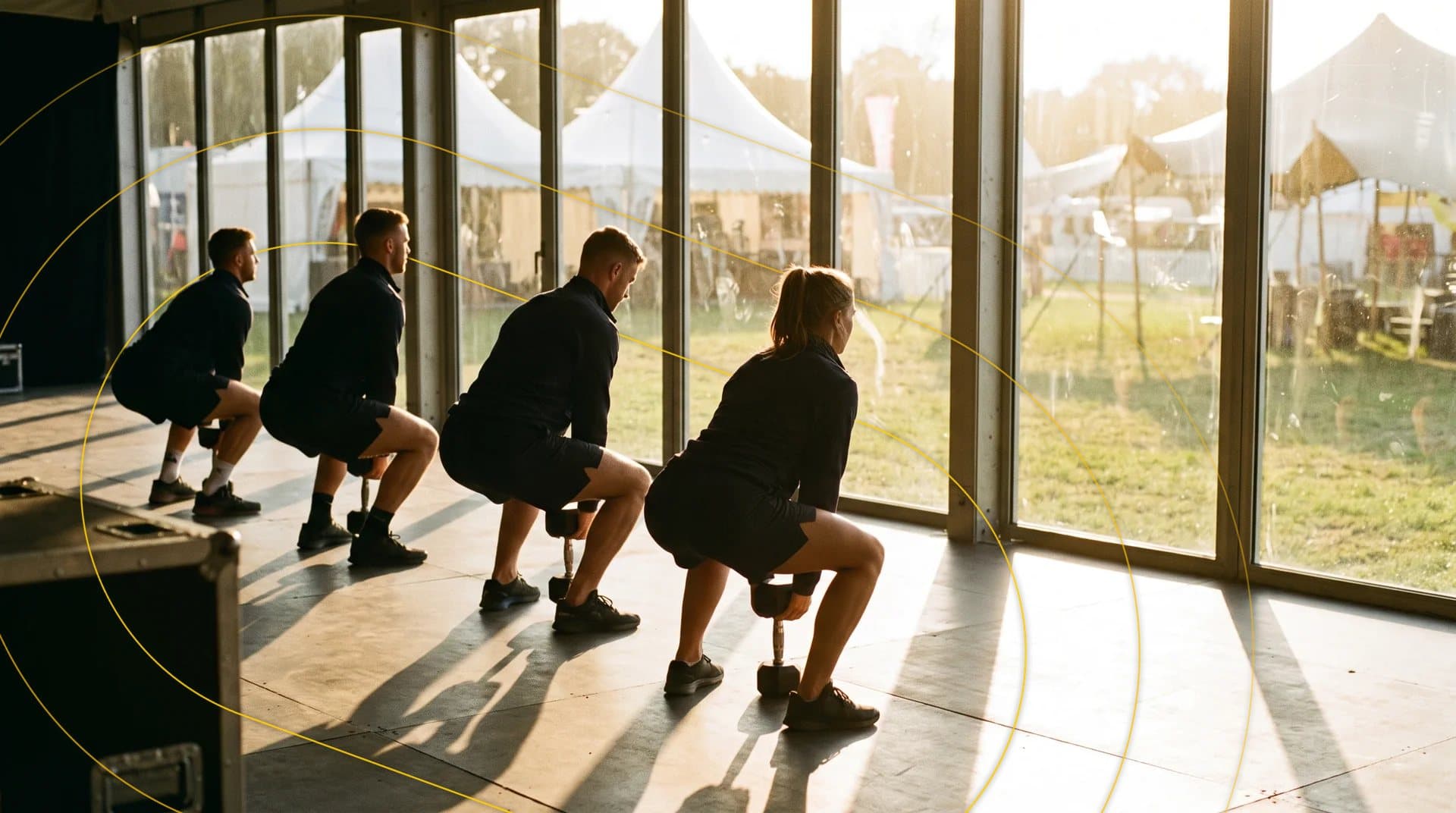
Turf Games is a team functional fitness competition, and every other fact about it follows from that one. You do not enter on your own and there is no finish time at the end of your day. You enter as a team of four or six, you work through a set of separately scored workouts with real rest between them, and your team is ranked against the other teams in your division.
That makes it the odd one out on a hybrid fitness calendar full of solo races. It also makes it the hardest of them to prepare for, because the workouts are not a fixed test you can rehearse. They change from event to event, and the organisers publish an archive of past ones rather than the ones you are about to do.
Below is the whole series: the three competition formats and who each is for, how a festival day is actually timed, what the workouts contain with five real examples from the published archive, the division loads movement by movement, and where all of it sits next to HYROX. Every figure comes from Turf Games’ own pages.
Key Takeaways
- Turf Games is a team competition. Festivals run male and female teams of four and mixed teams of six, made up of three men and three women.
- Every event has three divisions: Everyday, Intermediate and Elite. They change the loads and the movement standards, not the workouts.
- A festival day is four workouts with 45 to 75 minutes between them, so it is four separate efforts rather than one continuous race.
- The series runs three competition formats: the festivals, Fittest in the City for teams of four inside a 95-minute window, and Engine, an endurance race for pairs, individuals or teams of three.
- The workouts are not published as a fixed season test, so you cannot rehearse the exact thing you will be scored on.
- No muscle-ups, handstand push-ups or handstand walks appear in any division. Rope climbs are Elite only.
- In the organisers’ own words: “We don’t do any technical heavy oly lifting or gymnastic styles of workouts.”
- Entry to Turf Games Manchester 2026 was £330 for a team of four and £490 for a team of six.
What Is Turf Games?
Turf Games is a functional fitness event series that describes itself as a community built on inclusivity, authenticity and camaraderie, and it has run everything from small in-gym training days to festivals inside some of the world’s largest exhibition venues. The competitive core is the same at all of them: teams, scored workouts, and a division system that grades the loads so the same event works for a first-timer and for an athlete chasing a title.
The organisers are unusually direct about what the sport is not. Their own description of it rules out technical Olympic lifting and gymnastics styles of training, and states that raw strength or a decent engine is enough to belong on the floor. That single sentence explains most of the programming decisions further down this page, including why rope climbs appear in one division out of three and why handstand work appears in none of them.
Four words sit behind the whole thing, and Turf Games uses them as its pillars: teamwork, community, fitness and celebration. In practice that shows up as long gaps between workouts, a vendor village to spend them in, and a scoring system that never asks one athlete to carry a team alone.
Where the Name Comes From
The word TURF is doing real work here rather than decorating a logo. Turf Games explains it as a symbol of where you are from: your tribe, your territory, the gym you are representing when you compete. The founding idea was a metaphorical flag in the ground, planted to break down the me-against-you instinct between gyms and get people onto shared teams instead.
Teams come as gyms, as friends and as work colleagues, and the culture rewards showing up together far more than it rewards an individual performance.
The Three Turf Games Formats
Turf Games is not one competition, and picking the wrong format is the most common way to end up in an event that does not suit your team. This table separates the three.
| Format | Who enters | Length | What it is |
|---|---|---|---|
| Festival | Male and female teams of 4, mixed teams of 6 | Four workouts across a half-day session | The flagship: most competitors, most spectators, a festival village |
| Fittest in the City | Teams of 4, male, female or mixed | Four workouts in a 95-minute window | A fast waterfall format with a global season and a global leaderboard |
| Engine | Pairs, individuals or teams of 3 | Roughly 35 to 65 minutes of continuous work | A pure endurance race on machines and running |
| Training Days | Anyone, no entry to a competition required | One session | Open workouts hosted at gyms around the world |
What separates them is shape, not difficulty. A festival gives you long recovery and asks for four maximal efforts. Fittest in the City gives you almost none. Engine gives you none at all and takes the strength out entirely.
The Festivals
The festivals are the events most people mean when they say Turf Games. They are the largest in the series and the ones built as a day out, combining the competition floor with music, food and exhibitors. The majority run mixed teams of six, made up of three men and three women, and the workouts are graded across Everyday, Intermediate and Elite so all three divisions do a recognisable version of the same day.
Some festivals also sell male and female teams of four alongside the mixed sixes. Turf Games Manchester 2026 did exactly that, running teams of four in one session and mixed teams of six in another.
Fittest in the City
Fittest in the City, usually shortened to FITC, launched in 2020 as a pairs event hosted inside gyms: a 60-minute window covering four workouts of 10 minutes each, with five minutes of rest between them. It travelled from London across the UK and to Dubai, and in 2024 the format changed to teams of four, male, female or mixed.
FITC now runs as a global season with a global leaderboard, and at the end of each 12-month season the top team in each division and category is crowned world champions. The competition window is 95 minutes, teams waterfall through four workouts back to back, and the scores land on a live leaderboard while the event is still running. Recent seasons have taken it to Sydney, Glasgow, Malaga, Dublin, Auckland, Melbourne, Singapore, London and Manchester.
Engine
Engine is the format that will feel most familiar to anyone who races HYROX or runs. Turf Games describes it as an endurance race built from the machines, the SkiErg, the rower and the bike, plus running, burpee broad jumps and movements using kit such as dumbbells, box step-overs and sandbags. It is explicitly not a strength test: the series pitch is that it comes down to how fast you can move and how well you work together.
The length depends on which page you read, and both figures are the organisers’ own. The series description puts the workout at 35 to 55 minutes depending on your fitness level, while the Dubai 2026 edition is billed at 45 to 65 minutes. Treat it as a fixed window of hard continuous work rather than a fixed distance.
Entry is the loosest in the series. You can sign up as an individual, as a pair or as a team of three, though a given event may narrow that: Dubai Engine 2026 is a pairs-only race with male, female and mixed divisions and age brackets set on the average age of the pair.
Training Days
Training Days are not a competition at all, and they are the cheapest way to find out whether the sport suits you. Turf Games hosts them at gyms and studios around the world, open to anyone at any level whether or not you hold an entry to an event. Some are team workouts and some are skill, education or recovery sessions. You can turn up alone.
How a Turf Games Festival Day Actually Runs
The timings are the thing most first-time teams get wrong, because a Turf Games day looks like a race weekend and is scheduled like a track meet. Turf Games Manchester 2026 is the clearest published example, so it is worth walking through.
The day splits into a morning session and an afternoon session, and your team competes in one of them. Heats run from 10:00 to 20:30, with the morning block roughly 10:00 to 14:30 and the afternoon block roughly 14:30 to 19:45. Male and female teams of four are scheduled in the morning and mixed teams of six in the afternoon, subject to demand, and the published guidance warns that times can move by up to 90 minutes.
Inside your session you do four workouts with 45 to 75 minutes between each one. Teams start on different workouts and flow through all four in different orders, so nobody is following the same running order as the team beside them. A first heat in the morning session at Manchester was scheduled at 10:00, 11:03, 12:15 and 13:18.
Read those gaps as part of the competition rather than as waiting around. An hour between efforts is long enough to eat, rehydrate and bring your heart rate all the way down, which means each workout is scored on what you can produce reasonably fresh. A team that treats the breaks as social time and arrives at workout four cold has given away a score the format was trying to hand them.
Turf Games Workouts: What You Actually Do
Turf Games workouts are not published as a fixed test you can train against. The programming changes from event to event, and the organisers say so plainly: ahead of Dubai 2026 their own page tells teams that the workouts will be slightly different to other events while sharing some similarities, and points them at an archive of past workouts to practise on.
So train the vocabulary, not the workout. Across the published archive the kit stays remarkably consistent: SkiErgs, rowers, bikes, running, dumbbells, kettlebells, barbells, D balls, sleds, torque tanks, plyo boxes, wall balls, sandbags and rope climbs at the top division. The movements are the accessible end of functional fitness, with burpees, lunges, squats, cleans, snatches, sit-ups and carries doing most of the work.
The scoring is where Turf Games differs most from a race. Workouts are scored for time, for total reps, for metres covered, for points accumulated across two simultaneous tasks, or for total weight lifted across the whole team. Team mechanics are written into the standards rather than left to tactics: some reps must be performed in synchro by everyone at once, some can be split however you like, and some allow only one athlete to work at a time.
Five Turf Games Workouts From the Archive
These five are published in full on the Turf Games site, with their loads, their caps and their scoring. They span 2019 and 2020, so treat them as the shape of the sport rather than as this season’s test.
| Workout | Event | The work | Score |
|---|---|---|---|
| Off-Piste | London Summer 2019, Everyday | 50 synchro goblet squats with a single dumbbell at 22.5kg/15kg, 40 alternating lunges with a pair at 17.5kg/12.5kg, 30 synchro alternating snatches, 20 synchro burpees, then ski for distance | Metres on the SkiErg inside an eight-minute cap, or reps completed if you never reach it |
| Shift | London Summer 2019, Everyday | Two athletes pulling a sled arm over arm across 15m while three move four D balls at 20kg to 60kg over a plyo box, then push the loaded torque tank 10m and back | Combined points from sled lengths and tank lengths, five-minute cap |
| Strictly Synchro | London Summer 2019, Everyday | 2,000m for men’s and mixed teams, 1,500m for women’s, split across two bikes, then all five on synchro overhead plate lunges at 20kg/10kg, 20 synchro butterfly sit-ups, then synchro burpees | Total team synchro burpees in eight minutes |
| Rower Gang | Home Turf 2020 | 30 synchro burpees then 1km on every rower, three times over, with all five athletes on the first burpee set and three on the other two | For time. The Turf Games team posted 14:42 as a mixed team of five on two rowers |
| Tin Trail | Home Turf 2020 | 15 minutes for every athlete to set a 1RM bear complex | Total of all the athletes’ best lifts. The published benchmark mixed team total was 460kg |
Not one is a single test of the fittest athlete on the team, and three of the five are impossible to score well without genuine synchronisation. That is the skill nobody trains and everybody needs.
What the Workouts Never Include
The exclusions are published and they are firm across every division. There are no muscle-ups, no handstand push-ups and no handstand walks, anywhere. Intermediate also has no overhead squats. Rope climbs appear at Elite only. Toes to bar appear at Intermediate and Elite, and even there the requirement is limited: a team of four needs a minimum of one athlete who can do them, and a mixed team of six needs a minimum of one man and one woman. Everyday substitutes knee to chest.
If you have been avoiding fitness competitions because the gymnastics locks you out, this is the series where that argument stops working.
Turf Games Divisions: Everyday, Intermediate and Elite
Every Turf Games event runs the same three divisions, and they change the loads and the movement standards rather than the workouts themselves. The table below is the published movement standard for Turf Games Manchester 2026, with male loads first and female second.
| Movement | Everyday | Intermediate | Elite |
|---|---|---|---|
| Dumbbell | 1 x 17.5kg / 10kg | 1 x 22.5kg / 15kg | 2 x 22.5kg / 15kg |
| Deadlift | 60kg / 35kg | 80kg / 55kg | 120kg / 80kg |
| Kettlebell | 24kg / 12kg | 24kg / 16kg | 32kg / 24kg |
| D ball | 40kg / 20kg | 50kg / 30kg | 60kg / 40kg |
| Barbell shoulder to overhead | 40kg / 25kg | 50kg / 30kg | 70kg / 40kg |
| Barbell clean | 40kg / 25kg | 50kg / 30kg | 70kg / 45kg |
| Wall balls | 6kg | 9kg / 6kg | 9kg / 6kg |
| Plyo box | Step over | Jump over | Jump over |
| Rope climbs (3.7m, listed as 12ft) | No | No | Yes |
| Toes to bar | Knee to chest | Minimum one athlete | Minimum one athlete |
| Ergs and running | Yes | Yes | Yes |
Two footnotes travel with that table and both matter. Everyday women carry a D ball at 30kg over 20m but load only 20kg to the shoulder. And these are not one-rep maxes: the published guidance is that you should be able to perform five to eight reps at the weight listed, which is a much higher bar than touching it once.
Which Division Your Team Should Enter
Turf Games polices this more actively than most series, and the rules are written down rather than implied. An Everyday team may contain a maximum of one athlete who has previously competed in Intermediate, may contain nobody who has competed in Elite, and may contain a maximum of two athletes who have won an Everyday category before. Personal trainers, coaches and gym owners are told to enter Intermediate or Elite. A team finishing in the Everyday top 10 is asked to consider moving up next time.
There is one clarification worth quoting because it catches people out: carrying an injury is not a reason to enter Everyday, and a team still has to meet every criterion above. Turf Games also reserves the right to move a team, or to remove it from a podium, if it has entered the wrong division.
If your team straddles the line, enter the division you can all complete. A load one of your six cannot move for five to eight reps under fatigue does not become lighter because the other five are strong.
Turf Games vs HYROX: Two Different Sports
This is the comparison the searches are really asking for, and the honest answer is that they share equipment and almost nothing else. HYROX is a standardised individual endurance race. Turf Games is a team competition with variable programming. The table sets them side by side.
| Feature | Turf Games | HYROX |
|---|---|---|
| Who competes | A team of four or six, or a pair at Engine | An individual, a pair, or a relay of four |
| The work | Different at every event, released by the organisers | The same 8 x 1km runs and the same eight stations, every race |
| Your result | A score per workout, ranked inside your division | One finish time |
| Levels | Everyday, Intermediate, Elite | Open, Pro |
| Rest | 45 to 75 minutes between workouts at a festival | The Roxzone, and nothing else |
| Equipment range | Barbell, dumbbell, kettlebell, D ball, sled, rope climbs at Elite | No barbell, no gymnastics, eight fixed stations |
| Running | Present, but never the spine of the event | 8km, and roughly half your race |
| How you prepare | Broad functional fitness plus team tactics | Compromised running and the eight stations you already know |
The row that decides everything is the second one. A HYROX race is the same course in every city, so preparation is a rehearsal of a known test and the whole sport rewards specificity. Turf Games publishes standards but not the workouts, so preparation is the opposite discipline: you are training to have no obvious gap on the day rather than to peak at one thing.
In HYROX a bad station costs you the seconds you lose in it. In a Turf Games workout that needs everyone synchronised, or that caps out on the slowest athlete, one athlete’s gap becomes the team’s score. That is why the entry rules above exist, and it is why teams built from friends of similar ability tend to outperform teams built around one strong athlete.
How to Train for Turf Games
The format tells you what to build, and it is not the usual race-preparation advice. Four things do the work, in this order.
- Cover the whole vocabulary before you perfect any of it. You will not know the workouts, so the goal is having no movement on the standards table you cannot manage for five to eight reps at your division’s load. Go down that list, find the honest gaps, and spend your training there.
- Build the strength end, because a broad event exposes it first. Deadlifts, cleans, shoulder to overhead and D ball work all appear at real weights, and those qualities decay quietest when training is mostly conditioning. A structured progressive overload block is usually the missing piece for an endurance athlete entering Turf Games.
- Keep the engine honest on the machines. Ergs and running appear in every division and at Engine they are the entire event, so guessing at effort is expensive. The training zone calculator gives you a ceiling to hold, and a general hybrid training programme covers the combination of running and lifting well.
- Then practise as a team rather than as four fit individuals. Synchro reps, handovers, who takes which share of a split workout and who calls the pace are all skills, and they are the only ones you cannot build alone. Pick two workouts from the table above and run them with the people you are actually entering with.
FAQ
Turf Games is a team functional fitness competition series. Teams of four or six work through a set of separately scored workouts across a half-day session and are ranked against other teams in their division. It runs festivals, a team-of-four series called Fittest in the City, and an endurance race called Engine, plus open Training Days at gyms worldwide.
It depends on the format. Festivals run mixed teams of six, made up of three men and three women, and some events also sell male and female teams of four. Fittest in the City is teams of four, male, female or mixed. Engine is entered as an individual, a pair or a team of three, though a specific event may only sell one of those.
Every event runs Everyday, Intermediate and Elite. They change the loads and the movement standards rather than the workouts. Everyday is the entry point for athletes new to competitions, Intermediate is for those who compete regularly or coach, and Elite uses the heaviest loads and is the only division that includes rope climbs.
They change at every event and are not published as a fixed season test. Across the published archive the kit is consistent: SkiErgs, rowers, bikes, running, dumbbells, kettlebells, barbells, D balls, sleds, plyo boxes, wall balls and sandbags. Workouts are scored for time, for reps, for distance, for points, or for total weight lifted by the whole team.
Not as a fixed test you can rehearse. The organisers publish an archive of past workouts with their loads and scoring, and tell teams to train on those, noting that each event's programming will be slightly different while sharing similarities with previous ones.
No. Muscle-ups, handstand push-ups and handstand walks do not appear in any division, and the organisers state that they do not programme technical Olympic lifting or gymnastics styles of workouts. Rope climbs appear at Elite only, and toes to bar are required from a minimum of one athlete per team at Intermediate and Elite.
HYROX is an individual timed race with the same 8 x 1km runs and eight stations everywhere in the world. Turf Games is a team competition whose workouts change from event to event, scores each workout separately, and gives you 45 to 75 minutes of rest between them at a festival. One rewards rehearsing a known test, the other rewards having no gaps.
It varies by event. Turf Games Manchester 2026 was priced at £330 for a team of four and £490 for a team of six, entered through Circle21, with team entries non-refundable unless the event moves or is cancelled. Team names can be changed up to three weeks before the event and team members up to the day before.
Conclusion
Turf Games is the team event in a calendar full of solo ones, and that is the whole point of it. Four or six of you, four workouts with a separate score on each and enough time between them to recover, three divisions that change the weight rather than the task, and a scoreboard that no single athlete can rescue.
It also asks for something no other hybrid event does. Because the workouts are not published, you cannot arrive having rehearsed them, so the preparation is the unglamorous version: close the gaps on the standards table, build the strength that conditioning quietly erodes, keep the engine honest, and practise moving in time with four or five other people.
When you are ready to pick an event, the Turf Games race calendar carries the dates and venues we hold. Checked on 17 September 2026, the organisers’ upcoming list runs Manchester on 10 October, Singapore Engine on 17 and 18 October, and Dubai Engine and the Dubai Fitness Festival across 20 and 21 November, with no 2027 dates published yet.
Holding strength, an engine and a wide enough movement range together, and having all three ready on one Saturday, is a scheduling problem before it is a training one, and the schedule moves whenever your week does.
Kracey exists for exactly that bit. Your coach sits in Telegram, reads every session through intervals.icu so it judges what your watch recorded rather than what you meant to do, and reshapes the block when a Thursday disappears and you say so in the chat. Give it the date your team is on the Turf and it builds towards it. You get 14 free days, counted from the moment it can see your training rather than from the day you sign up.
Start your 14 free days and build towards your team’s event .