
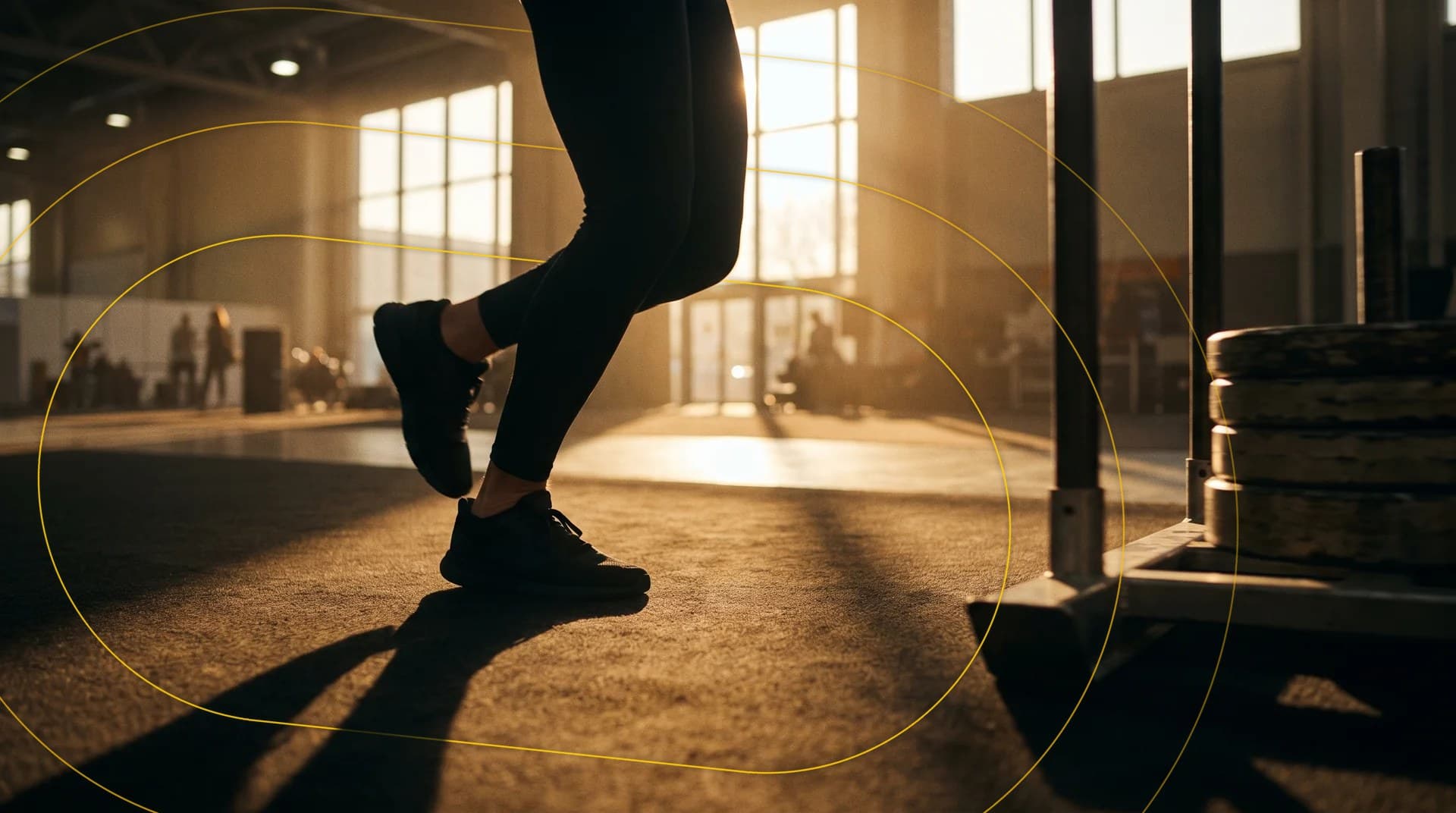
The best HYROX shoes are running shoes with a grippy, full-length rubber outsole and a firm, stable platform. Eight kilometres of the race are running, so the shoe has to run well first. The sled push and sled pull are where the wrong pair costs you, because a sole that slides on the sled carpet turns leg drive into nothing.
HYROX says much the same itself. On its own race page , the organiser’s advice for the sled push is to try it at least once before your race “and invest in some grippy shoes”. It is the only footwear advice HYROX gives on that page, and it points at the right station.
This guide starts from what the race asks of a shoe, station by station, using the loads and rules in the official HYROX Season 26/27 rulebook. Then it covers what to look for, the three types of shoe people race in, and a shortlist described from each brand’s own product pages. We have not wear-tested these shoes and nothing below pretends otherwise. The spec sheet tells you what a shoe is built to do. Your own sled session tells you whether it does it for you.
Key Takeaways
- A HYROX race is eight 1km runs with a station after each one, held indoors in exhibition halls, so the shoe has to run 8km and then work on the stations.
- The official HYROX Season 26/27 rulebook requires closed-toe shoes at all times during the race, except at wall balls, where you may take them off.
- If you take your shoes off for wall balls, they go under the rig and you carry them to the finish, because you cannot go back for them.
- Grip on the sled carpet is the property that matters most. The sled push is 50m at 102kg to 202kg including the sled, depending on your division.
- The rulebook sets no limit on stack height, plates or brand. Any closed-toe shoe is legal.
- HYROX shoes come in three types: HYROX-specific shoes, running shoes and cross-trainers. Each trades running comfort against stability at the stations.
- PUMA, listed among HYROX’s global partners, describes the HYROX version of its Deviate NITRO Elite as the first super shoe engineered specifically for HYROX, with a full-coverage PUMAGRIP outsole.
- Whatever you choose, test it on a sled and through a race simulation for weeks before race day, never for the first time on the day.
What a HYROX Shoe Has to Do
A HYROX shoe has two jobs that pull in opposite directions. The running asks for cushioning and an efficient ride across eight 1km legs. The stations ask for grip, a stable base under load and a sole that does not shift when you drive into the floor. Every shoe choice for HYROX is a decision about where to sit between those two.
The table below lists each part of the race with the Open to Pro range from the official HYROX rulebook , and what it asks of the shoe on your feet.
| Part of the race | The work | What it asks of the shoe |
|---|---|---|
| Running | 8 x 1km, indoors | Cushioning and an efficient ride, legs already tired from the stations |
| Station 1: SkiErg | 1,000m | A stable base to hinge from |
| Station 2: Sled Push | 50m, 102kg to 202kg incl. sled | Forefoot grip on the carpet, a sole that holds under horizontal force |
| Station 3: Sled Pull | 50m, 78kg to 153kg incl. sled | Heel grip and stability while you brace and haul |
| Station 4: Burpee Broad Jumps | 80m | A secure fit for repeated take-offs and landings |
| Station 5: Rowing | 1,000m | Fits under the foot strap, little else |
| Station 6: Farmers Carry | 200m, 2 x 16kg to 2 x 32kg | A stable platform while walking fast under load |
| Station 7: Sandbag Lunges | 100m, 10kg to 30kg | Side-to-side stability on every step |
| Station 8: Wall Balls | 100 reps, 4kg to 9kg | A stable squat base, or no shoes at all |
Notice where the risk sits. Most stations ask a shoe for little beyond staying stable, but the two sled stations push horizontal force through the outsole into the floor, and that is where a sole either holds or slips.
The Running: 8km You Cannot Shortcut
The running is the one part of the race you cannot do differently. Every athlete in every division runs the same 8km, as eight 1km legs, and every leg after the first starts straight off a station on tired legs. That is compromised running, and it is where a shoe that feels fine on a fresh 5K can start to feel heavy or harsh.
HYROX states that every race is hosted indoors in exhibition halls. That has one useful consequence for your shoe: there is no mud, rain or loose ground to plan for, so the deep lugs of a trail shoe solve a problem the course does not have. What the course does have is laps, the Roxzone in and out of every station, and a hall floor under every one of the 8km.
The Sleds: Where Shoes Fail
The sled push is 50m in four 12.5m lengths at 102kg for Open women, 152kg for Open men and Pro women, and 202kg for Pro men, all including the sled. The sled pull is also 50m in four 12.5m lengths, at 78kg, 103kg and 153kg. On the push, you are driving off the balls of your feet into a carpeted track. On the pull, you are braced in the racer’s box, sitting back and hauling rope, and the rulebook does not let you step on the box’s front or back line while you hold the rope.
Both stations ask the outsole to hold horizontal force, which running never does. PUMA’s own account of building its HYROX shoe makes the point well: the heel rubber pods on its earlier marathon racer “began tearing away during HYROX testing”, and the company says running had never exposed that issue. Its answer was rubber running continuously from forefoot to heel, with a traction pattern designed for sled pushes and pulls. The technique side of both stations is in the sled push guide and the sled pull guide .
Lunges, Jumps and the Carry: Stability Under Load
Three stations load you through one leg at a time or through an awkward position. The sandbag lunges are 100m with 10kg to 30kg across your shoulders, the farmers carry is 200m with a kettlebell in each hand, and the burpee broad jumps are 80m of jumping forward from the floor.
A tall, soft heel is comfortable on a run and less helpful here, because it can compress and roll when your weight lands on one foot under load. PUMA says it made the foam in its HYROX version slightly firmer for exactly this reason, to add stability “when you’re doing walking lunges or farmer’s carries”. If your current shoe feels wobbly on the sandbag lunges , that is the platform telling you something, not your balance.
Wall Balls: The Only Station You Can Do Barefoot
The rulebook allows you to take your shoes off at the wall ball station once you reach your target. The shoes go under the rig, and after 100 valid reps you have to take them with you to the Finisher Stage, because racers are not allowed back into the wall ball area once their race is complete.
Whether that is worth doing is a training question, not a race-day one. Some athletes like a flat, solid base for 100 squats, and others would rather not spend time on laces at the end of the race. Try it in a simulation before you decide. The full rep plan for the station is in the wall balls guide .
What the HYROX Rulebook Says About Shoes
The official HYROX Season 26/27 rulebook says very little about shoes, and that is the useful part. Section 10 requires every racer to wear closed-toe shoes at all times during the race, except at the wall ball station, where shoes may come off. That is the whole footwear rule.
There is no stack height limit, no rule on plates, no approved shoe list and no brand requirement. A carbon-plated racer, a cross-trainer and a 10-year-old pair of gym trainers are all legal, provided they cover your toes. Sandals, open-toe shoes and bare feet on the run course are not.
The wall ball exception comes with its own procedure, set out under the station’s standards:
- Reach your designated target first, then remove your shoes.
- Place them under the rig.
- Complete your 100 valid reps.
- Take your shoes with you to the Finisher Stage. You cannot return to the wall ball area afterwards.
Kit rules beyond footwear, including which accessories are permitted and what gets you penalised, are covered in the HYROX rules guide .
What to Look for in HYROX Shoes
Five properties decide whether a shoe suits HYROX, and they are not equally important. Grip on the sled comes first, stability under load second, then stack height and drop, then weight and durability. Fit sits underneath all of them.
Grip: Look at the Outsole, Not the Upper
Turn the shoe over. What you want to see is rubber covering most of the sole, from the forefoot to the heel, rather than islands of rubber with exposed foam between them. Exposed foam is lighter and fine on a road, but it is softer and less durable against a carpet under a 152kg sled.
This is the property PUMA chose to rebuild for its HYROX shoe, moving from rubber used “very precisely to keep weight down” on the marathon version to full-coverage PUMAGRIP. HYROX’s own advice for the sled push is the same in four words: invest in grippy shoes.
Stack Height and Stability
Stack height is how much material sits between your foot and the floor. More stack usually means more cushioning on the runs, and also a higher, softer platform at the stations. On a lunge or a carry, a soft, tall heel has more room to compress and tilt.
You do not need a low shoe for HYROX, and most of the shoes people race in are running shoes. You do want a platform that feels stable when you stand on one leg with weight on your back. Firmer foam and a wider base both help, which is why the HYROX-specific shoes tend to keep the running stack and firm up the foam rather than lower it.
Drop
Drop is the difference in height between the heel and the forefoot. A higher drop tips you slightly further forward when standing, and a lower drop feels flatter. On the shortlist below, the brands that publish a drop list 8mm or 10mm.
Drop matters less than grip or stability for HYROX. The practical rule is to race in a drop your calves and Achilles are used to, because 8km of running in a much lower drop than you train in is a new load, and race day is the wrong day to introduce it.
Weight
A lighter shoe costs less effort on every stride and every broad jump, and you will lift each shoe thousands of times in a race. Weight still sits behind grip and stability on this list, because a light shoe that slides on the sled loses more than a slightly heavier one that holds. The shortlist below gives each brand’s published weight so you can compare like for like.
Durability
Sled work wears an outsole differently from running. PUMA’s tearing heel pods are the clearest example published by a brand. Check your outsole after sled sessions, and replace a pair whose rubber has worn smooth at the forefoot, because a worn sole on a carpet is the one equipment problem you can see coming.
Fit and Lockdown
Lunges, broad jumps and the sled pull all ask your foot not to move inside the shoe. A heel that lifts or a forefoot that slides costs control on every rep. Lace the shoe the way you will race it, and do a full simulation in it, including 20m to 30m of lunges, before you commit.
The Three Types of HYROX Shoe
People race HYROX in three kinds of shoe, and each makes a different trade between the running and the stations. HYROX-specific shoes try to do both. Running shoes favour the 8km. Cross-trainers favour the stations.
| Type | Built for | Strength in HYROX | Trade-off |
|---|---|---|---|
| HYROX-specific | Running, re-tuned for stations | Running cushioning with a full-coverage, sled-ready outsole | Fewer models to choose from, and the top versions are racing shoes |
| Running shoe | The run | The most comfortable choice for 8km of running | Outsole coverage and stability vary a lot between models |
| Cross-trainer | Gym work | A flat, firm, stable base for sleds, lunges and wall balls | Less cushioning for eight 1km runs |
The table hides the most useful fact: the running is the same 8km for everyone, while how much the stations punish a soft shoe depends on your division and your strength. A Pro athlete pushing 202kg has more reason to care about the sled than a woman in the Open division pushing 102kg.
HYROX-Specific Shoes
These are running shoes rebuilt for the stations. The clearest example is the HYROX version of PUMA’s Deviate NITRO Elite, sold as the PUMA x HYROX Deviate NITRO Elite 4, which PUMA developed from its marathon racer of the same name. According to PUMA, about 80% of the chassis was already right, the foam was made slightly firmer for stability under load, and the outsole was redesigned with full-coverage PUMAGRIP and a traction pattern for sled pushes and pulls.
PUMA is listed among HYROX’s global partners on hyrox.com, and the World Championships carry its name. That makes PUMA the brand most visible at a HYROX event, but it does not make PUMA compulsory: the rulebook names no brand.
Running Shoes
A running shoe is what most people already own. It makes the 8km as comfortable as it can be. The question to ask of any running shoe is the outsole: how much rubber is there, and does it reach the heel?
Daily trainers and lightly plated uptempo shoes are the usual choices. Soft, tall maximum-cushion shoes are the riskier end for the stations, for the stability reasons above.
Cross-Trainers
Cross-trainers, such as the Nike Metcon and Reebok Nano lines, are built for gym work: a flat, firm base and a durable outsole. They are at their best on the sled, the lunges and the wall balls. The cost is the running, where a firm, flat shoe can feel harsh by the later kilometres.
They make most sense for athletes whose race goes wrong at the stations rather than on the run, and for anyone racing Relay, where each athlete runs a share of the 8km rather than all of it.
HYROX Shoes Worth Shortlisting
Six shoes cover the three types: PUMA’s two HYROX models, two widely worn running shoes, and two cross-trainers. This is a shortlist to try on, not a ranking. We have not tested these shoes, and every figure below comes from the brand’s own product page, linked in each name. Not published means the brand does not give that figure on the product page.
| Shoe | Type | Stack (heel/forefoot) | Drop | Weight | Plate |
|---|---|---|---|---|---|
| PUMA x HYROX Deviate NITRO Elite 4 | HYROX-specific | 40mm/32mm | 8mm | 194g (UK 8) | Carbon fibre |
| PUMA x HYROX Velocity NITRO 4 | HYROX-specific | Not published | 10mm | Not published | None stated |
| Saucony Endorphin Speed 5 | Running | Not published | Not published | 237g | Nylon |
| Nike Pegasus 42 | Running | Not published | 10mm | About 300g (US 10) | None stated |
| Nike Metcon 10 | Cross-trainer | Not published | Not published | Not published | Hyperlift plate under the heel |
| Reebok Nano X5 | Cross-trainer | Not published | Not published | Not published | None stated |
The gaps in the table are a finding in themselves. Only PUMA publishes stack, drop and weight together for its HYROX shoe, and neither cross-trainer lists a drop or weight on its product page, so for those two the only reliable comparison is the one you make in a shop.
PUMA x HYROX Deviate NITRO Elite 4
The Deviate NITRO Elite 4 is PUMA’s carbon-plated racer in its HYROX version, with NITROFOAM Elite, a PUMAGRIP outsole and, in PUMA’s words, a “modified outsole” that “provides optimal traction for sleds”. PUMA’s account of its development describes the changes from the marathon version: slightly firmer foam for stability under load, and rubber that runs unbroken from forefoot to heel. It is the most race-specific shoe on this list.
PUMA x HYROX Velocity NITRO 4
The Velocity NITRO 4 is the everyday option in PUMA’s HYROX range: a NITROFOAM midsole, a PUMAGRIP outsole, a 10mm drop and no plate stated. PUMA describes it as “built to handle the full demands of hybrid fitness racing”. It is the shoe to look at if you want PUMA’s outsole without racing on a carbon plate.
Saucony Endorphin Speed 5
The Endorphin Speed 5 is a running shoe with a full-length, semi-rigid nylon plate between two layers of PWRRUN PB foam, at 237g by Saucony’s figure. Saucony’s page says nothing about sleds or HYROX, so its grip on a carpet is something to check yourself.
Nike Pegasus 42
The Pegasus 42 is Nike’s everyday road trainer: a ReactX foam midsole with a full-length Air Zoom unit, a high-abrasion rubber outsole and a 10mm drop, at about 300g for a men’s US 10. It is the heaviest running shoe here and the most conventional, which is the point of including it: a daily trainer rather than a race shoe.
Nike Metcon 10
The Metcon 10 is a gym shoe first. Nike describes a Hyperlift plate under the heel that “optimises stability for heavy lifts”, ReactX foam for cushioning, and flex grooves in the outsole. That makes it a strong platform for the sleds, lunges and wall balls, and a firmer shoe for 8km of running.
Reebok Nano X5
The Nano X5 is Reebok’s cross-trainer, with a dual-density midsole that Reebok says uses firmer foam in the heel for stability and more responsive foam in the forefoot, on a decoupled Metasplit outsole that the brand says “enhances runnability”. On paper it is the cross-trainer that leans furthest towards the run.
How to Test a Pair Before Race Day
The only test that settles a HYROX shoe is the one you run yourself, in conditions close to race day. Do it at least four weeks out, so you have time to change your mind and still train in the replacement.
- Push a sled at race weight on carpet or turf. If your gym has a sled track, load it to your division’s weight and do 4 x 12.5m. Watch for your forefoot slipping on the drive.
- Run 1km straight off the sled. This is the compromised running the race is built on, and it shows you how the shoe feels when your legs are already heavy.
- Lunge 20m to 30m with a sandbag. Notice whether your heel rolls or your foot moves inside the shoe.
- Do a full race simulation in them. Eight runs and eight stations, or as close as your gym allows, laced the way you will race.
- Check the outsole afterwards. Look for smooth patches at the forefoot or rubber starting to lift, the kind of damage PUMA describes sled work causing.
- Decide on wall balls in training. If you plan to race them barefoot, practise the shoes off, under the rig, and carried to the finish routine.
Then stop changing things. Kracey’s race week guide puts it plainly: race in shoes you have trained in for at least four weeks, and never in new footwear on the day.
FAQ
A running shoe with a grippy, full-length rubber outsole and a stable platform suits most athletes. The race is 8km of running with eight stations, so the shoe has to run well first, and the sled push and sled pull are where a slippery sole costs time. HYROX's own advice for the sled push is to invest in grippy shoes.
Yes, and most athletes do. The official HYROX rulebook only requires closed-toe shoes, so any running shoe is legal. The thing to check is the outsole: rubber that covers most of the sole grips the sled carpet better than islands of rubber with exposed foam between them.
HYROX does not require any brand. PUMA is listed among HYROX's global partners on hyrox.com, the World Championships carry its name, and PUMA sells a HYROX version of its Deviate NITRO Elite that it describes as the first super shoe engineered specifically for HYROX. You can race in any closed-toe shoe.
Yes. The HYROX Season 26/27 rulebook sets no rule on plates or stack height, only that shoes are closed-toe. Whether a plated racer suits you depends on its grip and stability at the stations, so test it on a sled and through lunges before racing in it.
They are good at the stations and harder work on the runs. A cross-trainer gives a flat, firm, stable base for the sleds, lunges and wall balls, but has less cushioning for eight 1km runs. They suit athletes whose race goes wrong at the stations, and Relay athletes who run only part of the 8km.
Only at wall balls. The rulebook requires closed-toe shoes at all times except at the wall ball station, where you may remove them once you reach your target. They go under the rig, and you must carry them to the finish, because you cannot return to the wall ball area.
No. HYROX states that every race is hosted indoors in exhibition halls, so there is no mud or loose ground to grip. What matters indoors is rubber contact on the sled carpet and stability under load, not deep lugs.
Only if you have time to train in them first. Race in shoes you have used for at least four weeks, including sled work and a full simulation, and never wear a new pair for the first time on race day.
Conclusion
The right HYROX shoe is the one that runs 8km comfortably and holds on the sled carpet, and for most people that is a running shoe with a full rubber outsole and a platform that does not wobble under a sandbag. The rulebook asks only that it covers your toes, and lets you take it off for wall balls if you carry it to the finish.
So choose in this order. Grip first, then stability, then cushioning and drop you are used to, then weight. Test the pair on a sled, run off it, lunge in it, and race in the shoes you trained in.
The shoe is the easy decision. The harder part is the weeks between now and the start line, when the sled sessions and the runs off them have to fit around the rest of your life.
That is the job Kracey does. Your coach is a conversation in Telegram rather than one more app to remember to open, and it reads every session through intervals.icu, so it works from the file your watch produced instead of the label you gave the workout. Tell it when your HYROX is and it counts the weeks backwards from that date. Tell it a session has to move and it redraws the week without an argument. The 14 free days need no card, and their clock starts once your coach can actually see your training.