
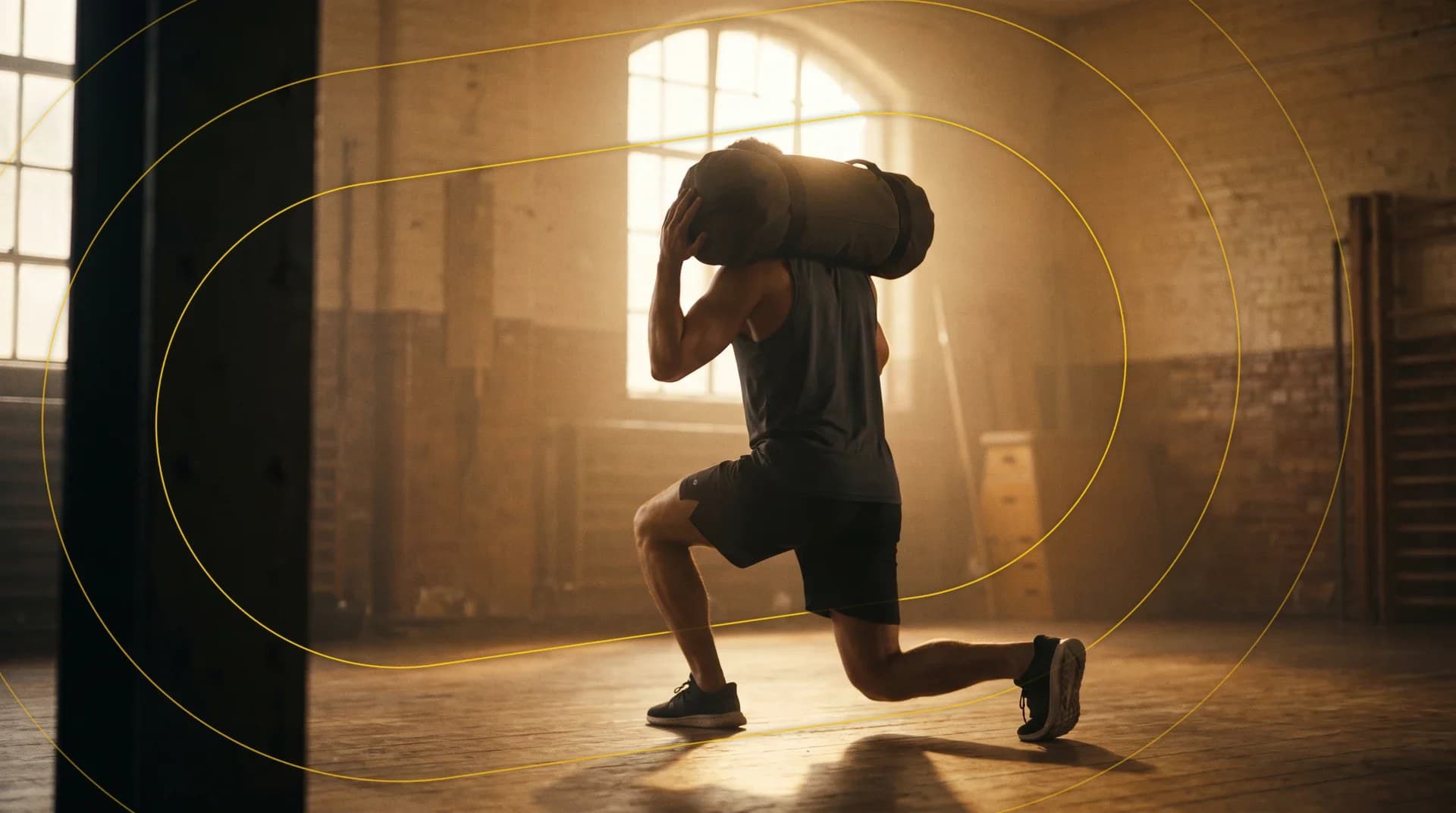
The HYROX sandbag lunges are Station 7 of 8, where you carry a sandbag on your shoulders and walk 100 metres of lunges, touching your back knee to the ground on every step. Open Women lunge with 10kg, Open Men and Pro Women with 20kg, and Pro Men with 30kg. It is the second-to-last station, and it lands when your legs are already deep in the red.
This is the station that decides how your race finishes. You reach it after seven runs and six stations, then you have to control roughly 55 to 65 lunges with a loaded bag on your back, before running again and facing the wall balls. Athletes who rush it end up gassed with nothing left for the final station. Athletes who own a steady rhythm walk off the lunges with their legs intact.
This guide gives you the exact weights by division, the movement standards that stop you getting no-repped, the technique to lunge efficiently, and how to train the station whether or not you own a sandbag. New to the format? Our HYROX workout stations guide covers all eight in race order.
Key Takeaways
- Sandbag lunges are Station 7: 100m of walking lunges with a sandbag on your shoulders, right before the final run and wall balls.
- Weights: Open Women 10kg, Open Men 20kg, Pro Women 20kg, Pro Men 30kg.
- The standard is strict: the bag stays on your shoulders and your back knee must clearly touch the floor on every rep, or it will not count.
- Expect roughly 55 to 65 lunges to cover 100m, so a repeatable rhythm matters more than raw speed.
- Pace it to protect your legs. There is a run and 100 wall balls waiting after this station.
What Are the HYROX Sandbag Lunges? Station Rules, Weights and Standards
The HYROX sandbag lunges are a 100m loaded walking-lunge station performed with a sandbag resting across your shoulders behind your neck. It is the seventh of the eight stations, sitting between Run 7 and the final run into the wall balls (Station 8). You cover the full 100 metres one lunge at a time, and the bag never leaves your shoulders.
The weight depends on your division:
| Division | Sandbag weight |
|---|---|
| Open Women | 10kg |
| Open Men | 20kg |
| Pro Women | 20kg |
| Pro Men | 30kg |
Two movement standards decide whether your reps count. First, the sandbag must stay on your shoulders or upper back for the entire station. Carrying it in your arms or letting it slip to your chest is not allowed. Second, your back knee must clearly touch the ground on every single lunge. A shallow lunge where the knee hovers above the floor is a no-rep, and judges do watch for it. Covering 100m takes most athletes between 55 and 65 lunges, though a longer stride reduces the count. For the weights across every station, see our HYROX weights guide .
Muscles Worked: What the Sandbag Lunges Actually Train
The sandbag lunges hit your quads, glutes and hamstrings hardest, with your core and upper back bracing to keep the bag stable and your torso upright. Every rep is a single-leg strength effort under load, repeated more than fifty times, which is why the station burns even strong lifters who have not trained the specific endurance.
The hidden cost is metabolic. By Station 7 your legs have already run seven kilometres and absorbed the sled push, sled pull and any earlier leg fatigue. Loading them with 50-plus deep lunges spikes your heart rate hard, and unlike a pure strength set, you cannot rest between reps without losing time. This is a muscular endurance station wearing a strength station’s clothing, and it is why the last run into the wall balls so often feels like wading through mud.
Technique: How to Lunge Without No-Repping or Blowing Up
Good sandbag lunge technique keeps the bag stable, your torso tall, and every knee-touch clean, so you bank clean reps without wasting energy. Small setup errors here cost you either no-reps or a blown heart rate, and both are avoidable.
Set the bag high and centred. Rest the sandbag across both shoulders behind your neck, centred so it does not pull you to one side, and clamp it in place with both hands. A bag that slides costs you balance and reps.
Stay tall through the torso. Keep your chest up and core braced. Leaning forward shifts the load onto your lower back and your front knee, which slows you and raises no-rep risk. Think proud posture, eyes forward.
Use a moderate stride and touch the knee. Step into a controlled lunge and lower until your back knee clearly touches the floor, then drive up. Overstriding feels fast but dumps the load onto your front knee and tires you quicker. Understriding risks a shallow, no-repped knee-touch. Find the length you can repeat cleanly.
Hold one continuous rhythm. The single biggest time-saver is a steady, unbroken cadence. Every stop and restart costs you balance, a moment to re-settle the bag, and a heart-rate spike. A slightly slower pace you never break beats a fast pace you keep interrupting.
Take Sarah, a strong runner from Leeds targeting sub-1:40. She hit the lunges feeling good and attacked them at a near-sprint cadence. By 60 metres her heart rate was maxed, her back knee was hovering (three no-reps she had to repeat), and she needed 20 seconds hunched over the bag before she could finish. The athlete beside her lunged slower but never stopped, and walked off 15 seconds ahead. Rhythm beat aggression.
Race Day Strategy: How to Pace the HYROX Sandbag Lunges
The best sandbag lunge strategy is to settle into a steady, unbroken rhythm you can hold for the full 100m, and to remember there is a run and 100 wall balls still to come. This is not the station to empty the tank on.
Come off Run 7 and shoulder the bag with control. Resist the urge to charge the first 25 metres, because a fast start you cannot sustain just means a longer recovery later. Lock in your knee-touch depth early so you are not risking no-reps, then hold that cadence to the line. If you have trained the lunges well, unbroken is both the fastest and the safest option, since you never lose time re-settling the bag.
If your legs are a known weakness, plan where you might pause rather than breaking randomly. A brief two-second reset at the 50m mark, bag still on your shoulders, is far better than grinding to a stagger at 80m. But treat breaks as insurance, not the plan. The clock keeps running whether you move or not.
Above all, pace for what follows. After the lunges you run 1km and then face 100 wall balls, the same count in every division, which is the most leg-dependent station of the race. Blowing your legs on the lunges is the classic way to turn a strong race into a survival crawl through the wall balls. Our HYROX wall balls guide covers that final station, and the HYROX pace calculator shows how a controlled lunge protects your closing splits.
How to Train for the HYROX Sandbag Lunges
Train the sandbag lunges by building single-leg strength and lunge endurance two to three times a week, then adding the bag and the fatigue that race day brings. You do not need an exact HYROX sandbag to build the right legs.
If you have a sandbag or loadable kit:
- Distance lunges at load: Walking lunges for 100m at or near race weight, focused on a clean knee-touch every rep. Progress by adding a set or cutting rest.
- Heavier short sets: Load above race weight for 40 to 50m to build strength, then return to race weight for distance.
- Post-run lunges: Run 800m to 1km, then lunge immediately. This rehearses the exact fatigued-leg state you meet at Station 7, which is the piece most athletes skip.
If you train at home or with minimal kit:
- Bodyweight and backpack lunges: A loaded rucksack held high on the shoulders mimics the bag well. Accumulate volume: sets of 40 to 60m.
- Reverse and walking lunges for reps: Build the muscular endurance base with high-rep bodyweight lunges before adding load.
- Split squats: Elevated rear-foot split squats build the single-leg strength that makes the loaded lunge feel lighter.
Because the lunges tax the same legs your running relies on, general leg strength pays off twice. Our strength exercises for runners guide covers the lunge and single-leg work that supports both. Kracey, coaching in Telegram , builds lunge endurance into your running block rather than treating it as a separate gym day.
FAQ
What is a good HYROX sandbag lunges time? A good sandbag lunges split is around 3:00 or faster for Open athletes, with strong competitors finishing the 100m closer to 2:30. Because the station lands late and taxes tired legs, a controlled, unbroken effort usually beats a fast start that forces a recovery break.
How heavy is the HYROX sandbag lunge? Open Women lunge with 10kg, Open Men and Pro Women with 20kg, and Pro Men with 30kg. The bag rests on your shoulders for the full 100 metres and the weight is fixed by division.
How many lunges is 100m in HYROX? Most athletes take roughly 55 to 65 lunges to cover the 100m, though a longer stride lowers the count. Finding a repeatable stride length that still lets your back knee clearly touch the floor is the key to an efficient split.
Why am I getting no-repped on the sandbag lunges? The two most common reasons are a back knee that does not clearly touch the ground and letting the bag slip off your shoulders. Lunge to a genuine knee-touch on every rep and keep the bag clamped high on your shoulders, and your reps will count.
How do I train legs for the HYROX sandbag lunges? Build single-leg strength and lunge endurance two to three times a week with loaded walking lunges, split squats, and high-rep bodyweight lunges. The most race-specific drill is lunging immediately after a hard run, which trains the fatigued-leg state you face at Station 7.
Conclusion: Own Station 7, Finish Strong
The HYROX sandbag lunges are where a smart race is won or lost. They are not about brute strength, they are about clean reps at a rhythm you can hold with tired legs, while saving enough to run and tackle the wall balls that follow. Get no-repped or blow your legs here, and the finish becomes a grind.
Nail the weight for your division, drill the knee-touch until it is automatic, and train your lunges in the fatigued state you will actually race in. Then on race day, settle into a steady cadence, keep the bag high, and walk off Station 7 with your legs ready for the finish.
Want the lunges trained where they actually hurt, at the back end of a session? Get coached in Telegram , or map your target splits with the HYROX time predictor so every station has a number before you reach the start line.