
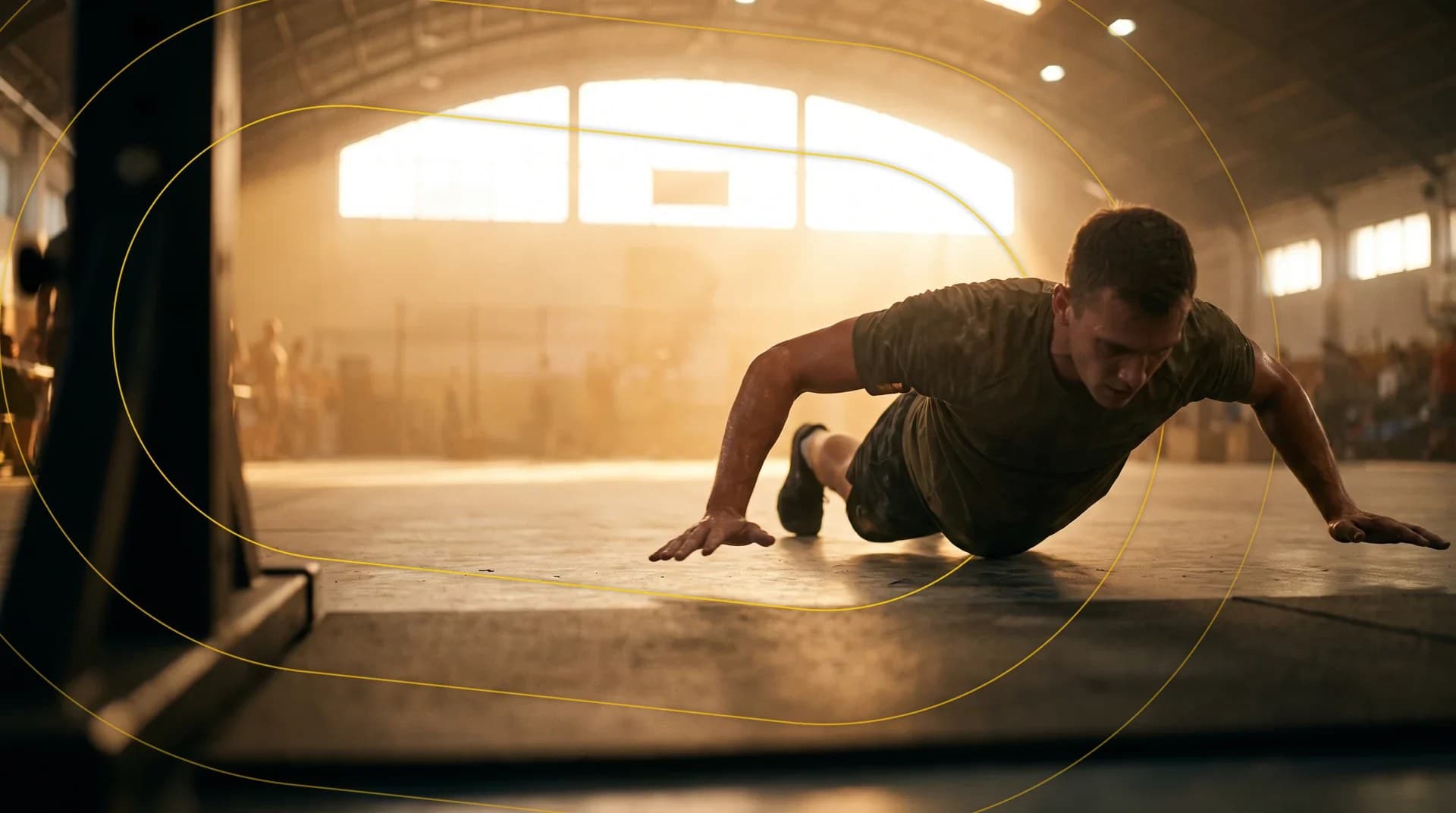
HYROX burpee broad jumps cover 80 metres of chest-to-floor burpees combined with a horizontal broad jump, repeated for 40 to 60 reps depending on your jump distance. It is the most cardiovascular station in the race, it arrives at Station 4 after your legs are already fatigued from the sled, and how you execute it here dictates the quality of every run and station that follows.
If Run 5 is where your race falls apart, this station is usually why.
Picture this: you hit the BBJ station in solid shape. HR is elevated but manageable. You see the turf stretching out in front of you and decide to bank some time. You go hard for the first 20 metres. By 40 metres, your legs are misfiring and your lungs are screaming. You stagger across the finish line and step onto Run 5 with a heart rate that refuses to come down. What was meant to be your fastest run becomes your slowest shuffle. Sound familiar?
The difference between athletes who hold their pace through Run 5 and those who don’t almost always comes down to one decision: how they approached the BBJ station.
This guide covers everything you need, official rules, technique cues, a pacing framework built around your rep-count maths, and a periodised training progression to build the specific fitness this station demands.
Key Takeaways
- HYROX burpee broad jumps cover 80 m; most athletes complete 40 to 60 reps depending on jump distance, taking 3 to 6 minutes
- BBJ is the only unweighted station in HYROX with identical standards across all divisions: Open, Pro, Women, Men
- Starting too fast on the first 20 m is the single most common cause of Run 5 blow-up; sustainable cadence always wins
- The step-up method (stepping feet to hands rather than jumping) significantly reduces cardiovascular demand and is legal at all levels
- Arm swing contributes 10 to 15% of horizontal displacement; maintaining it under fatigue is one of the cheapest time saves available
- A 3-phase training progression (Foundation, Build, Specificity) is essential; random burpee practice without fatigue context does not prepare you for race conditions
What Are HYROX Burpee Broad Jumps?
The burpee broad jump station covers 80 metres of continuous effort: you perform a chest-to-floor burpee, then drive forward with a horizontal broad jump, land and immediately go into the next rep. You are not moving to a fixed number of reps; you are moving to cover the distance. The shorter your jump, the more reps you need.
This station sits at Position 4 in the race, after the SkiErg , sled push and sled pull , with 4 km of total running already in your legs.
The Only Station Where Everyone Plays by the Same Rules
Unlike every other HYROX station, the hyrox burpee broad jump has no load variation between divisions. The sled weights differ between Open and Pro. Farmer’s carry loads differ. The sandbag changes. The BBJ does not. Every athlete, in every division, male or female, Open or Pro, covers 80 metres to the same movement standard. That makes it a genuine equaliser, the athletes with the best combination of cardiovascular fitness, technique and pacing intelligence separate from the field here, regardless of their strength numbers.
The Rep-Count Maths
Your actual rep count is determined by your average jump distance. Use this as a target-setting tool before race day:
| Average Jump Distance | Approximate Reps | Time at 5 s/rep | Time at 7 s/rep |
|---|---|---|---|
| 1.5 m | ~53 reps | 4:25 | 6:11 |
| 1.8 m | ~44 reps | 3:40 | 5:08 |
| 2.0 m | ~40 reps | 3:20 | 4:40 |
| 2.5 m | ~32 reps | 2:40 | 3:44 |
Every extra 10 cm of jump distance saves approximately 3 to 4 reps at pace conditions. The practical takeaway: consistent 1.8 m jumps beat inconsistent jumps that spike between 2.2 m and 1.1 m. Pick a distance you can maintain. Own it for 80 m.
Official HYROX BBJ Rules (and How to Avoid Penalties)
Getting penalised here adds distance and costs time at one of the most cardiovascularly demanding moments in the race. Know the rules before race day, not after.
Movement Standards
- Hands start behind the starting line and are placed no more than 30 cm ahead of the toes (roughly one foot’s length) when you drop into the burpee
- Once your hands are placed on the floor, they cannot be moved forward
- Your chest must touch the floor at the bottom; there is no push-up requirement, but passive lowering to the chest counts
- When you stand to jump, feet cannot pass the fingertips (i.e., the hands position on the floor)
- The broad jump must be a simultaneous two-foot take-off and two-foot landing with feet parallel
- No steps forward between reps; each rep starts from where your feet land
- The station is complete when you jump over the finish line; if either foot lands on or before the line, you must complete another rep
The Penalty System
The first violation earns a verbal warning and the rep is discounted (you must complete it again). The second violation triggers a 5-metre distance penalty added to the 80 m. At a 1.8 m average jump, that 5 m costs you roughly 3 additional reps and an extra 20 to 40 seconds. Compliance is free; penalties are expensive.
The most common violations:
- Hands placed more than 30 cm ahead of the toes (rushing the drop)
- Single-foot take-off on the broad jump (usually under fatigue in the final 20 m)
- Stepping forward between reps
Doubles Rules
In HYROX Doubles, your partner takes over from the exact point where your feet landed. They place their hands where your feet were and begin their rep. This requires a clear, confident landing signal to your partner and good communication through the station.
BBJ Technique Breakdown
Technique in this station is not about being pretty. It is about being economical. Every unnecessary movement, every wasted second of air time, every heavy landing costs you cardiovascular currency you cannot afford to spend.
The Burpee Phase: Efficiency Cues
The goal of the burpee phase is to descend, touch and return to standing as efficiently as possible. Not as athletically as possible. Not as explosively as possible.
- Hand placement: controlled, deliberate, within 30 cm of toes. Rushing this is where violations happen
- Descent: lower to chest touch under control; collapsing with too much force just slows your ascent
- Foot position on the way up: step-back and step-forward is standard; wide feet on landing gives you a more stable base for the jump
Jump-up vs. step-up: two techniques, two different physiological costs.
The jump-up (jumping both feet back on descent, jumping both feet forward on return) is faster per rep but significantly more cardiovascular. It is appropriate for elite athletes with a very high aerobic ceiling who can sustain it for 80 m without spiking HR above a manageable threshold.
The step-up (stepping one foot back, then the other, stepping one foot forward, then the other) is slower per individual rep but dramatically reduces HR elevation. For most Open-division athletes, especially later in the race, the step-up produces a better overall station time because it allows a higher cadence and protects Run 5.
Most Kracey athletes we work with achieve faster overall BBJ times using the step-up. Try both in training and measure your heart rate response, the data will tell you which technique suits your aerobic ceiling.
The Broad Jump Phase: Maximising Distance Without Burning Out
The hyrox burpee broad jump is where you can gain meaningful time without meaningful extra effort, if you execute correctly.
- Arm swing: as you stand and prepare to jump, drive your arms back (loaded back-swing) and then aggressively forward and up as you leave the floor. Arm swing contributes approximately 10 to 15% of your horizontal displacement. Under fatigue, athletes lose arm drive first. Consciously maintaining it is one of the cheapest performance interventions available in this station
- Take-off angle: aim for roughly 30 to 45 degrees from horizontal; jumping too vertically wastes energy and reduces horizontal distance
- Brace on landing: bend your knees slightly on landing to absorb force; this reduces impact stress and sets up a faster transition to the next rep
The Transition: Where Most Time is Actually Lost
Here is what most guides miss: the biggest time-leak in the hyrox burpee broad jump station is not the burpee and it is not the jump. It is the moment between landing and initiating the next rep.
Athletes who are fatigued or unfocused pause on landing. They stand briefly, gather themselves, then begin dropping. Those half-second pauses add up to 20 to 40 seconds across a full station.
The cue to build in training is: land, absorb, and hands down in one fluid sequence. Use the stretch reflex from landing to immediately drive your hands to the floor. The momentum of landing can become the momentum of the next descent. This is trainable and it makes a measurable difference.
Pacing Strategy for HYROX Burpee Broad Jumps
This is the section that changes race outcomes.
Why “Go Hard Early” Destroys Run 5
Your heart rate in HYROX never fully recovers between stations. By Station 4, HR is sitting at 160 to 170 bpm between transitions in most athletes, even before the BBJ begins. When you go hard in the first 20 metres of the hyrox burpee broad jump, you spike an already elevated HR to near-maximum. That HR does not return to a manageable level within the station. You step off the mat and onto Run 5 with your cardiovascular system in crisis mode.
The result is not a slightly slower Run 5. For many athletes, it is a 30 to 60 second per kilometre deterioration compared to their Run 4 pace, and it cascades through the second half of the race.
The Sustainable Cadence Formula
Pick a target. Commit to it before you start.
- Decide your realistic average jump distance (use training data, not optimism)
- Look up your rep count from the table above
- Estimate your sustainable seconds-per-rep (5 to 7 seconds is the typical range)
- Set that as your station target time and work backwards to your required cadence. The HYROX time predictor models your full race, including the BBJ split, so you arrive at Station 4 with a target rather than a guess
An athlete who can jump 1.8 m consistently needs approximately 44 reps. At 7 seconds per rep, that is just over 5 minutes for the station. If they try to push to a 5-second cadence for the first 20 m, they will not hold it. They will regress to an 8 to 9 second cadence in the back half, finishing in roughly the same total time but with far greater cardiovascular cost and a wrecked Run 5.
Flat cadence beats surge-and-die every time. This same principle applies across all eight HYROX workout stations, pacing discipline is what separates athletes who finish strong from those who survive.
How to Use Run 4 to Set Up Your BBJ
The 200 m leading into the BBJ mat is transition preparation, not just running.
- Reduce your Run 4 effort level deliberately in the final 200 m
- Focus on nasal breathing if possible to bring HR down
- Shake out your hands and arms to release upper-body tension
- Arrive at the BBJ mat with HR dropping, not climbing
This does not cost meaningful time on Run 4. Even a 5-second reduction in Run 4 pace over 200 m is 3 to 4 seconds of “lost” time. If it saves you 30 seconds on Run 5, it is one of the highest-ROI decisions in the race.
Breathing as a Pacing Mechanism
Almost no hyrox burpee broad jump guide addresses breathing, which is remarkable given that this is the most cardiovascular station in the race.
The pattern to practise: inhale on the descent, exhale on the jump take-off. Controlled breathing serves two functions: it keeps HR regulated, and it provides a rhythm that naturally moderates your cadence. Athletes who lose their breathing pattern in the first 20 m are almost always the ones who blow up by 50 m.
Practise this rhythm in training until it is automatic. Under race stress, automatic patterns hold; deliberate ones collapse.
If You Need to Rest
Rest on the floor, not standing. When you are in the bottom of the burpee position, you are in a lower-demand posture than standing with your HR spiking. If you need 3 to 5 seconds to reset, take them from the floor. This also keeps you compliant with the station (no steps forward) and means you are already in position when you continue.
Common BBJ Mistakes and How to Fix Them
Overjumping the First 20 Metres
Going out at max effort feels powerful. It is not a strategy. Start at 80% of perceived max effort and hold it. If you feel strong at 60 m, you can push the final 20 m.
Jumping High Instead of Horizontal
Vertical height is wasted energy in this station. Air time without horizontal distance costs you cardiovascular effort without shortening the total distance. Focus on a low, flat trajectory with aggressive arm drive forward, not upward.
Poor Landings
Landing stiff-legged with locked knees creates impact stress, slows your transition and increases injury risk. Land with soft knees, absorb, and use that absorbed energy to flow directly into the next rep.
Irregular Breathing
Holding your breath, gasping, or losing your inhale/exhale pattern sends HR spiralling. If you notice your breathing has gone irregular, deliberately slow your cadence for 3 to 4 reps to reset it. The cadence cost is far lower than the HR cost of pushing through breathlessly.
Skipping Rule Compliance Under Fatigue
Violations increase in the final 20 to 30 metres as athletes fatigue. Rushing hand placement past the 30 cm limit and single-foot take-offs are the most common culprits. Build compliance habits so deeply in training that they hold under race stress. The 5 m penalty is brutal.
How to Train HYROX Burpee Broad Jumps: A 3-Phase Progression
Training hyrox burpee broad jumps randomly, or only as part of general conditioning, does not prepare you for what this station demands in a race context. You need a structured progression that builds technique first, then volume and fatigue tolerance, then race-specific simulation.
This is the same three-phase structure used in Kracey’s HYROX training plans , applied specifically to the BBJ station.
Phase 1, Foundation: Build the Pattern (Weeks 1 to 3)
Before you worry about conditioning, own the movement.
Technique ladders: Set out 10 m, then 20 m, then 30 m. Complete each distance focusing exclusively on movement quality, hand placement, chest touch, step-up technique, arm drive on the jump, soft landing. Rest fully between sets. Do not progress distance until each section is technically clean.
Step-up practice at low intensity: Spend 10 to 15 minutes per session practising the step-up technique at conversational pace. Film yourself if possible. Identify where your technique breaks down (usually hand placement or landing mechanics).
Breathing drills: Practise the inhale-on-descent / exhale-on-jump pattern at low intensity until it is natural.
Target sessions: 2 per week, technique-focused, no higher than 70% effort.
Phase 2, Build: Volume and Fatigue Tolerance (Weeks 4 to 7)
Now you add load. The key principle in this phase is training the hyrox burpee broad jump in a fatigued state, because that is always how you will encounter it in a race.
Fatigued BBJ sets: After a 1 km run at threshold pace, or after a sled work block, complete 20 to 30 BBJ reps. Rest 2 to 3 minutes. Repeat 3 to 4 rounds. This is the most important adaptation in the build phase, your nervous system learns to execute the movement with elevated HR and heavy legs.
EMOMs (Every Minute on the Minute): Set a 10-minute EMOM at 8 to 10 reps per minute. This trains consistent cadence and teaches you what a sustainable rhythm actually feels like. Most athletes discover their natural cadence is slower than they assumed.
Distance pyramids: Build progressively to 80 m unbroken, 20 m, 30 m, 40 m, 60 m, 80 m across separate sessions. Do not attempt 80 m unbroken until your 60 m sets feel controlled.
Metronome burpees: Use a metronome app set to 60 to 70 bpm. One rep per beat. This is deliberately slower than race pace and trains rhythmic consistency.
This phase also requires supplementary strength work (see below). Integrating this into a complete HYROX training schedule ensures the BBJ-specific work sits within the right periodisation context rather than piling fatigue on top of an already loaded week.
Target sessions: 2 to 3 per week, mixing the formats above.
Phase 3, Specificity: Race Simulation (Weeks 8 to 10)
Now you train the actual race context.
The Run-BBJ brick: 1 km at race pace, immediately into 80 m BBJ at race cadence, then back into 400 m at race pace. Rest 3 minutes. Repeat 3 rounds. This is the most race-specific drill available.
4-round race simulation:
- 400 m at race pace
- 20 m BBJ
- Rest 90 seconds
- Repeat 4 rounds
Increase the BBJ distance across the phase from 20 m to 40 m to 60 m to 80 m as fitness develops.
Full station simulations with transition practice: Cover the full 80 m with your race pacing strategy and deliberately practise the final 200 m run-in (bringing HR down before you start). This teaches the tactical execution, not just the physical capacity.
Competition-standard reps only: No shortcuts. Every rep in the specificity phase is to full movement standards. This locks in compliance under fatigue.
For athletes following a complete programme, this station-specific work integrates into your hybrid training programme as a targeted conditioning block, not an add-on. The running fitness that underpins a strong Run 5 is built through the same strength training for runners principles that make you resilient across all eight stations, not just this one.
Supplementary Strength Work
These exercises build the specific capacities the hyrox burpee broad jump demands without adding high-volume BBJ reps to already-loaded training weeks:
- Box jumps (3 sets of 5 to 8): trains explosive hip extension and landing mechanics
- Bounding broad jumps (3 sets of 6 to 8): builds horizontal power and arm drive
- Explosive push-ups (3 sets of 8 to 10): develops upper-body contribution to the burpee phase
- Kettlebell swings (3 sets of 12 to 15): hip hinge power that transfers directly to the jump
- Single-leg Romanian deadlifts (2 sets of 10 per side): landing stability and deceleration control
Frequently Asked Questions
How many burpees do you do in a HYROX race? There is no fixed rep count. HYROX burpee broad jumps cover 80 metres; your rep total depends on your average jump distance. Most athletes complete 40 to 60 reps, with those jumping around 1.8 m averaging approximately 44 reps. Elite athletes with longer jumps can be closer to 30 to 35 reps.
What is the step-up method for HYROX burpee broad jumps? The step-up method means stepping one foot at a time to your hands on the way up from the burpee, rather than jumping both feet simultaneously. It is slower per individual rep but significantly reduces cardiovascular demand, allowing you to maintain a consistent cadence across all 80 m and arrive at Run 5 with a more manageable heart rate. It is legal at all levels.
How do I pace burpee broad jumps at HYROX without blowing up? Pick a target jump distance you can maintain consistently, calculate your approximate rep count using the table in this guide, and set a sustainable seconds-per-rep target. Hold that cadence from the first rep. Do not go harder in the first 20 m regardless of how strong you feel. Use the final 200 m of Run 4 to lower your heart rate before you begin.
Why do HYROX burpee broad jumps destroy your running afterwards? By Station 4, heart rate in most athletes is already sitting at 160 to 170 bpm between transitions due to cumulative fatigue. The BBJ station, if approached too aggressively, spikes HR to near-maximum. Heart rate recovery is slower under cumulative fatigue than in fresh conditions, meaning you step onto Run 5 with a HR that cannot drop. The result is a significantly deteriorated run pace.
Should I practise burpees every day for HYROX training? No. Training BBJs 2 to 3 times per week with appropriate recovery is more effective than daily practice. Overuse without recovery impairs motor pattern quality and increases injury risk. The specificity phase sessions (run-BBJ bricks and race simulations) are demanding enough that 48 hours minimum between sessions is required.
What happens if I break the rules at the BBJ station? The first violation earns a verbal warning and the rep is discounted; you must complete it again. The second violation adds a 5-metre penalty to the total distance, which translates to approximately 3 additional reps and an extra 20 to 40 seconds at typical race pace. Rule violations cluster in the final third of the station when fatigue is highest, which is exactly why compliance needs to be trained, not assumed.
Conclusion
HYROX burpee broad jumps are where second halves are won or lost. Master the technique, respect the pacing maths, and train the station in the fatigued context you will actually face on race day.
The athletes who run a strong Run 5 are not just fitter. They are smarter. They arrive at the BBJ mat with a plan: a target jump distance, a cadence, a breathing pattern, and a clear understanding of what sustainable effort looks like for 80 metres of combined burpee and broad jump.
Build the foundation, develop your fatigue tolerance, and practise the full race context before your event. If you want a structured programme that periodises all eight stations alongside your running blocks, explore the Kracey HYROX training plans and find the plan matched to your race timeline.
Race crazy. Finish strong.