
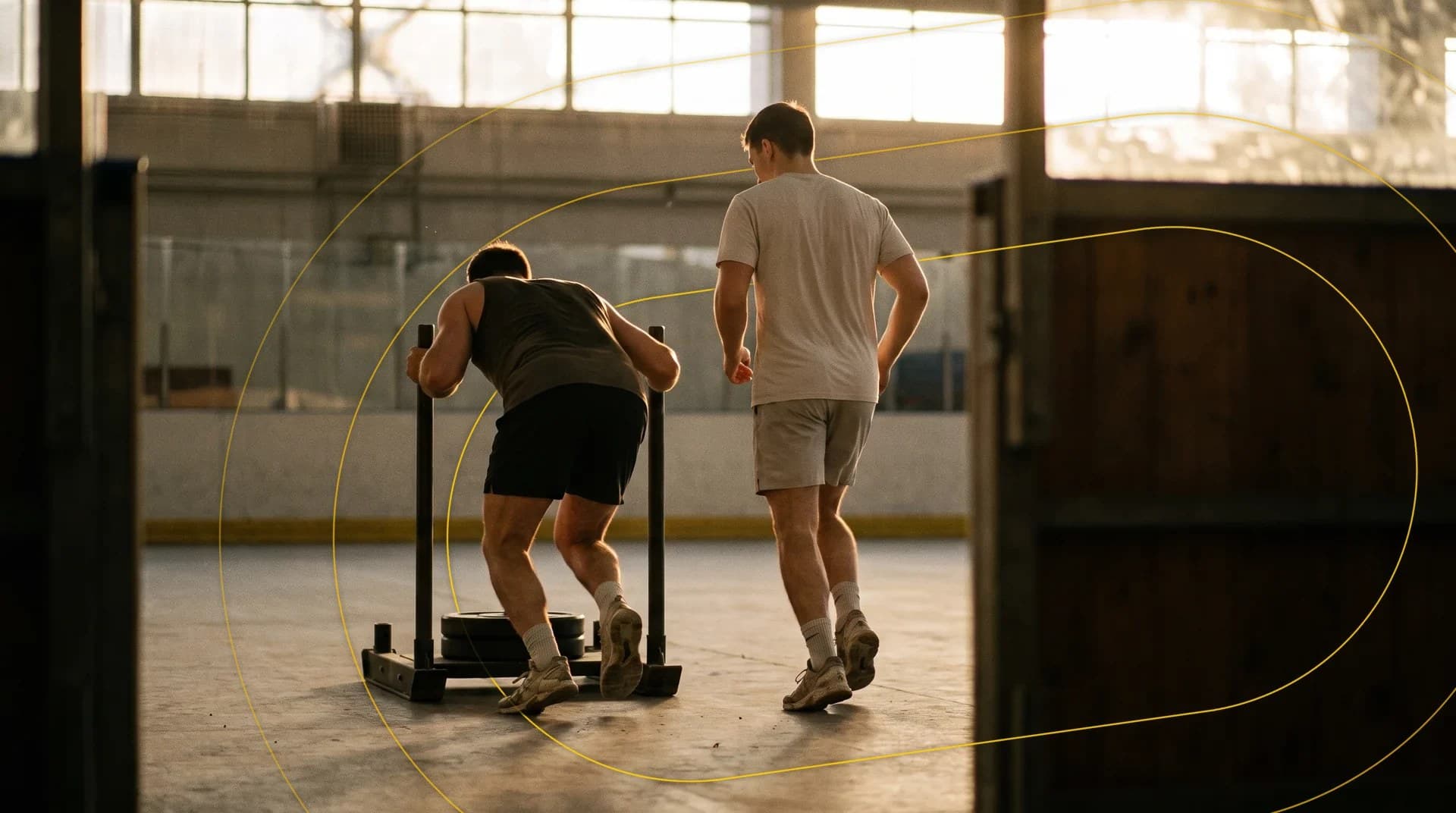
HYROX has four main competition divisions: Open, Pro, Doubles, and Relay. The vast majority of athletes, over 90%, compete in Open, which has no qualification requirements and is the right starting point for first-timers and fitness newcomers alike.
If you have typed “which HYROX division should I enter” into a search engine at midnight before registering for your first race, you are not alone. The division structure looks simple on paper, but it raises real questions: are you good enough for Pro? Is Doubles too easy? What do the age categories actually mean? This guide cuts through all of it so you can register with confidence and train with a purpose.
Key Takeaways
- HYROX runs four formats: Open, Pro, Doubles, and Relay. Most athletes start and stay in Open.
- Pro uses significantly heavier station loads, with the Men’s sled push rising from 152kg to 202kg.
- No formal qualification is required for any division, but completing at least one Open race before entering Pro is strongly recommended.
- Sub-80 minutes in Open (men) or sub-90 minutes (women) is a common benchmark for considering the switch to Pro.
- From 2026, World Championship qualification requires Pro division entry, except in the 60+ age groups, which qualify through Open and race Open weights at the Championships.
What Are the HYROX Divisions? A Quick Overview
Every HYROX race follows the same format: 8km of running broken into 1km segments, each followed by one workout station. The format never changes. What changes between divisions is the load at those stations, and in some formats, how the work is shared between athletes.
The four HYROX divisions are, as defined in the official HYROX Season 26/27 rulebook :
- Open (individual, men and women separately)
- Pro (individual, men and women separately)
- Doubles (teams of 2, with Men’s, Women’s, and Mixed categories)
- Relay (teams of 4)
Within Open and Pro, athletes are further sorted by age group and gender. This means your actual competition is people of a similar age and biological gender, not the entire Open field. More on age groups below.
The Open Division: The Right Start for Most Athletes
Open is where HYROX begins for almost everyone, and for good reason. There are no entry requirements, no prior race experience needed, and the station loads are achievable for athletes with a solid gym and running base.
This does not mean Open is easy. Far from it. Eight kilometres of running across 8 segments, combined with 8 demanding workout stations, is a serious physical test. The difference between Open and Pro is not beginner versus advanced. It is experienced versus elite.
Open Station Loads: Men and Women
| Station | Men’s Open | Women’s Open |
|---|---|---|
| Ski Erg | 1,000m | 1,000m |
| Sled Push | 152kg / 50m | 102kg / 50m |
| Sled Pull | 103kg / 50m | 78kg / 50m |
| Burpee Broad Jumps | 80m | 80m |
| Rowing Machine | 1,000m | 1,000m |
| Farmer’s Carry | 2×24kg / 200m | 2×16kg / 200m |
| Sandbag Lunges | 20kg / 100m | 10kg / 100m |
| Wall Balls | 6kg / 3.00m / 100 reps | 4kg / 2.70m / 100 reps |
Both Open categories complete 100 wall ball reps. What differs is the ball weight and the target height.
What Does Open Actually Feel Like?
The honest answer: harder than most athletes expect the first time around. The sled push and sled pull catch even experienced gym-goers by surprise, because they hit differently on tired legs after 3km of running. The cumulative fatigue is unlike any individual session you have done.
Across the 2025/26 season the median Open finish is 1:27 for men and 1:36 for women, with field averages of 1:31 and 1:40. Results do not flag first-timers, so the honest debut expectation is the back quarter of the field: 1:41 to 1:57 for men and 1:50 to 2:07 for women.
A common first-race pattern: an athlete with years of half marathons behind them and eight months of gym training, comfortable with the farmers carry in training, feels ready for everything. Then Station 6 arrives on jelly legs, and the race turns out to be a different beast from either the running or the gym on its own. Open is the right call for exactly that athlete.
The Pro Division: When and Why to Level Up
The Pro division keeps the same race structure as Open but increases the load at several key stations. For some athletes, this is a meaningful step up in challenge. For others who are chasing the World Championships, it eventually becomes the only path forward. If you are weighing the two, our guide on HYROX Pro vs Open walks through exactly how to decide.
From 2026, qualification for the HYROX World Championships requires competing in the Pro division, with one exception written into the rulebook: athletes aged 60 and above qualify through the Open division instead, and compete at the Championships using Open weights, repetitions and distances. If podium ambitions and world-stage appearances are on your radar and you are under 60, Pro is not optional, it is the entry price.
How Pro Loads Differ from Open
| Station | Men’s Open | Men’s Pro | Women’s Open | Women’s Pro |
|---|---|---|---|---|
| Sled Push | 152kg | 202kg | 102kg | 152kg |
| Sled Pull | 103kg | 153kg | 78kg | 103kg |
| Farmer’s Carry | 2×24kg | 2×32kg | 2×16kg | 2×24kg |
| Sandbag Lunges | 20kg | 30kg | 10kg | 20kg |
| Wall Balls | 6kg / 3.00m / 100 reps | 9kg / 3.00m / 100 reps | 4kg / 2.70m / 100 reps | 6kg / 2.70m / 100 reps |
The most dramatic jump is on the sled push. Men moving from Open to Pro face a 50kg increase on an already brutally taxing station. Women face a comparable 50kg increase. The wall ball change is also significant: the ball weight goes up in Pro while the target height stays the same, which turns a manageable station into a shoulder-burning test of endurance.
The stations that stay the same in terms of reps (burpee broad jumps, ski erg, rowing machine) still feel harder in Pro because the heavier station work leaves your body in a different state of fatigue going into them.
Are You Ready for Pro? Three Benchmarks
Pro is not a status symbol. Entering Pro before you are ready adds time, increases injury risk, and produces a demoralising experience. These benchmarks give you an honest picture:
- Running capacity: You can run 8km in under 40 minutes at a comfortable effort. If 8km at pace leaves you spent, the combined demand of Pro stations will compound that quickly.
- Open finish time: Men finishing Open in around 80 minutes or faster, and women finishing in around 90 minutes or faster, are showing the conditioning base that Pro demands.
- Station-specific strength: You can perform the Pro-weight sled push and sandbag lunges under fatigue, not just in a fresh training session.
Take James, a 38-year-old from Bristol whose first two HYROX races are both in Open: 76 minutes, then 71. Both are inside the 80-minute benchmark above, so for his third race he enters Pro, with his training structured specifically for the heavier loads. His time moves back to 84 minutes, 13 minutes slower than his second Open race, and the switch still makes sense: his running is strong enough to carry him through the heavier station work, and he is now racing at a different level.
If you are unsure, complete one more Open race and use it as a benchmark. Track your running splits and note which stations slow you down most. That data is more useful than any checklist.
Want to know whether your current running fitness supports a move to Pro? Use the HYROX Finish Time Predictor to benchmark your expected time and identify the biggest gaps in your preparation.
The Doubles Division: HYROX with a Partner
Doubles is one of the most popular HYROX formats for athletes who want to share the experience, whether with a training partner, a friend, or a spouse. Two athletes complete the race together, but the work is split in a way that makes the overall experience significantly different from solo racing.
How Doubles Works
Both athletes run every 1km segment together. At each workout station, the two athletes split the reps however they choose. One athlete might take all 100 wall ball reps while the partner rests, or they can alternate in any combination. The station weights are the same as Open. What changes is that the total volume is shared between two people.
This makes the aerobic demand higher relative to the strength demand, because the running cannot be split. Every kilometre is run together, every time.
Men’s, Women’s, and Mixed Doubles
Doubles runs in three categories:
- Men’s Doubles: two men
- Women’s Doubles: two women
- Mixed Doubles: one man and one woman
Age in Doubles is determined by the average age of both athletes, which affects which age group bracket the team competes in.
Mixed Doubles is a popular entry point for couples and training partners coming from different backgrounds. One athlete’s running strength can complement the other’s station ability. The flexibility in how you split the reps is one of the genuinely enjoyable tactical elements of the format.
Who Doubles Is Best For
Doubles works well for athletes who want to enter HYROX without the full solo load, who want to share the race with someone, or who are returning from injury and want to manage their individual volume. It is also a legitimate stepping stone for athletes building towards solo Open racing.
The Relay Format: Team of Four
In a HYROX Relay, four athletes split the race. Each person is responsible for two 1km running segments and two workout stations. The team completes the eight sets as a collective, with each athlete handling their assigned portion.
Relay is the most accessible format for people new to HYROX or coming from a gym-only background. The individual running and station load is a quarter of the solo race. It is also a strong team-building option and a good way to experience the race environment before committing to a solo entry.
HYROX Age Groups Explained
Every Open and Pro race includes age group sub-categories. Your finish time is ranked within your division and age group, so you are competing against people of a comparable age, not the full field of all entrants.
The official age groups are:
- 16-24
- 25-29
- 30-34
- 35-39
- 40-44
- 45-49
- 50-54
- 55-59
- 60-64
- 65-69
- 70-74
- 75-79
- 80-84
- 85-89
Official age groups extend in five-year increments all the way to 85-89, so the list does not stop at 60+. Your age is calculated on race day. The age group you race in at a regular event is the same age group you would compete in at the World Championships.
Most athletes find that competing within their age group reframes their expectations usefully. Being in the top third of your age group is a genuine achievement, and tracking your performance within that bracket across multiple races is a more meaningful measure of progress than a raw finish time.
Open, Pro or Doubles? How to Decide
Here is a straightforward decision framework:
Choose Open if:
- It is your first HYROX race
- You have been training for fewer than 12 months specifically for HYROX
- Your 8km run time is above 40 minutes
- You have not trained consistently with the Open station weights under fatigue
Choose Pro if:
- You have completed two or more Open races
- Your Open finish time is below 80 minutes (men) or 90 minutes (women)
- You are targeting World Championship qualification
- You can perform the Pro station weights comfortably in training under cumulative fatigue
Choose Doubles if:
- You want to share the race experience with a training partner
- You are managing an injury or returning to training
- You are new to HYROX and prefer to share the station volume
- You want to enter as a mixed pair and play to each other’s strengths
There is no wrong answer. Open is the starting point for a reason. The goal of your first race is to finish, to learn, and to walk away wanting to come back. The division you choose shapes how you train, because the right training programme accounts for the exact demands of your division.
How Your Division Choice Shapes Your Training
This is the part most division guides skip over. Choosing a division is not just a registration decision. It sets the parameters for how you train for the next 8 to 16 weeks.
Open athletes need to build strength at Open loads and running endurance across 8km. The goal is finishing the sled push on station two without compromising the next 6km of running. The training emphasis is on aerobic base and station-specific conditioning at race weights. Every load you need to programme against, for all four individual divisions plus Doubles and Relay, is in the HYROX weights by division reference .
Pro athletes need to train at heavier loads from the beginning of their build, because arriving at the sled push fresh from an Open programme leaves a significant gap. The heavier wall ball requires a different shoulder and leg endurance profile. The jump from Open to Pro is not just weight on a bar; it is the combination of heavier loads with the same aerobic demand.
Doubles athletes benefit from training together, but each individual still needs strong running fitness. Because both athletes run every kilometre, the aerobic engine matters just as much in Doubles as it does in Open.
Not sure how to structure your training around your division? The HYROX Training Plan from Kracey walks through the full periodisation framework, from foundation phase to competition prep, tailored to your race date and division.
Understanding your training zones is also critical here, particularly for the running component. Knowing whether you are in Zone 2 or pushing into Zone 4 during your 1km segments determines how much you have left for the stations. Use the Training Zone Calculator to find your personal training zones before your next run session.
Frequently Asked Questions
Can I enter the Pro division for my first HYROX race?
Technically yes, there is no rule preventing it. But it is strongly inadvisable. The Pro sled push alone is 50kg heavier than Open, and that load compounds across an 8km race. Most experienced coaches recommend at least one or two Open races before considering Pro, so you understand the fatigue pattern and know your station pacing.
Is Mixed Doubles competitive or just for fun?
Both. Mixed Doubles has serious athletes competing for podium places and World Championship qualification at the Doubles level. It also attracts couples and training partners who simply want to share the experience. The tactical element of deciding who does what at each station adds a genuinely interesting layer to the race.
What is a realistic finish time for my first HYROX Open race?
Nobody publishes a first-timer average, because results do not flag debut athletes. The back quarter of the Open field, 1:41 to 1:57 for men and 1:50 to 2:07 for women, is the honest expectation, and your running background and station preparation decide where inside it you land. The HYROX Finish Time Predictor can give you a personalised estimate based on your current running performance.
Do HYROX divisions have different race bibs or start times?
Yes. At most HYROX events, Pro athletes typically start in earlier waves, and divisions are grouped separately to ensure accurate age group and division rankings. Check the specific event guide on hyrox.com for the wave structure at your race.
How does the age group system work in Doubles?
In Doubles, the age group is determined by the average age of both athletes. So a 28-year-old and a 34-year-old competing together would have an average age of 31, placing them in the 30-34 age bracket.
What happens if I choose Open and want to move to Pro later?
You simply register for Pro at your next event. There is no formal process, no qualifying race required, and no application. Your readiness is determined by your own performance data, not by HYROX admin.
Conclusion
HYROX divisions exist to give every athlete a meaningful competitive context, whether you are completing your first race in Open or chasing a podium in Pro. For most athletes starting out, Open is the right choice. It is challenging, competitive within your age group, and it gives you the race experience and data you need to make an informed decision about where to go next.
If you are training for your first HYROX or planning the step up from Open to Pro, the key is preparing specifically for your division’s demands, not just building general fitness. The station weights are fixed. Your training should be built around them.
Use the HYROX Pace Calculator to plan your running splits before race day, and get coached in Telegram so every session between now and then is pointed at the weights and targets your division actually sets.
Choose your division. Train for its numbers. Show up ready.