
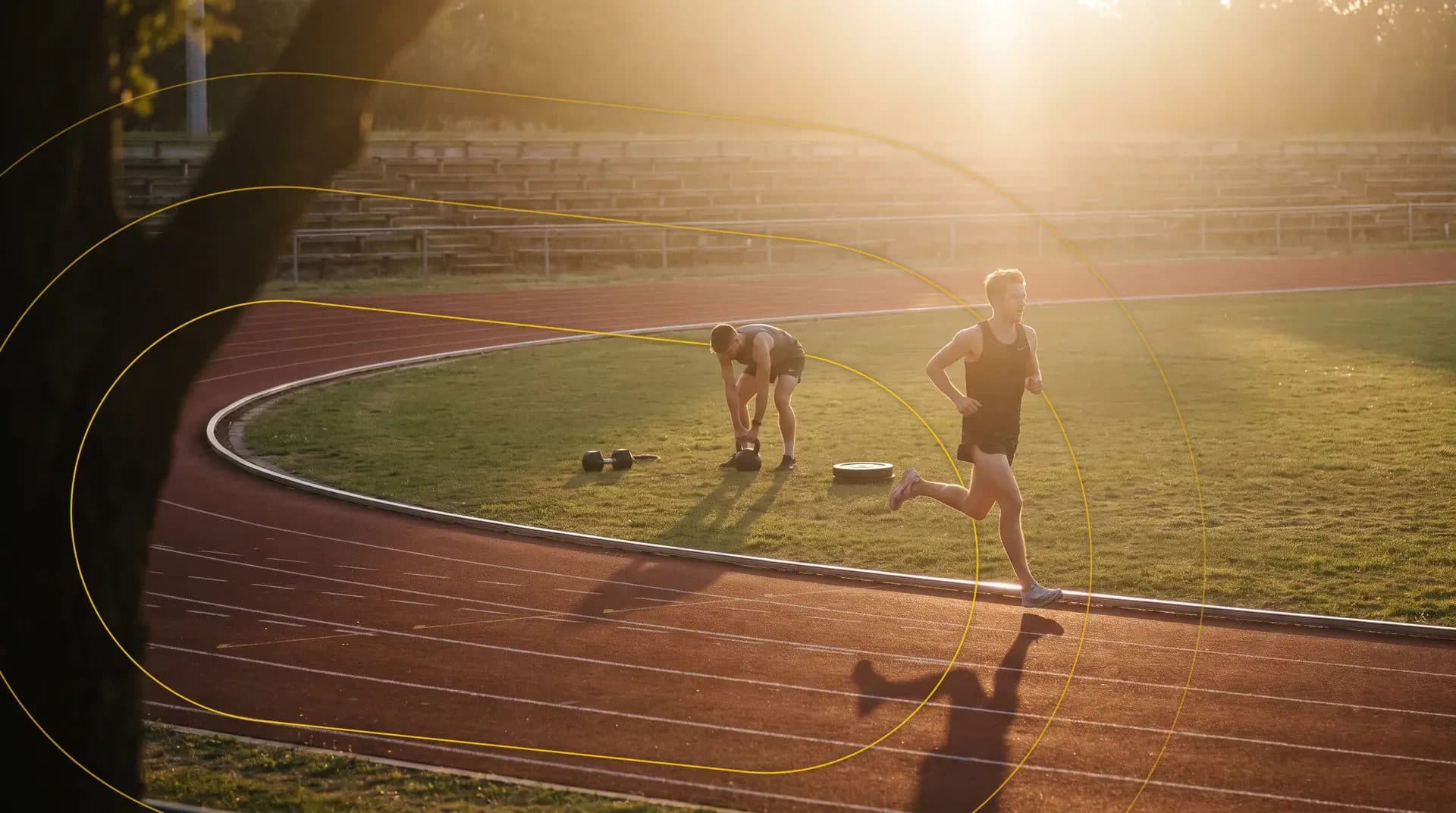
The Deadly Dozen is a hybrid fitness race held on an athletics track, combining 12 x 400m runs (called Journeys) with 12 functional exercise stations (called Labours), all completed in sequence with no rest between them. It is open to all adults aged 18 and over, scalable for beginners, and requires nothing more than a kettlebell, dumbbell, and weight plate to train for.
If you’ve been seeing location-specific searches popping up this summer, Kevelaer, Klagenfurt, Davos, Vancouver, and Crystal Palace for the World Championships, there’s a reason for that. The Deadly Dozen is growing at a rate that is turning heads across the hybrid fitness world, and 2026 is shaping up to be its biggest year yet.
This guide covers everything: what the race involves, what the name means, the format end to end, the 12 Labours in full, the entry categories and age groups, how it compares to HYROX, realistic finish times, and precisely how to prepare so you arrive at the start line ready to race it well.
Key Takeaways
- The Deadly Dozen combines 12 x 400m runs with 12 functional exercise stations on an athletics track, totalling roughly 4.8km of running.
- The 12 Labours use only a kettlebell, dumbbell, and weight plate, meaning the movements are trainable anywhere with basic kit.
- Scaling is built into the format: athletes who need to modify a Labour complete the race with an “(s)” next to their time, not a DNF.
- Entry categories include Solo, Pairs, and Relay (teams of four), with mixed pairs completing at male weights.
- Entry is open to anyone aged 18 or over on race day, across twelve age categories from 18-29 up to 80+, with a separate Deadly Youth format for 12 to 15 year olds.
- Competitive athletes typically finish in under 90 minutes; the broader field varies based on Labour pace and conditioning.
- The 2026 calendar includes international events in Germany, Austria, Switzerland, and Canada, plus the World Championships at Crystal Palace, London on 5, 6 September 2026, with a £120,000 prize pot.
- Hybrid athletes already training for HYROX adapt quickly to Deadly Dozen, as running fitness and functional strength transfer directly.
What Is the Deadly Dozen Race?
The Deadly Dozen was founded by Jason Curtis and the Institute of Fitness Racing as an athletics-track-based fitness race built around what its creators call the dozenal system: every element of the race is rooted in the number 12.
The format is deceptively simple. You run a 400m lap of the track (a Journey), then complete a functional exercise station on the grass infield (a Labour), then run another lap, complete another Labour, and repeat until you have done 12 of each. That’s 4.8km of running and 12 exercise stations, all completed in order, with no formal rest periods.
What makes Deadly Dozen stand out from most hybrid fitness events is the equipment philosophy. There is no ski erg, no sled, no rowing machine. Every Labour uses a kettlebell, dumbbell, weight plate, or bodyweight only, and the 12 were picked to cover what the rulebook calls the Half Dozen Fundamental Movements: hinge, squat, lunge, push, pull and carry. The movements are the same ones you’d train in any well-equipped gym or even a decent home setup. That accessibility is deliberate.
The race takes place on a standard athletics track, with Labours set up on the infield grass. The atmosphere is closer to a community sports day than a warehouse fitness event: spectators can watch from the stands, athletes start in small waves of two to four, and the open-air setting gives it a completely different feel to indoor arena events.
Who Is It For?
The Deadly Dozen is open to all adults aged 18 and over. You do not need to be an experienced athlete to enter, and the format includes a formal scaling system so that beginners can complete the race without being forced to withdraw.
Whether you’re a seasoned HYROX racer looking for your next challenge, a runner who wants to add functional fitness to your race calendar, or a gym-goer who has been watching hybrid fitness grow and wants to try it for the first time, the Deadly Dozen is built to accommodate you.
What Does “Deadly Dozen” Mean?
The name is literal on every count, and it points at three different things.
The race runs on a dozenal system. The rulebook describes the Deadly Dozen as working off a dozenal (duodecimal) system, so every distance and every rep count is built on the number 12: 12 Journeys of 400m, 12 Labours, and station targets (240m, 180m, 120m, 60m, 60 reps) that move up or down by 25, 50 or 75% and still land on whole numbers. That is why the numbers look the way they do. It was designed as a training system you can reproduce in any gym, not just a race-day layout.
“Deadly” is the difficulty claim, and the branding leans into it. The rulebook’s own description is “one of the hardest yet most accessible fitness races in the world”. Everyone who completes the race, scaled finishes included, receives a Mori Medal, a skull-and-bell pendant rather than a participation medal. Two discretionary awards go out on the day as well: the Hercules Patch, for the athlete who showed the most heart across the Labours, and the Atalanta Patch, for the same across the Journeys.
And “the Deadly Dozen” is also a group of people. The 12 fastest male and 12 fastest female athletes across every Deadly Dozen race worldwide in a given year are themselves known as the Deadly Dozen, and the number one man and woman take the title “Deadliest of the Dozen”. So when you see the phrase used about athletes rather than about an event, that is the sense being used.
Two more words you will hear all day at a race:
- Journey: one 400m lap of the track. There are 12 of them, 4,800m in total.
- Labour: one exercise station on the infield. There are 12 of them, completed in a fixed order.
What Is the Deadly Dozen Race Format?
The run-and-Labour loop described earlier is the whole format, and it does not change: Journey, Labour, Journey, Labour, twelve times each, in a fixed order. What follows is what that actually looks like on the day.
How a Deadly Dozen Race Runs, Start to Finish
- Journey 1. The race opens with a full 400m lap, set off in line with the first Labour station on the outside lanes. You can drop into lane two straight away, and into lane one once you have passed the last Labour station.
- Into Labour 1. Coming off the lap you run down the inside lane on the home straight, step across the timing mat onto the infield in line with the first Labour, and work.
- Back onto the track. Step back across the mat and Journey 2 is underway.
- Repeat, in order, all the way to 12. You cannot skip a Labour or take them out of sequence, and you cannot move on until the one in front of you is done.
- Finish. By the line you have covered 4,800m of running, roughly 900m of loaded carries and crawls, and 320 reps.
Water sits on the outer lanes of the final curve, so you can drink on the approach to a Labour rather than losing time standing at the station.
On rests and cut-offs. There are no rest periods built into the format, and there is no time limit either. That combination is worth thinking about before race day. You can stop inside a Labour whenever you need to, provided the equipment goes down under control and you take the pause on that exact spot, and nothing sends you back onto the track except your own finish time. That is why the pacing advice further down is built around arriving at each Labour composed enough to start working immediately, rather than around running the Journeys as fast as you can.
Track etiquette is in the rules, not just good manners. There is no fast lane, so you run around slower athletes rather than expecting them to move. Blocking is not allowed, pushing or physical contact to gain position at a Labour carries a penalty, and abuse of judges or staff is an immediate disqualification.
Wave Starts, Timings and the Seeding Labour
Athletes start in waves of two to four every five to six minutes. There is no mass start, which keeps the Labour stations from bottlenecking and gives the race a controlled, focused atmosphere rather than a chaotic festival feel.
Solo racers set off between 09:00 and 12:00, and Pairs and Relay racers between 13:00 and 16:00, so entering commits you to being available across your whole block rather than at a time you choose. Wave times are randomised within each category, you get yours at the start of race week, and requests for a specific slot are not accommodated. Turn up at least 60 minutes before your wave, and bring photo ID (a driving licence or a passport) for the registration desk.
Submitting a Seeding Time is optional. Deadly Dozen still recommends completing the Seeding Labour beforehand, not because it changes your wave, but because it gives you a feel for the race and a realistic baseline for your own pacing.
Track Race, Gym Races and the Other Deadly Dozen Formats
The Track Race is the flagship format: 12 Journeys, 12 Labours, athletics track, full distance. It is what this guide describes, and what almost every other Deadly Dozen race guide means when it says “the Deadly Dozen”.
The series runs a set of shorter or modified formats alongside it:
| Format | What It Is |
|---|---|
| Track Race | The full format: 12 x 400m Journeys and 12 Labours on an athletics track |
| Gym Races | Gym-based versions of the format, including Deadly Strong and Deadly ERG |
| Deadly Sprint | An indoor race format, a faster and sharper version of the original |
| Deadly Mile | 400m lunges, 400m burpee broad jumps, 400m bear crawl, 400m run |
| Deadly Ruck | The full Track Race completed wearing a weighted ruck vest |
| Deadly Youth | A scaled Track Race for 12 to 15 year olds: all 12 runs and 12 Labours at reduced volume and weight |
| Deadly Gross | A 12-hour ultra event: 12 full Deadly Dozens inside the cutoff |
If you are new to the series, the Track Race is the one to aim for.
The 12 Labours: Every Deadly Dozen Station in Order
The 12 stations split evenly into two types, and they strictly alternate: six Distance Labours, where you cover a set distance carrying or moving a weight, and six Rep Labours, where you complete a fixed number of repetitions. Every odd-numbered Labour is a Distance one, every even-numbered Labour is a Rep one, the whole way through.
The Distance Labours are run inside a 30m lane on the infield rather than around the track, which makes them shorter than they look on paper: a 240m carry is eight lengths of that lane, a 120m bear crawl is four, a 60m lunge is two. The Rep Labours are stationary.
A judge is stationed at every Labour. They can no-rep a repetition that is not to standard or tell you to correct your form, and if you cannot complete a Labour to the standard, or cannot cover the programmed distance or reps, your finish time carries an “(s)” for scaled. The standards are firm but the intent is clear: complete the movement properly, and you’ll have no issue.
Below is the full Labour list in official race order, with the weight standards published in the Deadly Dozen rulebook (they differ by gender). Confirm the current standards for your specific event and division on the Deadly Dozen official site before race day.
| # | Labour | Type | Amount | Weight (Male / Female) |
|---|---|---|---|---|
| 1 | Kettlebell Farmer’s Carry | Distance | 240m | 2 x 24kg / 2 x 16kg |
| 2 | Kettlebell Deadlift | Reps | 60 | 32kg / 24kg |
| 3 | Dumbbell Lunge | Distance | 60m | 2 x 12.5kg / 2 x 7.5kg |
| 4 | Dumbbell Snatch (alternating) | Reps | 60 | 15kg / 9kg |
| 5 | Burpee Broad Jump | Distance | 60m | Bodyweight |
| 6 | Kettlebell Goblet Squat | Reps | 60 | 16kg / 12kg |
| 7 | Weight Plate Front Carry | Distance | 240m | 25kg / 20kg |
| 8 | Dumbbell Push Press | Reps | 60 | 2 x 12.5kg / 2 x 6kg |
| 9 | Bear Crawl | Distance | 120m | Bodyweight |
| 10 | Weight Plate Clean and Press | Reps | 60 | 15kg / 10kg |
| 11 | Weight Plate Overhead Carry | Distance | 180m | 15kg / 10kg |
| 12 | Dumbbell Devil Press | Reps | 20 | 2 x 10kg / 2 x 5kg |
That works out to 4,800m of running across the Journeys, roughly 900m of loaded carries and movement across the Distance Labours, and 320 total reps across the Rep Labours.
The official Deadly Dozen Labour Techniques and Tips page is worth reading before your first race. The coaching notes on the Farmer’s Carry are particularly useful: a light jog rather than a full sprint reduces kettlebell swing and saves grip for later stations more than almost any other single tactical adjustment.
One tip that comes up repeatedly in race reports: grip endurance is the hidden limiter in the back half of the race. The three loaded carries (Farmer’s Carry, Front Carry, and Overhead Carry) plus the Deadlift and the Snatch place the heaviest demand on hand and forearm strength. If you train nothing else specifically for the Deadly Dozen race, train your grip.
Deadly Dozen Entry Categories: Solo, Pairs and Relay
| Category | How It Works | Age Category |
|---|---|---|
| Solo | One athlete completes all 12 Journeys and all 12 Labours | Your own age |
| Pairs | Two athletes run all 12 Journeys together and split each Labour between them however they choose | Average of both ages |
| Relay | Four athletes; each runs one Journey then one Labour before handing over, so each completes three Journeys and three Labours | Average of all four ages |
A Pairs team can divide a Labour any way it likes: one athlete does the whole thing, or you alternate through it. Two rules govern the handover in both team categories. The equipment goes down on the floor before your teammate takes over, so there is no passing a kettlebell or a plate between you, and on the Distance Labours a Pairs team has to move together, with the athlete who is not working walking or jogging alongside.
Important for Pairs: Mixed pairs (one male, one female) race at male weights, while female-only pairs use the female weights. Factor this into your training if you’re entering as a mixed pair. A mixed Relay is two male and two female athletes, and there each athlete uses the weights for their own sex.
The Eight Race Divisions
Results are split by two gender categories across the three race variations, and because Pairs and Relay each carry a mixed option as well, that comes to eight divisions: Solo Male, Solo Female, Pairs Male, Pairs Female, Pairs Mixed, Relay Male, Relay Female and Relay Mixed. The three fastest non-scaled times in each division take first, second and third, with age group prizes awarded on top of that.
If you are coming across from HYROX, the split maps loosely onto what you already know: our guide to HYROX divisions covers how Open, Pro, Doubles and Relay compare.
Scaling: What “(s)” Means
If an athlete cannot complete a Labour to the required standard, or cannot cover the programmed distance or reps, that element is adjusted and the result is marked with an “(s)” for scaled. This does not mean disqualification. You continue the race, complete every remaining Labour and Journey, and receive a finish time.
Scaling is also something you can set up in advance rather than something that only happens to you mid-race. The rulebook asks athletes with specific needs to email the race director before the event so the adjustment can be arranged properly, and a scaled finish still earns the finisher’s medal.
For beginners, this is a genuinely meaningful feature. It means the Deadly Dozen does not force athletes to either perform a movement incorrectly at risk of injury or abandon the race entirely. You scale, you finish, and you come back next time stronger.
Deadly Dozen Age Groups and Entry Rules
The minimum age is 18 on the day of the race. Not 18 that calendar year, and not 18 by the time the results go up: 18 on race day. It holds in every category, and Pairs and Relay teams can be any age combination at all as long as every athlete on the team clears it.
Your age category comes from your age on the race date. The rulebook is explicit about the edge case, and it is the one people get wrong: if you turn 50 the day after the race, you raced in 45-49.
The 12 Deadly Dozen Age Categories
- 18-29
- 30-34
- 35-39
- 40-44
- 45-49
- 50-54
- 55-59
- 60-64
- 65-69
- 70-74
- 75-79
- 80+
Twelve categories, which on a race built entirely around the number 12 feels about right.
Team entries are given a calculated category rather than taking the oldest or youngest athlete’s age:
- Pairs: the average of the two ages. A 40 year old racing with a 50 year old competes at 45.
- Relay: the average of all four, rounded. Ages of 40, 20, 50 and 60 average out to 42.5, which becomes 43.
One inconsistency to know about before you set a target: the rulebook’s awards section describes age group winners and runners-up in ten-year bands starting at 18-29, which is broader than the twelve registration categories above. Check what your specific event is actually awarding rather than assuming your five-year band is the one being scored.
The Championship Age Group Rule Is Different
World Championship qualification does not use your age on the race date. Your championship age group is set by your age on 31 December of the year you raced, and it locks to your most recent qualifying race: race again in a year that moves you into a new bracket and your qualification moves with you, while your previous fastest time in the old bracket stops counting.
For a sense of how finish times actually drift across age brackets in hybrid racing, our breakdown of HYROX times by age group is the closest like-for-like dataset available.
Under 18: Deadly Youth
Athletes under 18 cannot enter the standard Track Race, but the series runs Deadly Youth: a scaled version of the Track Race for 12 to 15 year olds, with all 12 runs and all 12 Labours at reduced volume and weight. A guardian has to be present.
Entry Admin Worth Knowing Before You Book
Entries close a week before the event, and there is a no refund, no deferral policy on every race. What you can do is transfer your place for free through your dashboard up to 12:00 on the Thursday of race week, and team members transfer individually because each athlete has their own booking reference. From 2026 the series also allows race-day transfers, subject to an admin fee and with ID required.
Deadly Dozen vs HYROX: Key Differences
This is the question every hybrid athlete asks, and it’s worth answering clearly.
| Feature | Deadly Dozen | HYROX |
|---|---|---|
| Running format | 12 x 400m (4.8km total) | 8 x 1km (8km total) |
| Exercise stations | 12 Labours | 8 stations |
| Equipment | KB, DB, weight plate, bodyweight | Ski erg, sled push/pull, rowing, sandbag, wall ball, burpee broad jump |
| Venue | Athletics track (outdoor/indoor) | Indoor arena |
| Typical competitive time | Under 90 minutes | 60, 90 minutes (men’s open) |
| Specialist equipment needed | No | Yes (ski erg, sled) |
| Scaling option | Yes (formal “(s)” system) | Limited |
| Entry price | Approximately £80 | Approximately £100 and above |
| World Championship | Crystal Palace, Sept 2026 | Frankfurt, annual |
The practical difference for most hybrid athletes comes down to two things: equipment access and running structure.
HYROX requires training on a ski erg and a sled. If your gym has neither, you are at a disadvantage on race day. The Deadly Dozen’s equipment list, kettlebell, dumbbell, weight plate, and bodyweight, means you can train for every Labour in a budget gym or at home. This is a genuine advantage for athletes outside major cities or without access to specialist HYROX facilities.
The running structure is also meaningfully different. HYROX asks you to sustain pace over 8 x 1km, which rewards athletes with a strong aerobic base and the ability to hold form over a longer sustained effort. The Deadly Dozen’s 12 x 400m format is shorter per rep but more frequent, rewarding athletes who recover quickly between high-intensity efforts and can maintain Labour quality under accumulating fatigue.
If you are already training for HYROX or have completed HYROX events, your fitness transfers well. Your running base, functional strength, and ability to perform under fatigue are exactly what the Deadly Dozen demands. Many athletes in the hybrid fitness community race both, and the crossover is real.
Use the HYROX Finish Time Predictor to benchmark your current HYROX fitness before deciding which race to target first, or use both as complementary goals across the season.
How Long Does a Deadly Dozen Race Take?
Competitive athletes typically finish in under 90 minutes. The fastest times in the elite field come in significantly under that, but for the broad competitive field, 75 to 95 minutes is a realistic range for athletes who have trained specifically for the event.
For first-timers and beginners, finish times vary considerably based on Labour pace and how much time is spent at each station. There is no time limit, which means the format rewards completing each Labour properly over rushing through and accumulating warnings.
What “Beating the Race” means: Deadly Dozen uses the phrase for completing the race at all. The official line is that the technical and strength barriers to entry are both low, but you still have to train hard to stand a chance of “Beating the Race”, because it is one of the hardest fitness races in the world. It is not a formal cut-off, since there is no time limit. It is the standard the event holds itself to.
The best way to build a realistic time expectation is to simulate a full race-pace effort in training: run 12 x 400m intervals with a Labour-quality exercise set between each one, and time the whole session. Your first attempt will almost certainly be slower than your race day effort, thanks to race adrenaline, crowd energy, and the absence of rest-period temptation, but it gives you a working baseline.
How to Train for the Deadly Dozen Race
The Deadly Dozen Triad
The Deadly Dozen Method (DDM) is built around three distinct pillars of fitness, collectively called the Deadly Dozen Triad (DDT):
- Strength: The capacity to move the weights in the Labours with control and form, even under fatigue.
- Labour Fitness: The functional conditioning to perform all 12 Labour stations without technical breakdown, especially in the second half of the race.
- Journey Fitness: The aerobic base to run 12 x 400m at a pace that allows you to complete each Labour properly, not just survive the run to get there.
Training that addresses only one or two of these pillars will leave a visible hole in your race performance. Most self-coached athletes over-develop Journey Fitness (they run well) but underestimate Labour Fitness, particularly grip and upper-body endurance across 12 stations.
Build Your Journey Fitness (Running Base)
The 12 x 400m format rewards athletes with a strong aerobic base and the ability to recover quickly between efforts. The goal is not to sprint every Journey: it’s to run each one at a pace that lets you start the next Labour with enough composure to execute it properly.
Key training priorities:
- 400m interval training: 8 to 12 x 400m at race pace with short recoveries (60 to 90 seconds). This directly simulates the race’s running structure.
- Aerobic base work: Apply the 80/20 principle. Eighty percent of your running should be at a comfortable, conversational effort. The aerobic base is what keeps your Journeys sustainable in rounds 8 through 12.
- Run-to-Labour transitions: Train yourself to move from a 400m run directly into a Labour movement. The first few reps of each station under a slightly elevated heart rate are the moments most athletes lose time through poor form.
Use the Kracey Training Zone Calculator to identify your correct training zones for each run session. Running too hard on easy days is one of the most common training errors for hybrid athletes preparing for events like the Deadly Dozen, and it compounds across a 12-week build.
Build Your Labour Fitness
This is where most preparation underestimates the race. Completing 12 Labours across a 90-minute effort, with running between each one, is a specific adaptation that requires specific training.
Priority movements to master:
- Farmer’s Carry: Train with kettlebells or dumbbells at your target race weight. Focus on grip endurance across longer distances rather than speed.
- Devil’s Press: The most technically demanding Labour for most athletes. Practise the transition from burpee to snatch until it is automatic. Technique under fatigue is the goal, not raw speed.
- Goblet Squat: Full depth is non-negotiable. Train it with race weight at moderate volume to build fatigue tolerance.
- Bear Crawl: Often underestimated. Wrist and shoulder endurance matter more than speed here.
- Snatch: Single-arm kettlebell snatch under grip fatigue is hard. Train both arms equally.
Grip endurance deserves its own focus. The three loaded carries (Labours 1, 7, and 11), the Deadlift, and the Snatch all heavily load the hands and forearms. Add farmer’s carries, dead hangs, and high-rep kettlebell work to your weekly training. Grip failure in the back half of the race is avoidable with specific preparation, it just requires deliberately training for it.
Race-Specific Training Tips
Simulate the full format under fatigue: Once every two to three weeks, run a full or half-race simulation. Run 400m, complete one Labour movement at target reps and weight, run another 400m, complete the next Labour. Even six rounds of this reveals exactly where your Labour Fitness and grip endurance are limiting you.
Complete the Seeding Labour before race day: Submitting a Seeding Time is optional and it will not change your wave, but running the Seeding Labour beforehand removes one unknown from race day and gives you a clean benchmark for your preparation progress.
Nutrition and hydration on race day: Eat a solid meal two to three hours before your wave start. The race is long enough that fuelling matters, but short enough that you do not need mid-race nutrition in most cases. Hydrate fully in the hours before and use the time between waves to settle your pre-race nerves rather than second-guess your pacing plan.
Train the movements, not just the energy system: Cardio-only preparation will leave you underprepared at the Labour stations. The Deadly Dozen rewards athletes who can still move a loaded weight cleanly deep into the race, not just those who can run fast on fresh legs.
To build all three pillars of the Deadly Dozen Triad progressively toward your race date, get coached in Telegram by Kracey . It programmes the block from your timeline, your fitness and the kit you can actually reach, then adjusts it as your sessions come in.
The 2026 Race Calendar: Where to Race the Deadly Dozen
2026 marks a significant moment of international expansion for the Deadly Dozen, with events confirmed across Europe and North America for the first time at scale.
UK Events
The Deadly Dozen originated in Macclesfield and has a strong UK circuit across the calendar year, with events in locations including Oxford, London, Edinburgh, Birmingham, Leicester, and Cardiff. The full UK schedule is available on the Deadly Dozen events page .
International Events in 2026
| Event | Date | Location |
|---|---|---|
| Deadly Dozen Vancouver | 19 July 2026 | Dhillon Track, UBC, Canada |
| Deadly Dozen Davos | 15 August 2026 | Davos, Switzerland |
| Deadly Dozen Klagenfurt | 22 August 2026 | Klagenfurt, Austria |
| Deadly Dozen Kevelaer | TBC 2026 | Kevelaer, Germany |
| Deadly Dozen World Championships | 5, 6 September 2026 | Crystal Palace, London |
Vancouver represents the race’s North American debut, held at the Dhillon Track at UBC. Davos and Klagenfurt bring the format to the Alps region. Kevelaer confirms German expansion. And Crystal Palace brings it home for the World Championships.
The World Championships 2026
The Deadly Dozen World Championships takes place on 5, 6 September 2026 at Crystal Palace National Sports Centre in London, one of the most iconic athletics venues in the UK.
Key facts:
- Prize pot: £120,000
- Capacity: 3,280 athletes
- Qualification: the 12 fastest athletes in each age group, in each division, across the qualification window, plus host-nation allocations beyond that global top 12
- Format: Full Track Race format
If the World Championships is your goal, plan your qualifying event now. The top-12-by-age-group structure means that for many age categories, a strong performance at a regional or international qualifying event is a realistic route to the start line at Crystal Palace. Build two details into that plan: qualification runs on the country you race in rather than your nationality, and championship age groups are set by your age on 31 December of the race year rather than by your age on race day.
Conclusion
The Deadly Dozen is one of the most compelling formats in hybrid fitness: accessible enough for beginners thanks to its scaling system and simple equipment, demanding enough to sort the field with 12 Labours and 4.8km of accumulated running, and growing fast enough in 2026 that you’ll want to be on a start line before it becomes the event everyone is talking about.
If you’re a HYROX athlete, your fitness transfers. If you’re a runner looking to add strength to your race calendar, the format rewards exactly the combination you’ve been building. If you’re new to hybrid racing entirely, the Deadly Dozen race is one of the most welcoming entry points in the field.
Three things to do next: confirm your target event from the 2026 calendar, identify which of the three Deadly Dozen Triad pillars needs the most work, and get a training plan in place that builds toward your race date.
Use the HYROX Pace Calculator to benchmark your current running fitness, then meet your Kracey coach and let it build the block from your race date, your kit and where you are starting today. The Klagenfurt and Davos August dates are closer than they look.
Frequently Asked Questions
The Deadly Dozen is a hybrid fitness race held on an athletics track, combining 12 x 400m runs (Journeys) with 12 functional exercise stations (Labours) using a kettlebell, dumbbell, weight plate, and bodyweight movements. Athletes complete the Journeys and Labours alternately in sequence, with no formal rest periods.
The race is built on a dozenal (duodecimal) system, so everything in it is a multiple or a fraction of 12: 12 x 400m runs called Journeys, 12 exercise stations called Labours, and rep and distance targets that scale in clean quarters. Separately, "the Deadly Dozen" is also the name given to the 12 fastest male and 12 fastest female athletes across all races worldwide in a year, with the top man and woman titled "Deadliest of the Dozen".
You run a 400m lap of an athletics track, step onto the infield and complete one Labour, then run the next lap and complete the next Labour, repeating until you have done 12 of each in a fixed order. That comes to 4,800m of running, roughly 900m of loaded carries and crawls, and 320 reps. There are no scheduled rest periods and no time limit, and waves of two to four athletes set off every five to six minutes rather than in a mass start.
Twelve. Six are Distance Labours, covered inside a 30m lane on the infield (Farmer's Carry, Dumbbell Lunge, Burpee Broad Jump, Weight Plate Front Carry, Bear Crawl and Weight Plate Overhead Carry), and six are stationary Rep Labours (Kettlebell Deadlift, Dumbbell Snatch, Goblet Squat, Dumbbell Push Press, Weight Plate Clean and Press and Devil Press). The two types alternate and the order never changes.
There are twelve: 18-29, 30-34, 35-39, 40-44, 45-49, 50-54, 55-59, 60-64, 65-69, 70-74, 75-79 and 80+. Your category is set by your age on the race date, a Pairs team is categorised on the average of both ages, and a Relay team on the average of all four. World Championship qualification is the exception: it uses your age on 31 December of the race year instead.
Competitive athletes typically finish in under 90 minutes. For the broader field, finish times vary based on Labour pace and conditioning, but the race has no time limit. Beginners should expect 90 to 120 minutes for a first attempt, depending on scaling and station time.
Yes. The Deadly Dozen has a formal scaling system: athletes who cannot complete a Labour to the standard, or cover the programmed distance or reps, have that element adjusted and continue the race, with their result marked "(s)" for scaled rather than a DNF. Athletes with specific needs can also arrange scaling with the race director in advance, which makes the race genuinely accessible to athletes at different fitness levels.
The main differences are the running structure (12 x 400m vs 8 x 1km), the equipment (no ski erg or sled in Deadly Dozen), the venue (athletics track vs indoor arena), and the number of stations (12 vs 8). The Deadly Dozen is more accessible for athletes without specialist equipment and rewards faster recovery between short, high-intensity efforts rather than sustained aerobic pace over longer runs.
The 2026 World Championships takes place at Crystal Palace, London on 5 and 6 September 2026. Qualification is based on being one of the 12 fastest athletes in your age group and division across the qualification window, with host-nation places awarded on top of that global top 12, and it counts the country you race in rather than your nationality. Full qualification details are on the Deadly Dozen World Championship page linked above.
Weights vary by Labour and gender category. All equipment is limited to kettlebells, dumbbells, and weight plates, with some Labours using bodyweight only. Mixed pairs race at male weights. Always confirm the current weight standards for your event and category on the official Deadly Dozen site before race day, as these are updated periodically.
Ready to race the Deadly Dozen? Start your 14 free days with Kracey , an AI coach in Telegram that trains you for every Journey and every Labour, and rewrites the week when one of them goes missing.